Family · Supreme Court of Pakistan
Can a father meet his children after divorce?
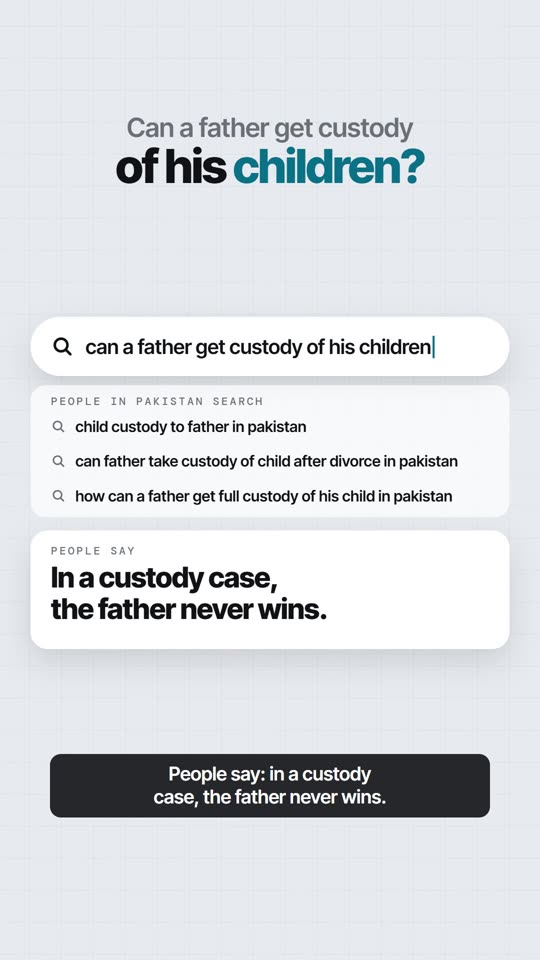
The myth: “After a divorce, if the children live with their mother, the father can't see them: forget them.”Wrong
The short answer
Dr. Muhammad Asif v. Dr. Sana Sattar and others, Supreme Court of Pakistan, PLD 2026 SC 238, C.R.P. No. 458 of 2024, decided 16 May 2025. Bench: Syed Mansoor Ali Shah and Aqeel Ahmed Abbasi, JJ. The catch: Shaista Habib v. Muhammad Arif Habib, PLD 2024 SC 629, decided 6 March 2023. The law: Family Courts Act 1964 (Punjab), Schedule, item 5; Guardians and Wards Act 1890, sections 12, 17 and 25.
Dr. Muhammad Asif v. Dr. Sana Sattar and others · Supreme Court of Pakistan · PLD 2026 SC 238 · decided 16 May 2025
By the FAI Legal editorial desk · 26 October 2026 · 8 min read

Yes. After a divorce a father keeps the right to meet his children, even when they live with their mother. The family court sets a meeting schedule, and in May 2025 the Supreme Court kept a mother's custody but told both parents to "strictly adhere to the visitation schedule" set for the father (PLD 2026 SC 238, para 14).
In plain words: losing custody is not losing your children. Ask the Guardian Court (the family court) for set meeting days, then use every one of them. The catch: a father who stays away can lose ground. In 2023 the Supreme Court took custody back from a father because his son called him a stranger and he had not made "a serious and meaningful effort to assert his visitation rights" (PLD 2024 SC 629, para 8).
Key points
- The father is the natural guardian of his children, and that does not end with a divorce; the mother usually has custody (hizanat) of a boy until 7 and a girl until puberty, but neither rule is absolute, and the child's welfare decides (PLD 2024 SC 629, para 5).
- The non-custodial parent can ask the court for a meeting schedule. In Punjab the Family Courts Act lists "Custody of children, and the visitation rights of parents to meet them" as a family court matter (Schedule, Part I, item 5), and the Guardians and Wards Act lets the court order the child to be produced "at such place and time" as it appoints (section 12(1)).
- In May 2025 the Supreme Court kept two children, aged eight and seven, with their mother and told both parents to strictly follow the father's visitation schedule. Custody stays with her unless the father applies again after a material change in circumstances (PLD 2026 SC 238, para 14).
- The same judgment says courts must hear the child in every custody and guardianship case; here the elder child told the judges he wanted to be with both parents (paras 8 and 13). It also tells family courts to try mediation first (para 12).
- The catch: a father who does not use his meeting rights can become a stranger to his child, and that counts against him. In PLD 2024 SC 629 two courts had given the father custody; the Supreme Court reversed it (paras 8 and 10). The father's duty to maintain the children continues even when the mother has custody (para 5).
Can a father meet his children after divorce? The short answer
Yes. A divorce ends the marriage, not the father's place in his children's lives. Under the law the father stays the natural guardian, and the mother usually keeps the day to day custody of young children; the Supreme Court has said that this right of custody "continues notwithstanding a divorce or separation" and so does the father's duty to maintain the children (PLD 2024 SC 629, para 5). Where the parents cannot agree, the court fixes when and where the other parent meets the children.
In Punjab the law says it in so many words: the Family Courts Act lists "Custody of children, and the visitation rights of parents to meet them" among the matters a family court decides (Schedule, Part I, item 5, as amended in 2015). Across Pakistan the Guardians and Wards Act lets the court order the person who has the child to produce the child "at such place and time and before such person as it appoints" (section 12(1)). That is how interim meeting orders are made while a case is still running.
Layyah: two children, a lost case, and the meeting days kept
Two children, aged eight and seven; the Supreme Court kept their names out of the judgment (PLD 2026 SC 238, para 1). Both parents are doctors and both had remarried. The father is a child specialist who runs a private hospital in District Layyah; the younger child has developmental delays and was in therapy in Lahore; the elder was doing well at school (paras 9 to 11).
The mother's custody application was first dismissed by the Senior Civil Judge (Family Division), Layyah, on 14 July 2023, with a visitation schedule for her. On 25 April 2024 the Additional District Judge, Layyah, gave her custody "and maintained a visitation arrangement for the petitioner (father)". The Lahore High Court, Multan, dismissed the father's petition on 24 May 2024, and the Supreme Court refused leave on 18 July 2024. The father then asked the Supreme Court to review that order (para 1).
What the Supreme Court said in May 2025
On review, the bench of Syed Mansoor Ali Shah and Aqeel Ahmed Abbasi, JJ, noticed that the children had never been heard, and spoke to them first: not from the rostrum, but "in a relaxed and informal manner". The elder child "conveyed a heartfelt desire to be with both parents"; the younger could not express his views (para 8). The court read section 17 of the Guardians and Wards Act together with the UN Convention on the Rights of the Child, so that the child's welfare now includes the child's right to be heard (paras 4 and 5). In its words, listening to a child "does not mean obeying them" but understanding them well enough to act in their best interests (para 5).
The court found both parents committed and capable, and kept custody with the mother, noting among other things that the father worked full time and in the evenings (para 11). The review was dismissed, but not the father: "The parties are directed to strictly adhere to the visitation schedule determined by the lower appellate court." Custody stays with the mother "unless and until" the father moves a fresh application on a material change in circumstances (para 14). The court also told family courts to try mediation first in children's cases (para 12) and sent the judgment to every High Court as a direction to hear the voice of the child (paras 13 and 15).
What a meeting schedule can look like
There is no single fixed schedule in the law; the court fits it to the child. One Supreme Court order shows the range. In 2018 the parents of two boys reached an agreement in court, and the Supreme Court made it the order: the boys stay with their mother; every alternate weekend with their father from Friday 8 pm to Sunday 1 pm; four weeks of the summer vacation and the first week of the winter vacation with him; Eid ul Fitr from chand raat to the second day of Eid; the father pays the school fees and other expenses and Rs 5,000 a month for each boy; and neither parent may do anything that may prejudice the boys' minds against the other (Mst. Madiha Younus v. Imran Ahmed, 2018 SCMR 1991).
Smaller schedules are common too. This month a Sindh High Court order described a family court schedule of two meetings a month for three hours at the court; the High Court widened it to a monthly overnight stay with the father, a week of the summer vacation, days at both Eids and winter days, with the handover at a police station, and told both parents not to turn the child against the other (Sindh High Court, Circuit Court Larkana, Constitutional Petition No. S-318 of 2024, order of 9 October 2026). In that case the mother's side relied on the same Supreme Court judgment as this reel, PLD 2026 SC 238, and the father's side on 2018 SCMR 1991.
The catch: a father who stays away
In PLD 2024 SC 629 a couple divorced in 2016 when their son was an infant. The father applied for custody in 2017; the Guardian Judge, Kahuta, gave him custody on 30 June 2021, the appeal court agreed, and the High Court dismissed the mother's petition (para 2). In the Supreme Court the boy, by then about ten, said his father was a stranger to him "since they had hardly met" (para 3). The record showed the father "had not made a serious and meaningful effort to enable him to spend time with the minor, either through intervention of the court or otherwise" (para 4).
On 6 March 2023 the Supreme Court reversed the two courts and kept the boy with his mother: "the respondent, despite being his father, had not made a serious and meaningful effort to assert his visitation rights" (para 8). It left the door open: if the parents could not agree on a schedule, the father was "at liberty to approach a competent court to assert his visitation rights", and any existing schedule stayed in force (para 10). In 2025 the Supreme Court refused custody to a father abroad who had never met his daughter in more than five years; it saw the custody claim as a reply to the mother's suit for her dowry articles and maintenance, yet it still allowed any later application for visitation to be heard on its merits (PLD 2025 SC 541, paras 2, 20 and 24, and the short order of 22 April 2025).
If you are a father: what to do
Ask the court for set meeting days. If a custody case is running, apply in it for interim meetings (Guardians and Wards Act, section 12); if not, you can apply to the Guardian Court (the family court) for a visitation schedule. Ask for what fits your child's age and school: weekends, school holidays, Eid, and how and where the handover happens. Mediation is worth trying first; the Supreme Court has told family courts to prioritise it (PLD 2026 SC 238, para 12).
Then use every meeting, on time, and keep a simple record of each one and of every payment. If the meetings are blocked, do not take the child yourself: go back to the court that made the order (PLD 2024 SC 629, para 10). Keep paying for your children, because the father's duty to maintain them goes on even when the mother has custody (para 5). And never speak against the other parent in front of the child; courts write that into their orders (2018 SCMR 1991). If you are the mother: the schedule is a court order and binds you too (PLD 2026 SC 238, para 14).
For law students and lawyers
PLD 2026 SC 238 is a review judgment that changes method, not the result: it reads "welfare of the minor" in section 17 of the Guardians and Wards Act with Articles 3 and 12 of the UN Convention on the Rights of the Child, under the doctrine of updating construction, so that hearing the child becomes a procedural duty in every custody and guardianship matter (paras 3 to 7 and 13). It ties this to Articles 9, 14, 25 and 34 of the Constitution (para 6), directs mediation as a first recourse (para 12), and leaves the visitation schedule of the appellate court in force with a route back on a material change of circumstances (para 14).
PLD 2024 SC 629 restates the welfare principle for both "custody and visitation rights of the parents" (para 7), treats a father's failure to use visitation as part of the welfare inquiry (paras 4 and 8), and shows the court converting a petition into an appeal where the courts below decided custody without assessing welfare (paras 8 and 10). For schedules, 2018 SCMR 1991 is the fullest Supreme Court template, though it records a compromise; for a father abroad, PLD 2025 SC 541 (2 to 1, Musarrat Hilali J dissenting) holds that conduct and genuine interest weigh heavily, while keeping visitation open. In Punjab, plead the Schedule item 5 entry for jurisdiction over visitation.
The case at a glance
- Facts
- Two children, aged eight and seven, one with developmental delays. The family court in Layyah first dismissed the mother's custody application (2023); the appeal court gave her custody and kept a visitation arrangement for the father (2024); the Lahore High Court and the Supreme Court refused to interfere (2024). The father sought review.
- The question
- Did the failure to hear the children make the earlier custody decisions flawed, and where should the children live?
- What the Court held
- Review dismissed. Custody stays with the mother; both parents must strictly adhere to the father's visitation schedule; the father may apply again on a material change in circumstances. All courts must hear the child in custody and guardianship cases.
- Why
- Section 17 of the Guardians and Wards Act is read with Articles 3 and 12 of the UN Convention on the Rights of the Child, so the child's welfare includes the child's right to be heard (paras 3 to 7). The bench heard the children itself (para 8) and weighed age, schooling, health, the special needs of the younger child and each parent's availability (paras 9 to 11).
- Limits
- It does not decide that mothers always keep custody: both parents were found capable, and custody can be revisited on a material change (paras 11 and 14). It does not fix any particular schedule; the schedule was the appellate court's. A father who does not use his meeting rights can lose ground (PLD 2024 SC 629, para 8).
In the Court’s words
“As a natural guardian it is the obligation of the father to maintain the child even if the custody is with the mother.”
PLD 2024 SC 629, para 5
The law it relies on
"Custody of children, and the visitation rights of parents to meet them." The words after "children" were added by the Punjab Family Courts (Amendment) Act 2015. Item 6 is "Guardianship".
"The Court may direct that the person, if any, having the custody of the minor shall produce him or cause him to be produced at such place and time and before such person as it appoints, and may make such order for the temporary custody and protection of the person or property of the minor as it thinks proper" (subsection (1)).
The court is guided by "what, consistently with the law to which the minor is subject, appears in the circumstances to be for the welfare of the minor" (subsection (1)), having regard to the minor's age, sex and religion and the character and capacity of the proposed guardian (subsection (2)); "If the minor is old enough to form an intelligent preference, the Court may consider that preference" (subsection (3)).
If a ward leaves or is removed from the custody of a guardian of his person, the court may order the ward's return if that is for the ward's welfare, and may enforce the order.
What this does not mean
- It does not mean the father gets custody. In both Supreme Court cases here the children stayed with their mother; what the father keeps is his time with them (PLD 2026 SC 238, para 14; PLD 2024 SC 629, para 10).
- It does not mean there is one fixed number of meetings. The schedule is set case by case for the child's welfare; 2018 SCMR 1991 records an agreement between the parents, not a rule for everyone.
- It does not mean a father can take the child himself if meetings are blocked. The route is back to the court that made the order (PLD 2024 SC 629, para 10).
- It does not mean a father can stop paying maintenance because he is not allowed to meet the children. His duty to maintain them continues while the mother has custody (PLD 2024 SC 629, para 5).
Questions people ask
Can a father meet his child after divorce in Pakistan?
Yes. The father stays the natural guardian, and the court can fix a schedule for him to meet the children even when the mother has custody. In May 2025 the Supreme Court told both parents to strictly follow such a schedule (PLD 2026 SC 238, para 14).
What are the visitation rights of a father in Pakistan?
The right to meet the children at times and places set by agreement or by the Guardian Court. In Punjab the Family Courts Act names "the visitation rights of parents to meet them" (Schedule, item 5), and the Guardians and Wards Act lets the court order the child to be produced at a set place and time (section 12).
How often can a father meet his child after divorce?
There is no fixed number in the law. Orders range from a few hours twice a month at the court to alternate weekends, school holidays and Eid; one Supreme Court order on the parents' agreement gave the father every alternate weekend and four summer weeks (2018 SCMR 1991).
What can a father do if the mother does not allow him to meet the child?
Go back to the court. The Supreme Court has said a father can approach a competent court to assert his visitation rights, and a schedule set by a court stays in force until the court changes it (PLD 2024 SC 629, para 10).
Does the child's wish matter in custody and visitation cases?
Yes. The court may consider the preference of a child old enough to form one (Guardians and Wards Act, section 17(3)), and since May 2025 the Supreme Court requires courts to hear the child in every custody and guardianship case (PLD 2026 SC 238, paras 5 and 13).
Can a father lose his rights if he does not visit his children?
He can lose ground. In PLD 2024 SC 629 the Supreme Court reversed a custody order for a father whose son called him a stranger, because he had not made a serious effort to use his visitation rights (paras 3, 4 and 8).
Check yourself
True or false? “After a divorce, if the children live with their mother, the father can't see them: forget them.”
Wrong. Dr. Muhammad Asif v. Dr. Sana Sattar and others, Supreme Court of Pakistan, PLD 2026 SC 238, C.R.P. No. 458 of 2024, decided 16 May 2025. Bench: Syed Mansoor Ali Shah and Aqeel Ahmed Abbasi, JJ. The catch: Shaista Habib v. Muhammad Arif Habib, PLD 2024 SC 629, decided 6 March 2023. The law: Family Courts Act 1964 (Punjab), Schedule, item 5; Guardians and Wards Act 1890, sections 12, 17 and 25.
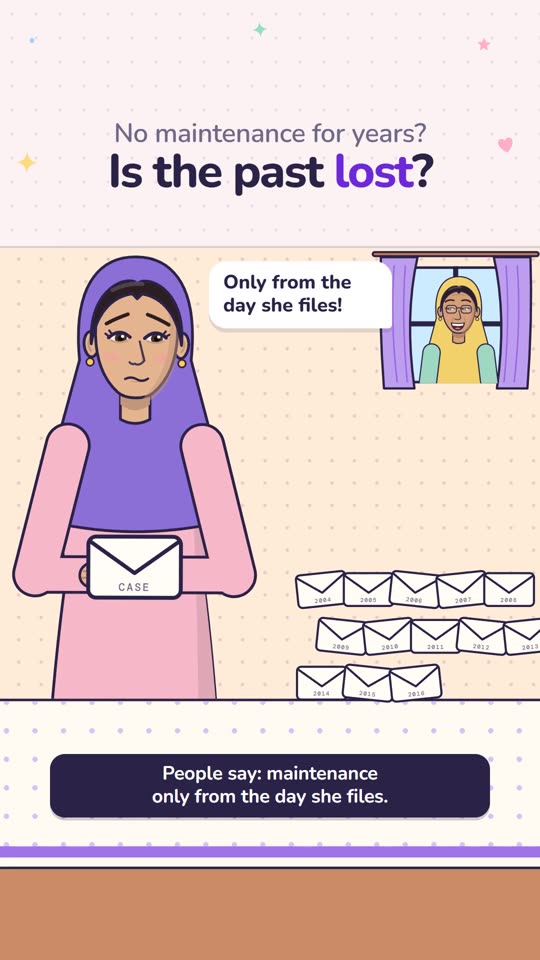
Next one: true or false? “A wife only gets maintenance from the day she files; the years before are lost.”
Sources
- Dr. Muhammad Asif v. Dr. Sana Sattar and others, PLD 2026 SC 238 (Supreme Court of Pakistan, 16 May 2025), paras 1, 2, 4, 5, 8-15
Children must be heard in custody cases; custody kept with the mother, both parents directed to strictly adhere to the father's visitation schedule; a fresh custody application is open on a material change. verified against full text - Shaista Habib v. Muhammad Arif Habib and others, PLD 2024 SC 629 (Supreme Court of Pakistan, 6 March 2023), paras 2-5, 7, 8, 10
Custody given to a father by two courts reversed: the boy called him a stranger and he had not made a serious and meaningful effort to assert his visitation rights; he may approach a court for a schedule. verified against full text Supreme Court of Pakistan (judgment PDF) - Mst. Madiha Younus v. Imran Ahmed, 2018 SCMR 1991 (Supreme Court of Pakistan, 3 September 2018), paras 2, 3
A full custody, visitation and maintenance plan, agreed by the parents and made an order of the court. verified against full text - Asjad Ullah v. Mst. Asia Bano and others, PLD 2025 SC 541 (Supreme Court of Pakistan, 22 April 2025), paras 2, 16, 20, 23, 24
Custody refused to a father abroad who had never met his daughter; any visitation application to be decided on its merits. verified against full text - Order in Constitutional Petition No. S-318 of 2024, C.P. No. S-318 of 2024 (Sindh High Court, Circuit Court Larkana, 9 October 2026), paras 1, 6, 11, 12
A father's visitation widened from two court meetings a month to a monthly overnight stay, holidays and Eid; PLD 2026 SC 238 and 2018 SCMR 1991 argued. read on the Sindh High Court's case law site, caselaw.shc.gov.pk (last checked 26 October 2026); not in the FAI archive - Family Courts Act, 1964 (as it applies in Punjab), Schedule, Part I, item 5 (as amended in 2015) text checked in FAI Statute Search, 26 October 2026
- Guardians and Wards Act, 1890, Sections 12, 17, 19 and 25 text checked in FAI Statute Search, 26 October 2026 Pakistan Code
Every quote and section above is traced to the full judgment or statute text by an automatic check that runs on every update.
What the reel says
Read the words of the reel
After a divorce, can a father still meet his children? Yes.
Talaq ke baad baap bachon se mil sakta hai?
People say: the kids are with their mother now, so forget them. Wrong.
A case from Layyah: the mother got custody, but the court kept the father's meeting days. In May 2025 the Supreme Court first talked to the children themselves. The elder one said he wants to be with both parents. Then it ordered both parents to "strictly adhere to the visitation schedule" (PLD 2026 SC 238).
If you are a father:
1. Ask the family court to set your meeting days.
2. Go to every meeting, on time.
3. If you are blocked, don't take the child yourself. Go back to the court.
4. Keep paying for your children.
One catch: in 2023 the Supreme Court took custody back from a father whose son called him a stranger. He had not made a serious effort to use his right to meet (PLD 2024 SC 629).
Educational legal information, not legal advice. Every case turns on its own facts. Speak to a qualified lawyer about your own matter. Reading this page does not create a lawyer-client relationship. Review status: Pending advocate review. How we check.