Family · Supreme Court of Pakistan
Nikah without rukhsati: is the wife owed maintenance?
The myth: “No rukhsati, no maintenance: until the bride moves in, the husband owes her nothing.”Wrong
The short answer
Ambreen Akram v. Asad Ullah Khan, Supreme Court of Pakistan, 2026 SCMR 1, Civil Petition No. 1107-L of 2015, decided 11 September 2025. Bench: Syed Mansoor Ali Shah and Aqeel Ahmed Abbasi, JJ.
Ambreen Akram v. Asad Ullah Khan · Supreme Court of Pakistan · 2026 SCMR 1 · decided 11 September 2025
By the FAI Legal editorial desk · 22 October 2026 · 5 min read
Yes. A wife's maintenance (nan nafqa) starts on the day of a valid nikah, not on rukhsati or consummation. The husband is excused only if he proves she left the marriage without good reason (Ambreen Akram v. Asad Ullah Khan, 2026 SCMR 1, Supreme Court).
In that case the rukhsati was set for February 2013 and the husband kept putting it off for more than a year. The Lahore High Court refused her maintenance because the marriage was never consummated. On 11 September 2025 the Supreme Court set that aside and restored Rs 5,000 a month from the date of the nikah until her iddat ended.
Key points
- A valid nikah is enough. The wife's right to maintenance begins on the day of the nikah, whether or not the rukhsati has happened and whether or not the marriage has been consummated (2026 SCMR 1, paras 15 and 19).
- Rukhsati is a custom. It has no legal status of its own in Islamic or statutory law (para 14).
- Delaying the rukhsati, giving her no home, holding back the agreed dower or not arranging her visa does not excuse the husband. In those cases her living apart is not her choice (para 16).
- The one exception: the husband proves, with clear and convincing evidence, that the wife herself withdrew from the marriage without justification. The burden is on him (para 18).
- Maintenance runs from the date of the nikah. If he divorces her, it runs to the end of her iddat (paras 20 and 21).
Is a nikah valid without rukhsati?
Yes. The nikah is the marriage. Under the Muslim Family Laws Ordinance 1961 every marriage must be registered, and the nikahnama is its main proof (2026 SCMR 1, para 8). The Supreme Court described a valid marriage as the point from which husband and wife take on their legal status, rights and duties (para 14).
Rukhsati is the custom of the bride leaving her parents' home to join her husband. The Court said that, however important it is socially, it "holds no independent legal status under Islamic or statutory law" (para 14). Making maintenance wait for rukhsati, it added, lets a husband avoid paying by leaning on a custom or simply delaying it (para 14).
What the law says about a wife's maintenance
Section 9 of the Muslim Family Laws Ordinance 1961: if a husband fails to maintain his wife adequately, she may, in addition to any other legal remedy, apply to the Chairman of the Union Council. The Chairman forms an Arbitration Council, which can certify the amount the husband must pay. Unpaid amounts are recoverable as arrears of land revenue.
She can also sue in the Family Court, which hears maintenance claims under the Family Courts Act 1964. In Punjab, section 17-A makes the court fix interim maintenance at the husband's first appearance. If he does not pay by the 14th of each month, his defence is struck off and the suit is decreed.
The Supreme Court noted that section 9 asks for no proof of consummation, of living together or of obedience (para 13).
November 2012: a nikah, and a rukhsati that never came
The nikahnama is dated 2 November 2012. Both sides agreed on a rukhsati in February 2013, but the husband put it off for more than a year (para 2).
In October 2013 the wife went to the Family Court in Faisalabad and claimed maintenance from the date of the marriage: Rs 25,000 a month, with arrears from November 2012 (para 2 and footnote 3). The husband filed a written statement but stayed away from the reconciliation proceedings. On 12 March 2014 the Family Court decreed Rs 3,000 a month from the date of the marriage (para 2).
Both sides appealed. On 2 May 2014, while the appeals were pending, he divorced her. On 27 October 2014 the District Court raised the amount to Rs 5,000 a month (para 2).
Why the Lahore High Court said no
On 28 April 2015 the Lahore High Court set aside both decrees. Its reason: the marriage had never been consummated, so she was not entitled to maintenance (para 2). Its judgment described maintenance as the wife's right only after consummation (quoted in para 25).
Before the Supreme Court, the husband's counsel relied on The Hidayah: a wife is entitled to maintenance only once she moves to her husband's home (para 3).
What the Supreme Court decided
A bench of Syed Mansoor Ali Shah and Aqeel Ahmed Abbasi, JJ heard the case on 8 July 2025 with three amici curiae and decided it on 11 September 2025. Justice Mansoor Ali Shah wrote the judgment.
The Court held that a wife's right to maintenance begins with the nikah itself and is a binding legal duty (para 15). It does not wait for rukhsati and does not depend on consummation (para 19). Asking a wife to prove consummation, the Court said, forces her to disclose the most private parts of her married life, against her right to dignity and privacy under Article 14 of the Constitution (para 17).
On the facts, the husband had given her no marital home and made no arrangements for the rukhsati, and there was no evidence that she refused to live with him (para 20). The High Court's judgment was set aside. Her maintenance was restored at Rs 5,000 a month from the date of the nikah, including the iddat period after the divorce (para 21). The Court called the High Court's wording about consummation "deeply patriarchal" (para 25).
When can a husband refuse maintenance?
Only in a narrow case: when he proves, through clear and convincing evidence, that she wholly and without justification withdrew from the marriage, emotionally, residentially and in the relationship itself (paras 16 and 18).
Her living apart does not count against her if he failed to arrange the rukhsati, did not provide a home, withheld the agreed dower or did not arrange her travel documents, such as a visa. A refusal to live with him because of abuse, neglect or coercive control is not disobedience either (para 16).
The case at a glance
- Facts
- Nikah on 2 November 2012; the rukhsati set for February 2013 was delayed by the husband for more than a year. The Family Court in Faisalabad awarded the wife Rs 3,000 a month from the date of the marriage, and the District Court raised it to Rs 5,000. The husband divorced her on 2 May 2014. The Lahore High Court set both decrees aside because the marriage was not consummated.
- The question
- When does a Muslim wife become entitled to maintenance, and when, if ever, can a husband be excused from paying it?
- What the Court held
- The right arises on a valid nikah and does not depend on rukhsati or consummation. A husband is excused only if he proves, by clear, cogent and compelling evidence, that the wife wholly and unjustifiably withdrew from the marriage. Maintenance restored at Rs 5,000 a month from the nikah, including iddat.
- Why
- Section 9 of the MFLO and section 17-A of the Family Courts Act treat maintenance as an enforceable right with no condition of consummation or living together. Rukhsati is a custom with no independent legal status. Tying maintenance to consummation would force wives to disclose intimate facts, against Article 14, and would let husbands escape by their own delay.
- Limits
- The exception remains: a wife who wholly and unjustifiably withdraws from the marriage can lose maintenance, but the husband must prove it. Rs 5,000 a month was the District Court's amount for this case. Dower was not in issue.
In the Court’s words
“the right to maintenance flows unconditionally from the solemnization of a valid marriage and constitutes a binding legal duty”
2026 SCMR 1, para 15
“a wife's right to maintenance is neither contingent upon consummation or rukhsati, nor subject to the discretion of the husband”
2026 SCMR 1, para 19
“The burden of proof lies squarely on the husband.”
2026 SCMR 1, para 16
The law it relies on
If any husband "fails to maintain his wife adequately", the wife may, in addition to any other legal remedy, apply to the Chairman, who constitutes an Arbitration Council; it may certify the amount payable, recoverable as arrears of land revenue.
In a suit for maintenance the Family Court fixes interim monthly maintenance at the defendant's first appearance; if he fails to pay by the 14th of each month, his defence is struck off and the suit is decreed. Unless the court sets another rate, maintenance rises by ten percent a year.
What this does not mean
- It does not mean a wife can never lose maintenance. If the husband proves, with clear evidence, that she herself walked away from the marriage without justification, he can be excused (para 18).
- It does not set a standard amount. Rs 5,000 a month was what the District Court fixed in this case.
- It does not decide dower (haq mehr) or any other claim between the couple. The case was about maintenance only.
Questions people ask
Is nikah valid without rukhsati?
Yes. A valid nikah is a complete marriage in law: it is the point from which husband and wife take on their rights and duties. Rukhsati is a custom with no legal status of its own (2026 SCMR 1, para 14).
Does a husband have to pay maintenance before rukhsati?
Yes. The Supreme Court held that a wife's right to maintenance starts with the nikah and does not depend on rukhsati or consummation (2026 SCMR 1, paras 15 and 19).
When can a wife not claim maintenance?
When the husband proves, with clear and convincing evidence, that she wholly and unjustifiably withdrew from the marriage. Refusing to live with him because of abuse, neglect or the lack of a proper home does not count (paras 16 and 18).
Nikah without rukhsati and divorce: what happens to maintenance?
In this case the husband divorced her while the case was going on, and the Supreme Court allowed maintenance from the nikah up to the end of her iddat (paras 20 and 21). Dower (haq mehr) is a separate claim and was not decided here.
What is nan nafqa?
Nan nafqa (nafaqa) is maintenance: what a husband must provide for his wife, such as food, clothing and a home. Under section 9 of the Muslim Family Laws Ordinance 1961 she can claim it through the Union Council, and she can also sue in the Family Court.
Where does a wife claim maintenance?
In the Family Court, by a suit for maintenance (in Punjab the court must fix interim maintenance at the husband's first appearance, s.17-A), or through the Union Council's Arbitration Council under section 9 of the Muslim Family Laws Ordinance.
Check yourself
True or false? “No rukhsati, no maintenance: until the bride moves in, the husband owes her nothing.”
Wrong. Ambreen Akram v. Asad Ullah Khan, Supreme Court of Pakistan, 2026 SCMR 1, Civil Petition No. 1107-L of 2015, decided 11 September 2025. Bench: Syed Mansoor Ali Shah and Aqeel Ahmed Abbasi, JJ.
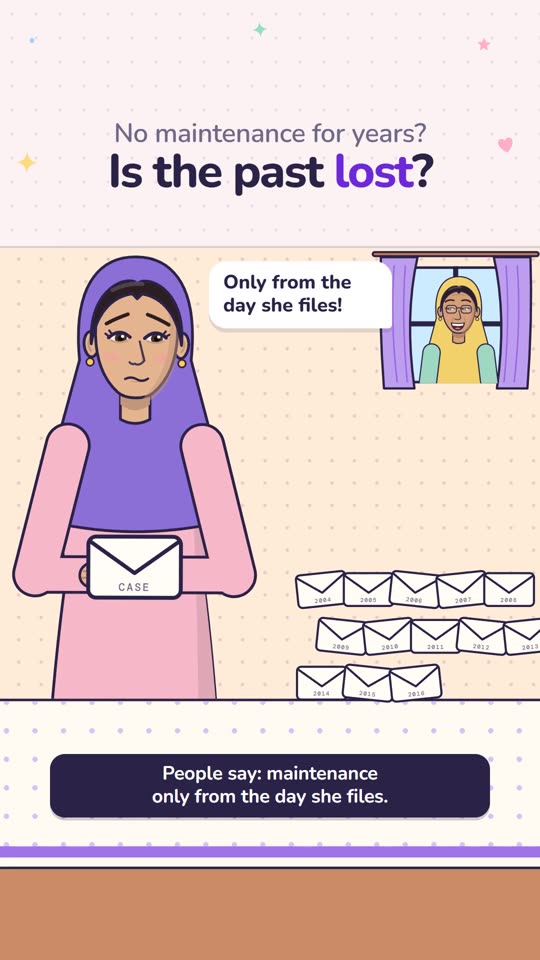
Next one: true or false? “A wife only gets maintenance from the day she files; the years before are lost.”
Sources
- Ambreen Akram v. Asad Ullah Khan, 2026 SCMR 1 (Supreme Court of Pakistan, 11 September 2025), paras 2, 3, 8, 13, 14, 15, 16, 17, 18, 19, 20, 21, 25
A wife's right to maintenance arises on a valid nikah, regardless of rukhsati or consummation; the husband is excused only if he proves she wholly and unjustifiably withdrew from the marriage. Rs 5,000 a month restored from the nikah, including iddat. verified against full text - Haseen Ullah v. Mst. Naheed Begum, PLD 2022 SC 686 (Supreme Court of Pakistan)
A husband must maintain his wife even if she can maintain herself; a wife prevented by her husband from performing her marital obligations keeps her right to maintenance. reported headnote checked; relied on in 2026 SCMR 1 - Muslim Family Laws Ordinance, 1961, s.9 text checked in FAI Statute Search, 22 October 2026 Pakistan Code
- Family Courts Act, 1964 (Punjab), s.17-A text checked in FAI Statute Search (Punjab Code text), 22 October 2026 Punjab Code
Every quote and section above is traced to the full judgment or statute text by an automatic check that runs on every update.
What the reel says
Read the words of the reel
Nikah without rukhsati: is the wife owed maintenance?
Yes. A wife's maintenance starts on the day of the nikah, not on rukhsati (Ambreen Akram v. Asad Ullah Khan, 2026 SCMR 1).
The case: a nikah in November 2012, rukhsati set for February 2013. The husband kept putting it off for over a year.
The Family Court and the District Court: pay her from the day of the nikah. The Lahore High Court: the marriage was never consummated, so nothing.
Supreme Court (September 2025): rukhsati is a custom with no legal status of its own. Rs 5,000 a month restored, from the nikah to the end of her iddat.
Not an excuse: a delayed rukhsati, no home for her, dower held back, no visa sent.
The one exception: she left the marriage without good reason, and he has to prove it.
Send this to whoever sent you the voice note.
Educational legal information, not legal advice. Every case turns on its own facts. Speak to a qualified lawyer about your own matter. Reading this page does not create a lawyer-client relationship. Review status: Pending advocate review. How we check.