Law study · For law students
Writ petitions in 9 flashcards.
In short
Mandamus, prohibition, certiorari, habeas corpus and quo warranto, plus orders to enforce Fundamental Rights, all from the text of Article 199 as amended.
By the FAI Legal editorial desk · 10 October 2026 · 11 slides · 2 min read
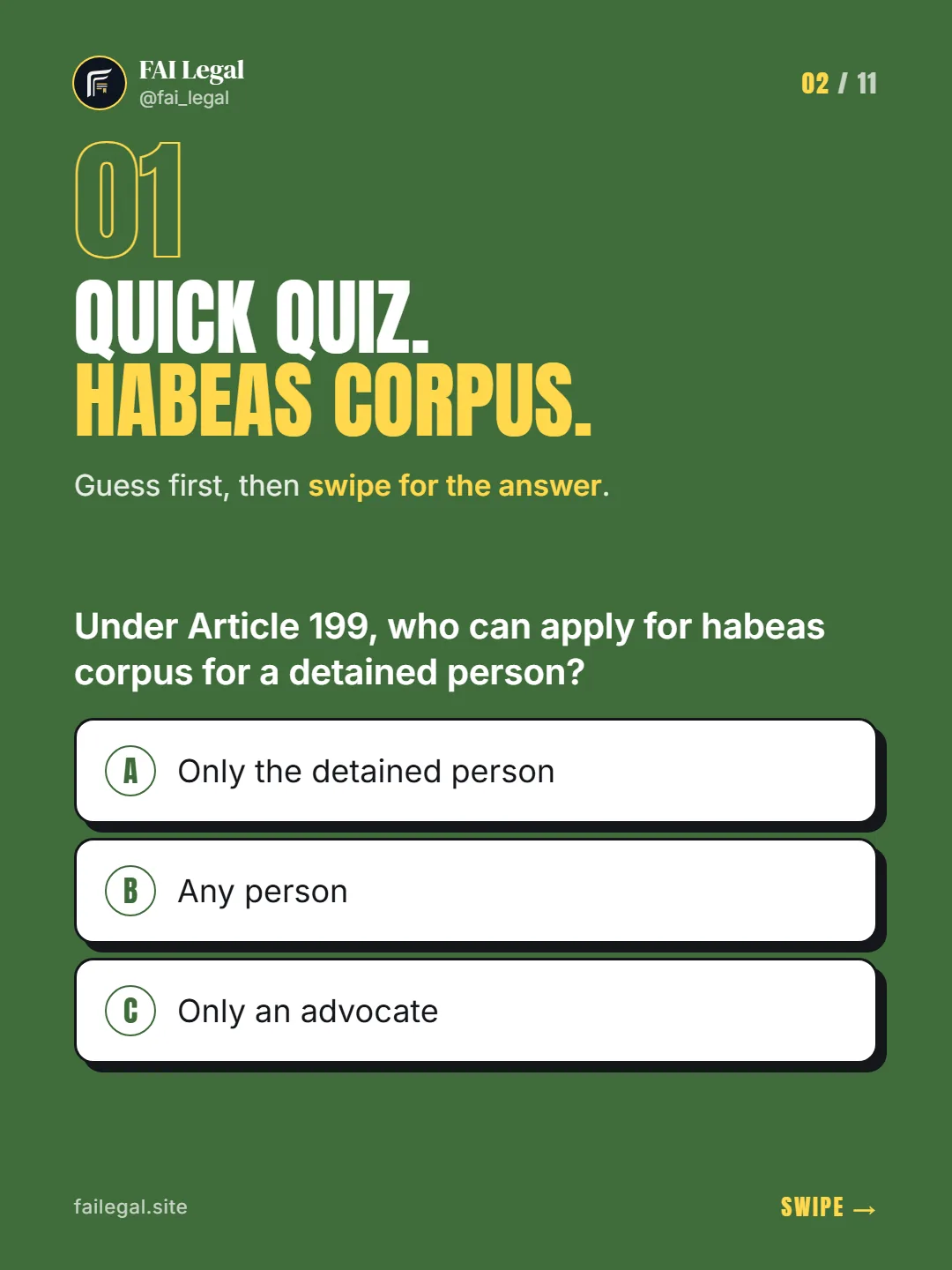

Quick quiz. Habeas corpus.
Guess first, then swipe for the answer.
- A. Only the detained person
- B. Any person
- C. Only an advocate
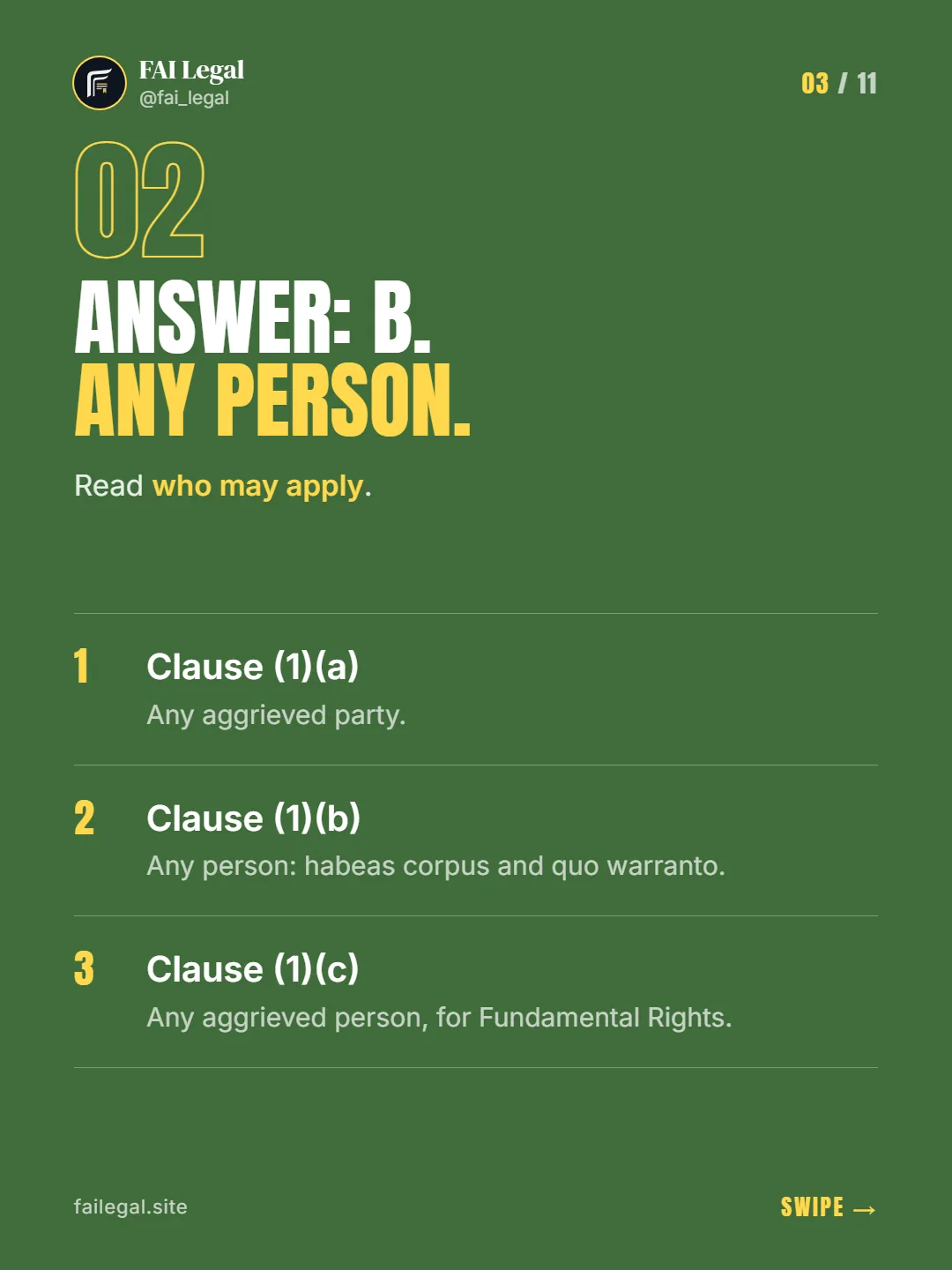
Answer: B. Any person.
Read who may apply.
- Clause (1)(a)Any aggrieved party.
- Clause (1)(b)Any person: habeas corpus and quo warranto.
- Clause (1)(c)Any aggrieved person, for Fundamental Rights.
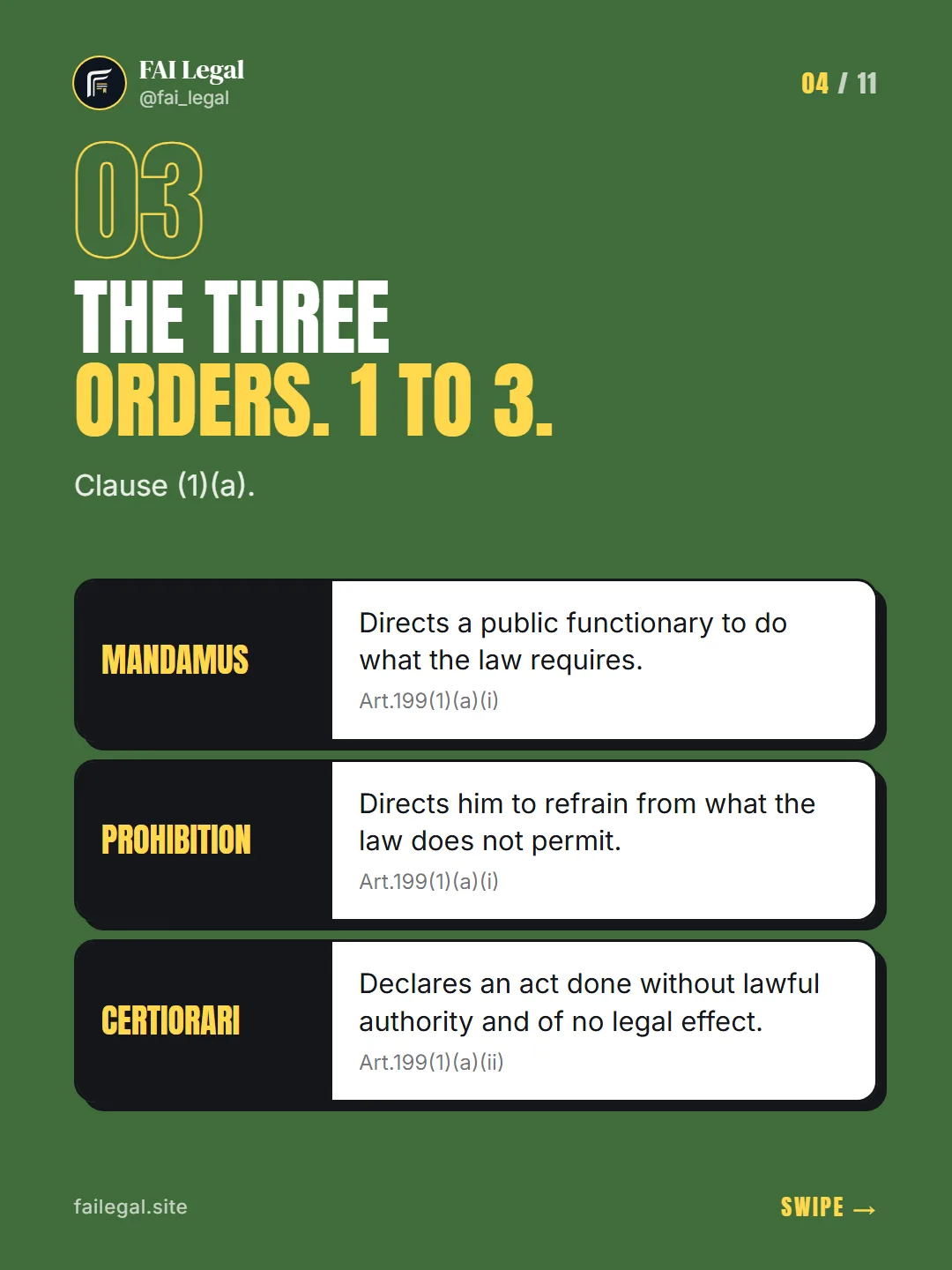
The three orders. 1 to 3.
Clause (1)(a).
- MandamusDirects a public functionary to do what the law requires. (Art.199(1)(a)(i))
- ProhibitionDirects him to refrain from what the law does not permit. (Art.199(1)(a)(i))
- CertiorariDeclares an act done without lawful authority and of no legal effect. (Art.199(1)(a)(ii))
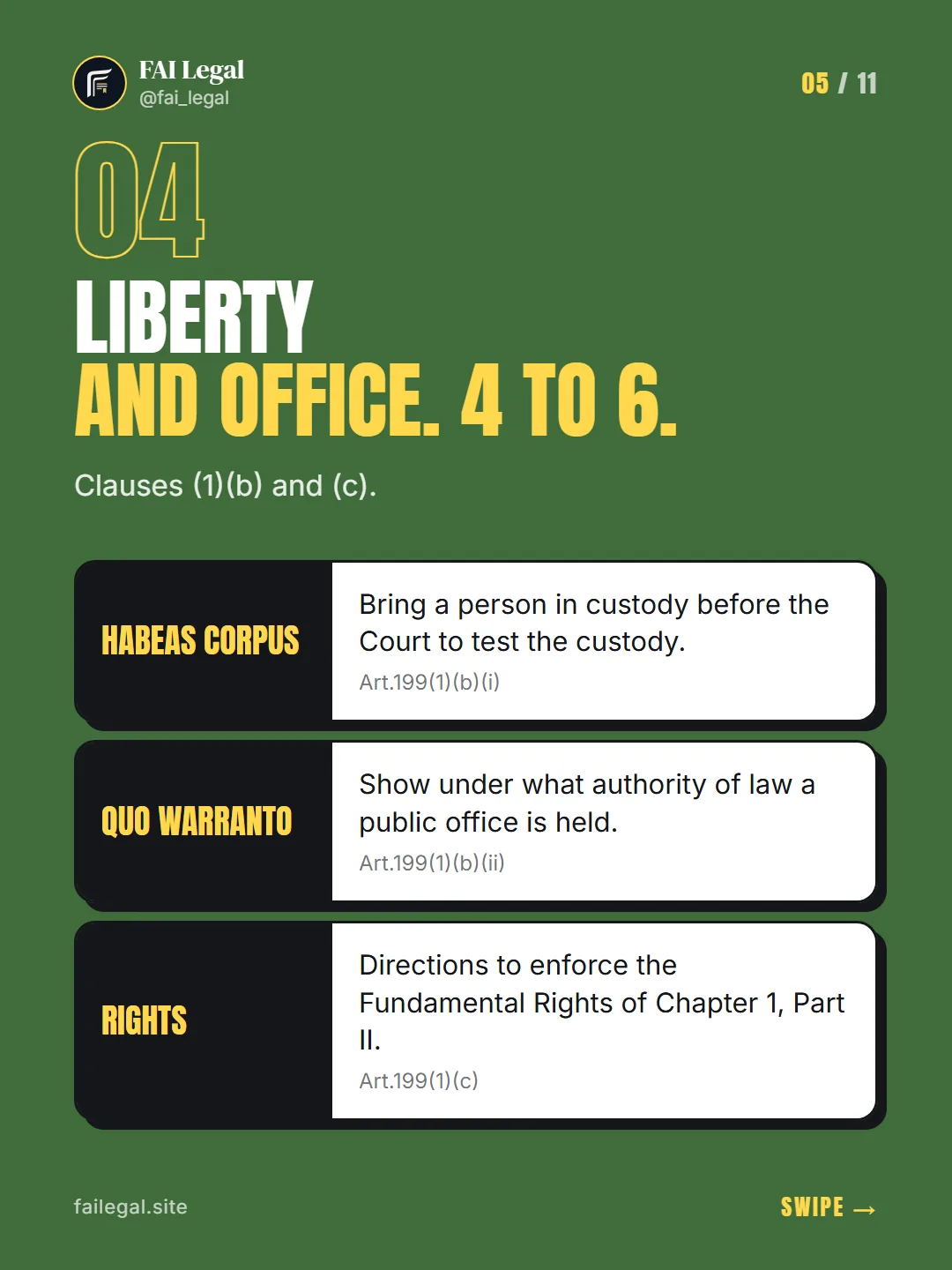
Liberty and office. 4 to 6.
Clauses (1)(b) and (c).
- Habeas corpusBring a person in custody before the Court to test the custody. (Art.199(1)(b)(i))
- Quo warrantoShow under what authority of law a public office is held. (Art.199(1)(b)(ii))
- RightsDirections to enforce the Fundamental Rights of Chapter 1, Part II. (Art.199(1)(c))
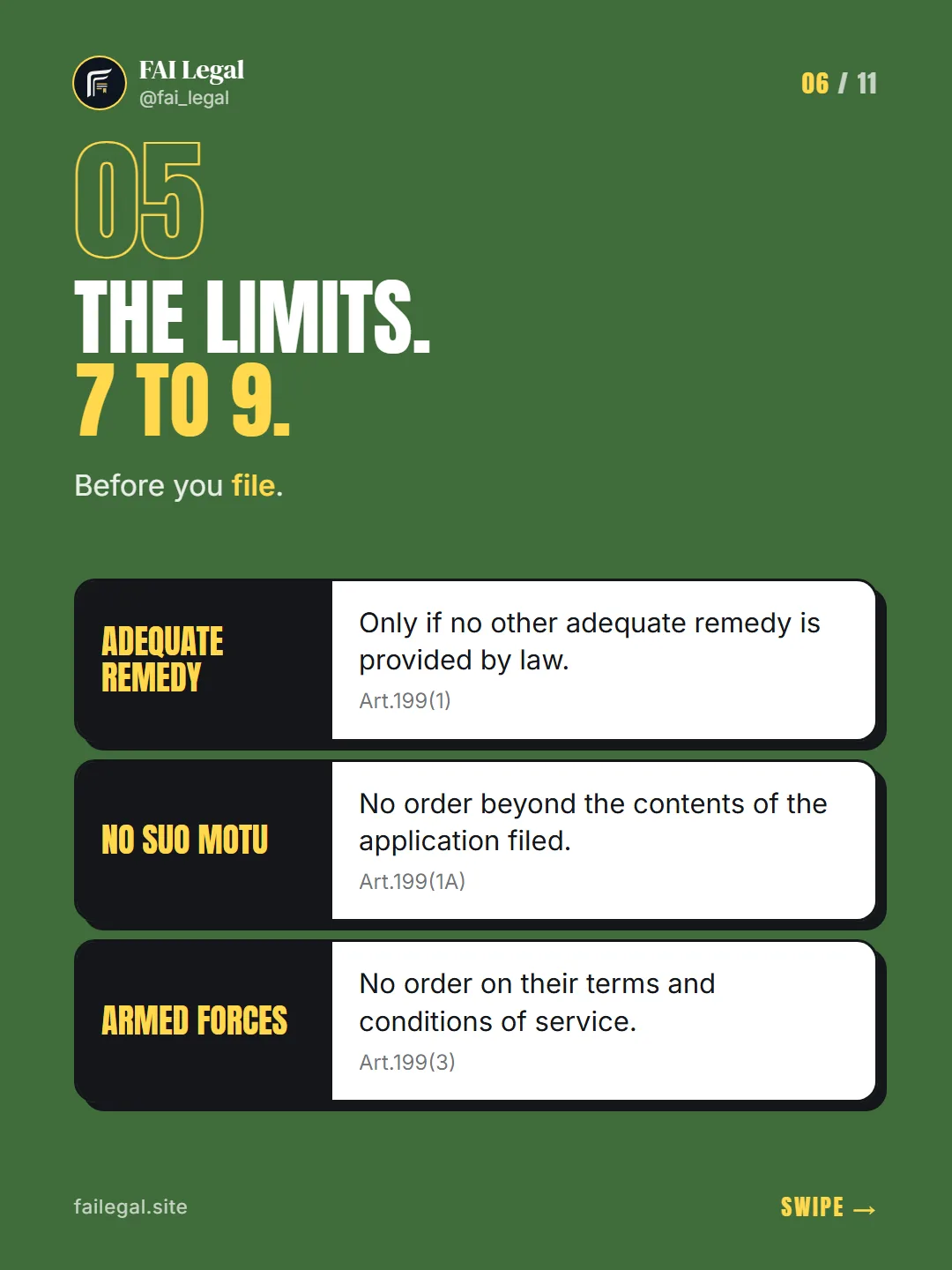
The limits. 7 to 9.
Before you file.
- Adequate remedyOnly if no other adequate remedy is provided by law. (Art.199(1))
- No suo motuNo order beyond the contents of the application filed. (Art.199(1A))
- Armed ForcesNo order on their terms and conditions of service. (Art.199(3))
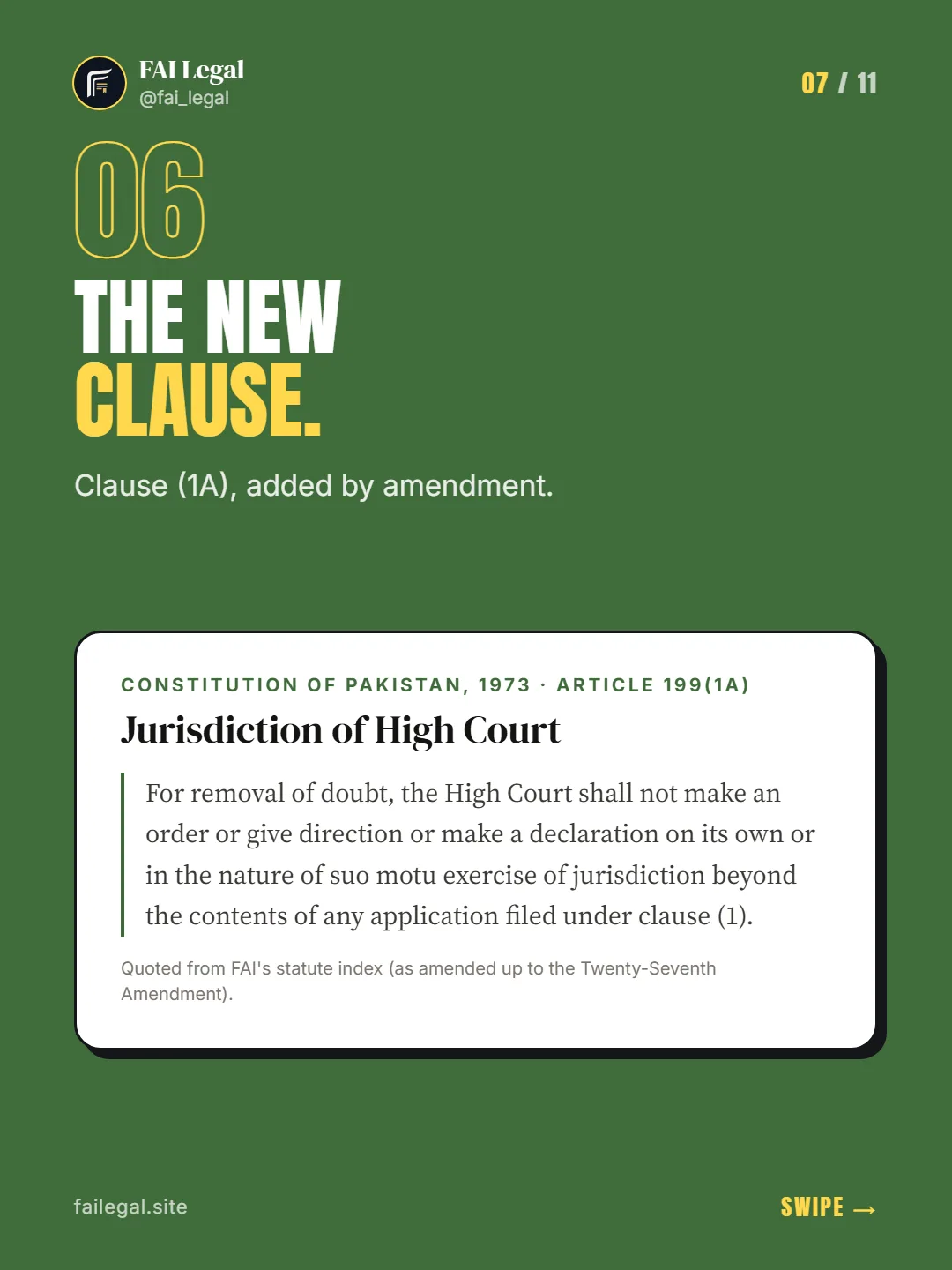
The new clause.
Clause (1A), added by amendment.
“For removal of doubt, the High Court shall not make an order or give direction or make a declaration on its own or in the nature of suo motu exercise of jurisdiction beyond the contents of any application filed under clause (1).”
Constitution of Pakistan, 1973 · Article 199(1A), Jurisdiction of High Court
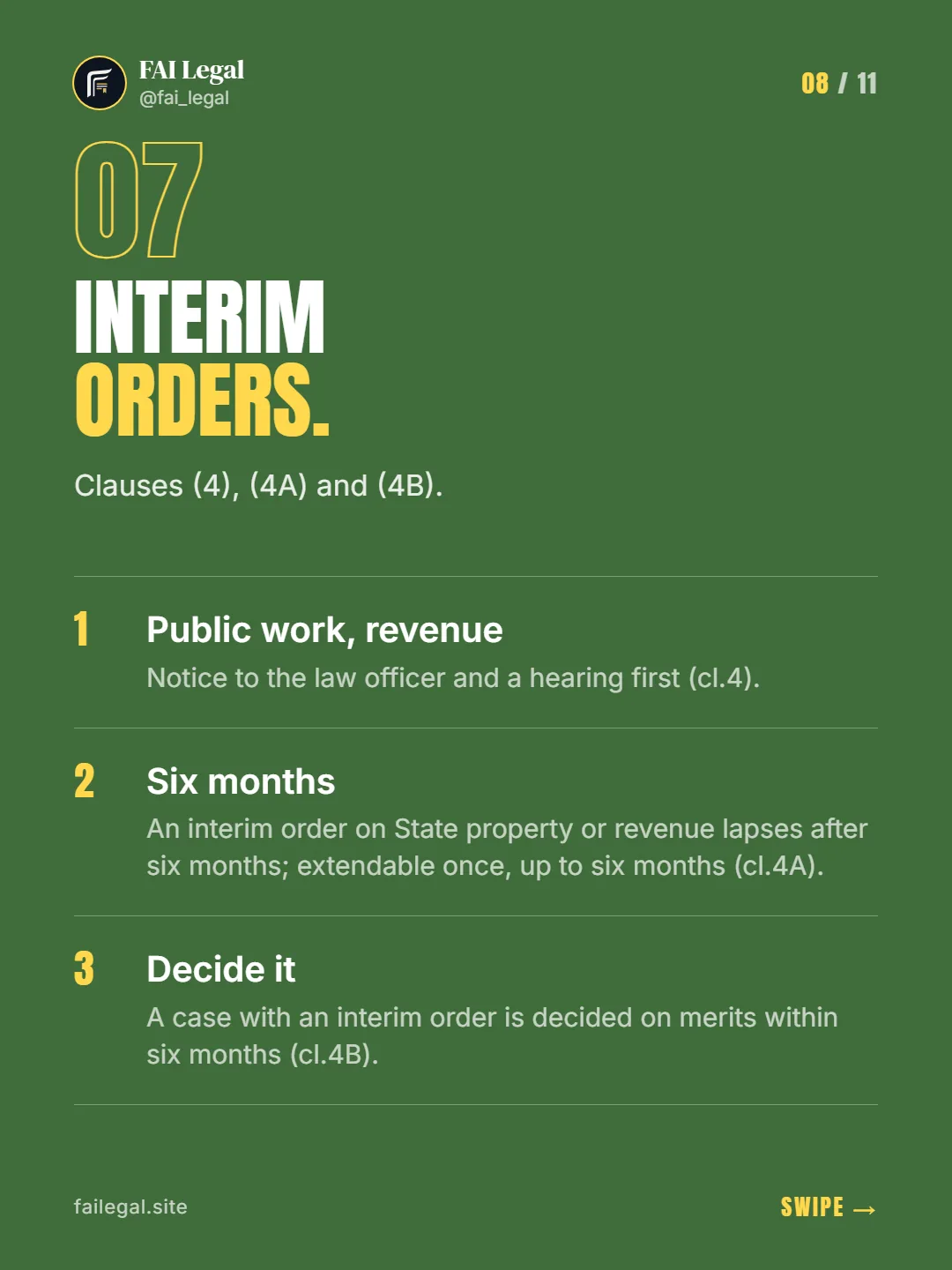
Interim orders.
Clauses (4), (4A) and (4B).
- Public work, revenueNotice to the law officer and a hearing first (cl.4).
- Six monthsAn interim order on State property or revenue lapses after six months; extendable once, up to six months (cl.4A).
- Decide itA case with an interim order is decided on merits within six months (cl.4B).
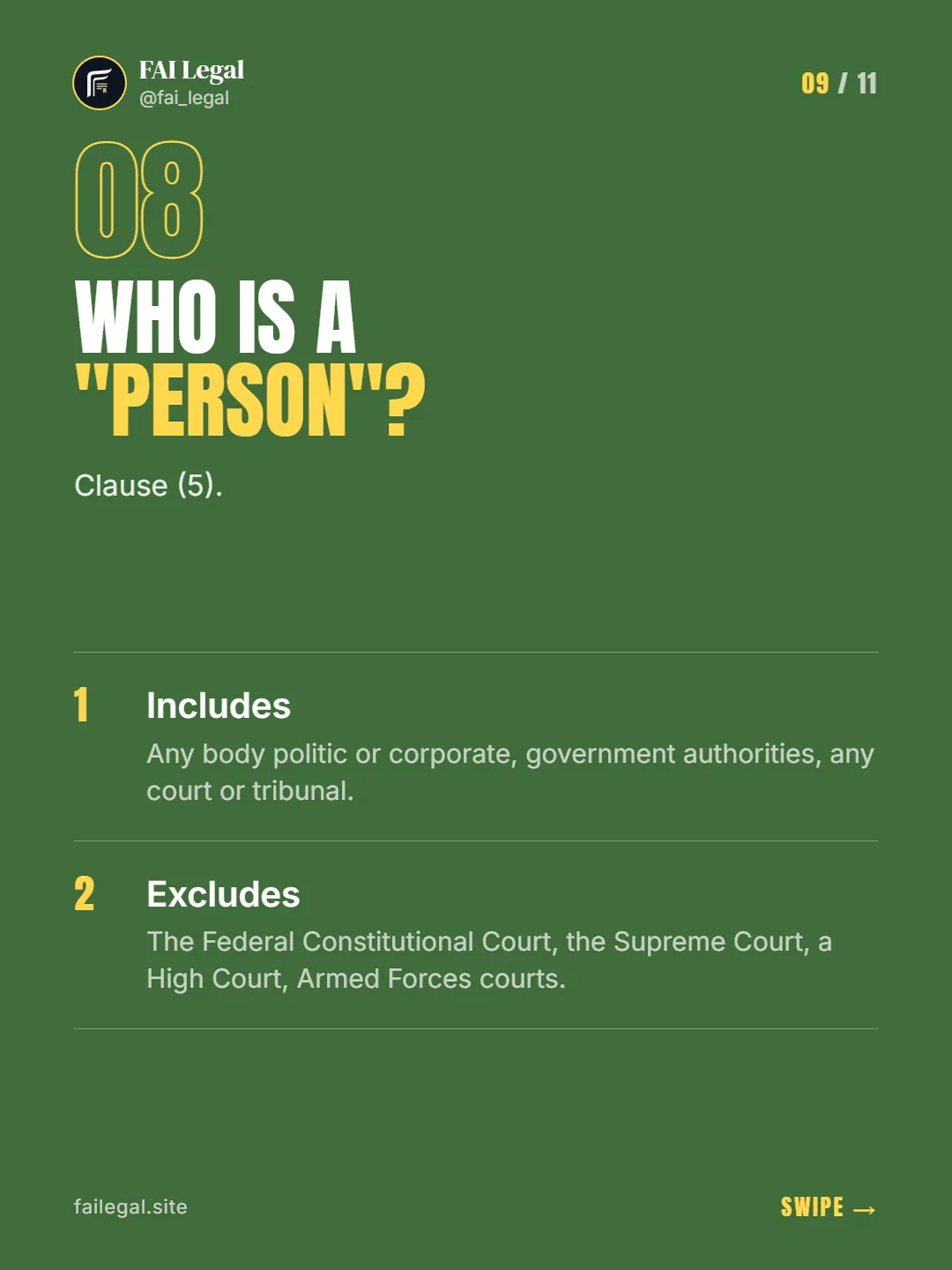
Who is a "person"?
Clause (5).
- IncludesAny body politic or corporate, government authorities, any court or tribunal.
- ExcludesThe Federal Constitutional Court, the Supreme Court, a High Court, Armed Forces courts.
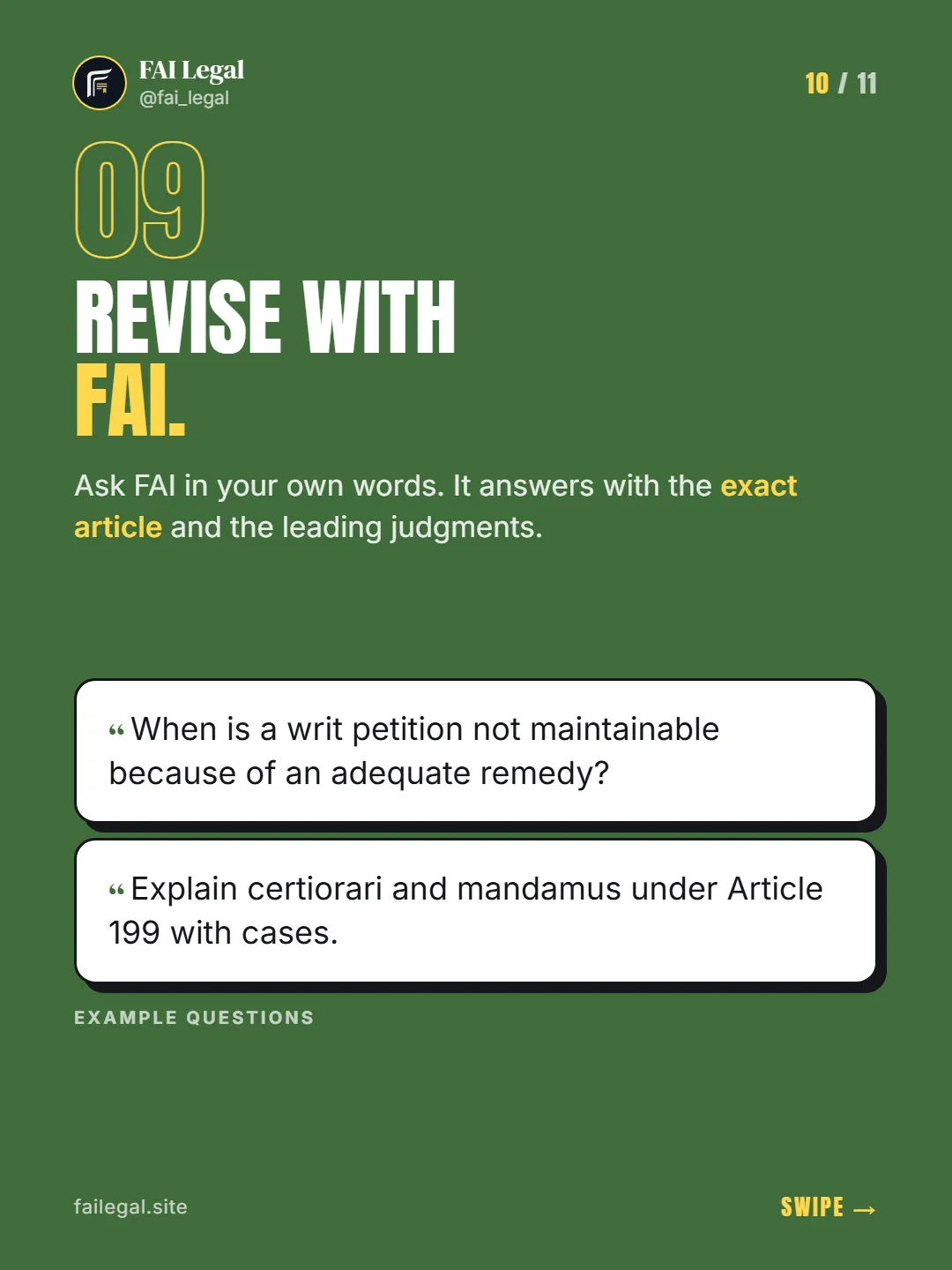
Revise with FAI.
Ask FAI in your own words. It answers with the exact article and the leading judgments.
- When is a writ petition not maintainable because of an adequate remedy?
- Explain certiorari and mandamus under Article 199 with cases.
Example questions
What this does not mean
- A writ lies only if no other adequate remedy is provided by law (Art. 199(1)).
- The High Court cannot act on its own or go beyond the contents of the application filed (Art. 199(1A)).
- No order can be made on the terms and conditions of service of the Armed Forces (Art. 199(3)), and the Federal Constitutional Court, the Supreme Court and a High Court are not a person for writ purposes (cl.5).
Questions people ask
What is a writ petition in Pakistan?
It is an application to the High Court under Article 199 of the Constitution for orders against public functionaries, for custody to be tested, for a public office holder to show his authority, or for Fundamental Rights to be enforced.
How many types of writ petition are there in Pakistan?
Article 199 gives five: mandamus, prohibition, certiorari, habeas corpus and quo warranto. It also allows directions to enforce the Fundamental Rights in Chapter 1, Part II (Art. 199(1)(c)).
Who can file a writ of habeas corpus?
Any person can apply for habeas corpus and quo warranto (Art. 199(1)(b)). Mandamus, prohibition and certiorari need an aggrieved party, and rights enforcement needs an aggrieved person.
Can a writ petition be filed if another remedy is available?
Only if no other adequate remedy is provided by law (Art. 199(1)).
How long does an interim order in a writ petition last?
An interim order on State property or revenue lapses after six months, extendable once up to six months (cl.4A). A case with an interim order is to be decided on merits within six months (cl.4B).
Sources
- Constitution of Pakistan, 1973 · Article 199(1A)
Jurisdiction of High Court Pakistan Code
Educational legal information, not legal advice. Every case turns on its own facts. Speak to a qualified lawyer about your situation. Review status: Pending advocate review. How we check.