Family · Supreme Court of Pakistan
Your uncle says you were adopted. Can he take your father's house?
The myth: “If your uncle says you were adopted, a DNA test follows and your father's house is gone.”Wrong
The short answer
Usually not. In September 2024 the Supreme Court refused an uncle's attempt to stop his late brother's son and daughter from inheriting by calling them adopted. He had no adoption deed and no court order, and the Court said the heirs had been kept out "on above false and frivolous grounds" (PLD 2024 SC 1223, para 6).
Moulvi Abdul Fateh v. Yar Muhammad and others · Supreme Court of Pakistan · PLD 2024 SC 1223 · decided 9 September 2024
By the FAI Legal editorial desk · 30 October 2026 · 6 min read
The Court also restated the rule that settles most of these fights: "only a putative father, within the time prescribed in Article 128 of Qanun-e-Shahadat Order, 1984 can challenge the paternity of child" (para 7). An uncle cannot do it for him. And a DNA test cannot be forced on you in a civil case unless a law allows it (PLD 2023 SC 461, para 11).
Key points
- A relative's word that the children were adopted is not proof; he must bring evidence such as an adoption deed or a court order (para 5).
- Official records count: NADRA, school, bank and GP Fund papers carry a presumption of correctness (paras 5 and 6; Qanun-e-Shahadat Arts. 49 and 91).
- Only the father himself, within the time in Article 128, can deny a child is his; an uncle has no standing to do it in succession proceedings (para 7).
- A civil court cannot order a DNA test without consent unless a law allows it; if the burden is on you and you refuse, the court may presume against you (PLD 2023 SC 461, paras 11 and 12).
- A succession certificate is a quick, summary step: a real dispute over the property or parentage can still be taken to a civil court with evidence (para 6).
Can your uncle take your father's house by saying you were adopted? The short answer
No, not on his word alone. In Moulvi Abdul Fateh v. Yar Muhammad (PLD 2024 SC 1223), decided on 9 September 2024, a man's brother said his son and daughter were adopted, to block their succession certificate. The Supreme Court refused to hear his petition: he produced nothing, and the children had fourteen witnesses and official records (paras 5 and 6).
The Court also restated who may question a child's parentage at all: "only a putative father, within the time prescribed in Article 128 of Qanun-e-Shahadat Order, 1984 can challenge the paternity of child" (para 7). Under Article 128, a child born during a valid marriage is conclusively the husband's child unless the husband refused, or refuses, to own the child.
Balochistan, 2009 to 2020: what happened
A teacher in the Education Department in Usta Muhammad died, leaving a house. His son and daughter applied to the District Judge for a succession certificate and a letter of administration under sections 372 and 278 of the Succession Act 1925. Their uncle opposed them, saying they were adopted (paras 2 and 4).
The District Judge dismissed the applications in 2009; the High Court sent the case back; it was dismissed again in 2015, sent back again, and dismissed a third time in 2016. On 5 October 2020 the Balochistan High Court allowed the children's appeal on fourteen witnesses and documents including NADRA records, school certificates, the father's bank account papers and his GP Fund nomination (paras 4 and 5).
What the Supreme Court decided in September 2024
A bench of Yahya Afridi, Shahid Waheed and Aqeel Ahmed Abbasi, JJ dismissed the uncle's petition; the reasons are by Aqeel Ahmed Abbasi, J. "Neither any adoption deed nor any order or proceedings from the competent court of jurisdiction to this effect were produced or referred by the petitioner before the Courts below" (para 5). The public documents were admitted without objection, so the presumption of correctness of official records applied (para 6).
The Court regretted that the certificate could not be issued since 2009 and that "the legal heirs have been deprived of their right of inheritance" "on above false and frivolous grounds" (para 6). It added that the uncle had no legal character to challenge the children's parentage in succession proceedings without even filing a suit under section 42 of the Specific Relief Act (para 7).
DNA tests: what the law allows
In Muhammad Nawaz v. ADJ (PLD 2023 SC 461), nephews claimed their uncle had died childless and got a revisional court to order DNA tests. The Supreme Court set that order aside: "This test can be ordered only either with the consent of the persons concerned or without their consent if permissible under a law." No civil law had been shown that allows such a test without consent (para 11), and forcing one infringes the rights to liberty and privacy under Articles 9 and 14 of the Constitution (para 5).
There is a fair warning on the other side: if the burden of proving a blood relationship is on you and you refuse a test, "the court may draw an adverse presumption against the claim of such person" (para 12). And where Article 128 applies, "no evidence, including the evidence of DNA test, can be accepted to negate the statutory declaration made by Article 128 of the Qanun-e-Shahadat, 1984" (para 14).
What to do if a relative questions your parentage
Keep your papers together: your B-form and CNIC from NADRA, school certificates, and any papers where your father named you, such as bank, pension or GP Fund nominations. Apply for the succession certificate (Succession Act 1925, s.372). Bring witnesses who knew the family.
If the relative still claims you are not the heir, the place for that claim is a civil court, where he has to prove it with evidence (PLD 2024 SC 1223, para 6). A false averment in a succession petition can itself be an offence (Succession Act s.372(2)).
If you are the uncle or another relative
A claim that the children are adopted needs proof, such as an adoption deed or a court order, not an allegation (para 5). Questioning another person's parentage is not the same as asserting your own legal character (para 7), and only the father could deny a child within Article 128's terms.
If you have a genuine claim to the property, bring it in a civil court with evidence. Using a summary succession hearing to block the heirs for years is exactly what the Court criticised here (para 6).
For law students and lawyers
The order relies on Laila Qayyum v. Fawad Qayum (PLD 2019 SC 449) and Munir Hussain v. Riffat Shamim (2023 SCMR 6) for the putative-father rule (para 7), and on Articles 49 and 91 of the Qanun-e-Shahadat for public records (para 6).
PLD 2023 SC 461 (Syed Mansoor Ali Shah, J) adds the privacy frame for DNA orders in civil cases and limits adverse presumptions under Article 129(g) to parties who carry the burden (paras 11 and 12); it also notes that a gift does not depend on the donee being an heir (para 14).
The case at a glance
- Facts
- A government teacher in Usta Muhammad died leaving a house. His son and daughter applied for a succession certificate in 2009; his brother said they were adopted. The District Judge refused three times (2009, 2015, 2016); the Balochistan High Court allowed their appeal on 5 October 2020.
- The question
- Could the uncle block the children's succession certificate by alleging they were adopted, without proof?
- What the Court held
- No. Leave refused and the petition dismissed: no adoption deed or court order was produced, official records proved the parentage, and only a putative father can challenge paternity under Article 128.
- Why
- Fourteen witnesses and public documents, with the presumption of correctness under Articles 49 and 91; an allegation is not evidence; questioning another's parentage is not an assertion of one's own legal character.
- Limits
- A succession certificate is summary: a real dispute over title or parentage can still be tried in a civil suit with evidence. Article 128 applies where birth during a valid marriage is proved.
The law it relies on
Birth during a valid marriage (not earlier than six lunar months after it, or within two years after its dissolution, the mother remaining unmarried) "shall be conclusive proof that he is the legitimate child of that man", unless the husband had refused, or refuses, to own the child.
"Application for such a certificate shall be made to the District Judge" by a petition setting out the death, the family and the right claimed; a false averment is an offence under section 198 PPC (s.372(2)).
What this does not mean
- It does not mean an uncle can never question who the heirs are. He can bring a civil suit with evidence; what he cannot do is block a succession certificate on a bare allegation (para 6).
- It does not make every claimed child an heir. Article 128 needs birth during a valid marriage; and whether an adopted child inherits was not decided here.
- It does not mean a DNA test can never happen. With consent it can, and criminal law allows it in some cases; refusing when the burden is on you can count against you (PLD 2023 SC 461, paras 11 and 12).
- It does not fix shares. The succession certificate lets the heirs collect the estate; the shares follow the law of inheritance.
Questions people ask
Does an adopted child have inheritance rights in Pakistan?
This case did not decide that. Here the uncle's claim of adoption failed for want of any proof, and the children were held to be the deceased's son and daughter (PLD 2024 SC 1223, paras 5 to 7).
Can an uncle challenge the children's parentage?
Not in succession proceedings on his word alone: only a putative father, within the time in Article 128, can challenge the paternity of a child (PLD 2024 SC 1223, para 7).
Can a court order a DNA test in an inheritance case?
Not without consent unless a law allows it (PLD 2023 SC 461, para 11). If the burden is on you and you refuse, the court may draw an adverse presumption (para 12).
How do I get a succession certificate?
Apply to the District Judge with the death, the family members and your right (Succession Act 1925, s.372), with documents such as CNICs, B-forms and the death certificate.
Succession certificate kya hota hai?
Yeh adalat ka certificate hai jis se waris marhoom ke qarz aur raqam (jaise bank account) wusool kar sakte hain. Darkhwast District Judge ko di jati hai (Succession Act, section 372).
Chacha kahe tum le palak ho, to virasat?
Sirf kehne se kuch nahin hota. Supreme Court ne kaha: bachay ki paternity sirf baap khud challenge kar sakta hai (PLD 2024 SC 1223). Apne kagaz sambhal kar rakhein: B-form, CNIC, school certificates.
Check yourself
True or false? “If your uncle says you were adopted, a DNA test follows and your father's house is gone.”
Wrong. Usually not. In September 2024 the Supreme Court refused an uncle's attempt to stop his late brother's son and daughter from inheriting by calling them adopted. He had no adoption deed and no court order, and the Court said the heirs had been kept out "on above false and frivolous grounds" (PLD 2024 SC 1223, para 6).
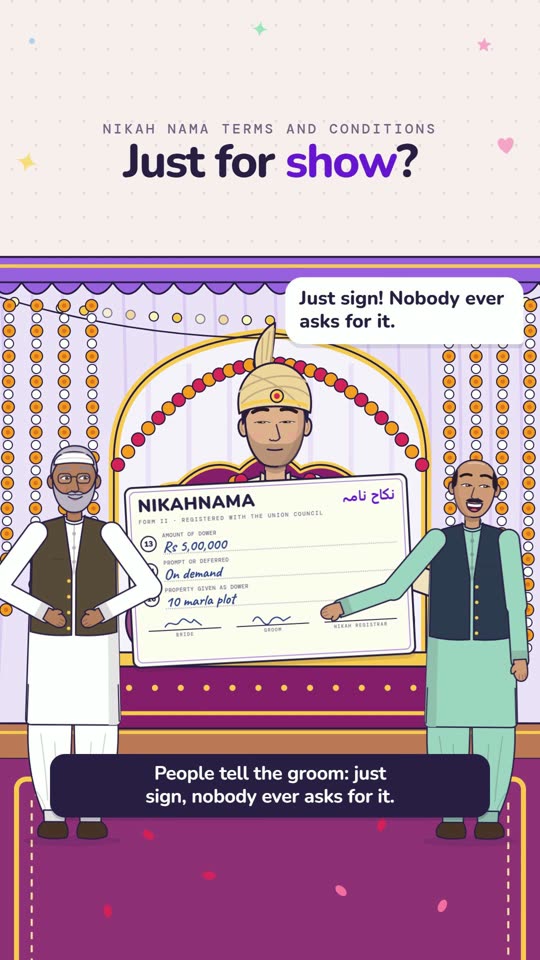
Next one: true or false? “Nikahnama conditions are just for show: sign it, nobody ever asks for it.”
Sources
- Moulvi Abdul Fateh v. Yar Muhammad and others, PLD 2024 SC 1223 (Supreme Court of Pakistan, 9 September 2024), paras 1 to 8
An uncle's bare claim that the children were adopted cannot block their succession certificate; only a putative father can challenge paternity. verified against full text - Muhammad Nawaz v. Additional District and Sessions Judge and others, PLD 2023 SC 461 (Supreme Court of Pakistan, 5 April 2023), paras 5 and 11 to 15
No DNA test in a civil case without consent unless a law allows it; Article 128 cannot be negated by a DNA test. verified against full text - Qanun-e-Shahadat Order, 1984, Article 128 text checked in FAI Statute Search, 30 October 2026 Pakistan Code
- Succession Act, 1925, Section 372 text checked in FAI Statute Search, 30 October 2026
Every quote and section above is traced to the full judgment or statute text by an automatic check that runs on every update.
What the reel says
Read the words of the reel
Your father dies, and your uncle says: you were adopted. Is your father's house gone?
Does a claim of adoption block a succession certificate in Pakistan?
People say: the uncle wins, or a DNA test decides. Wrong.
A teacher in Balochistan died and left a house. His son and daughter asked for a succession certificate; their uncle said they were adopted. The lower court said no, three times. The High Court looked at the papers: fourteen witnesses, NADRA and school records. They won. In September 2024 the Supreme Court said: no adoption paper, no proof, only "false and frivolous grounds", and only the father himself can deny a child is his, not the uncle (PLD 2024 SC 1223). And in a civil case a court can't order a DNA test without your consent unless a law allows it (PLD 2023 SC 461).
What to do:
1. Keep your B-form, CNIC and school papers.
2. Apply for the succession certificate (Succession Act, s.372).
3. If the uncle has a claim, he must prove it in a civil court.
Educational legal information, not legal advice. Every case turns on its own facts. Speak to a lawyer about your own matter. Last checked: 30 October 2026. Review status: Pending advocate review. How we check.