Criminal law · For citizens
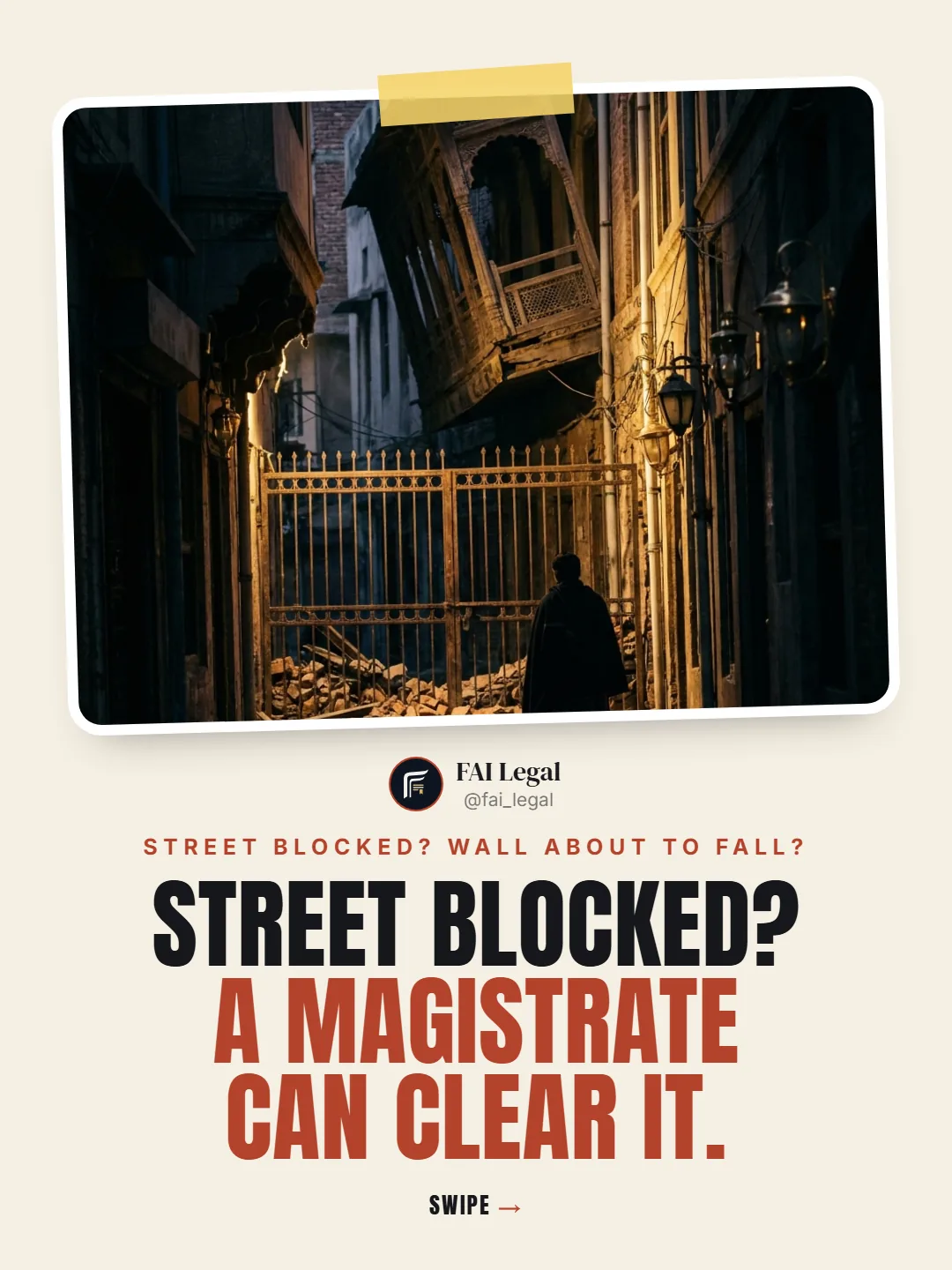
Street blocked? A magistrate can clear it.
In short
A Magistrate of the First Class. On a police report or other information he can make a conditional order to remove an obstruction or nuisance from a public way or place, or to repair or remove a dangerous building (CrPC s.133). Ignore it, and the order becomes absolute with a penalty under s.188 PPC (s.136).
By the FAI Legal editorial desk · 12 October 2026 · 11 slides · 2 min read
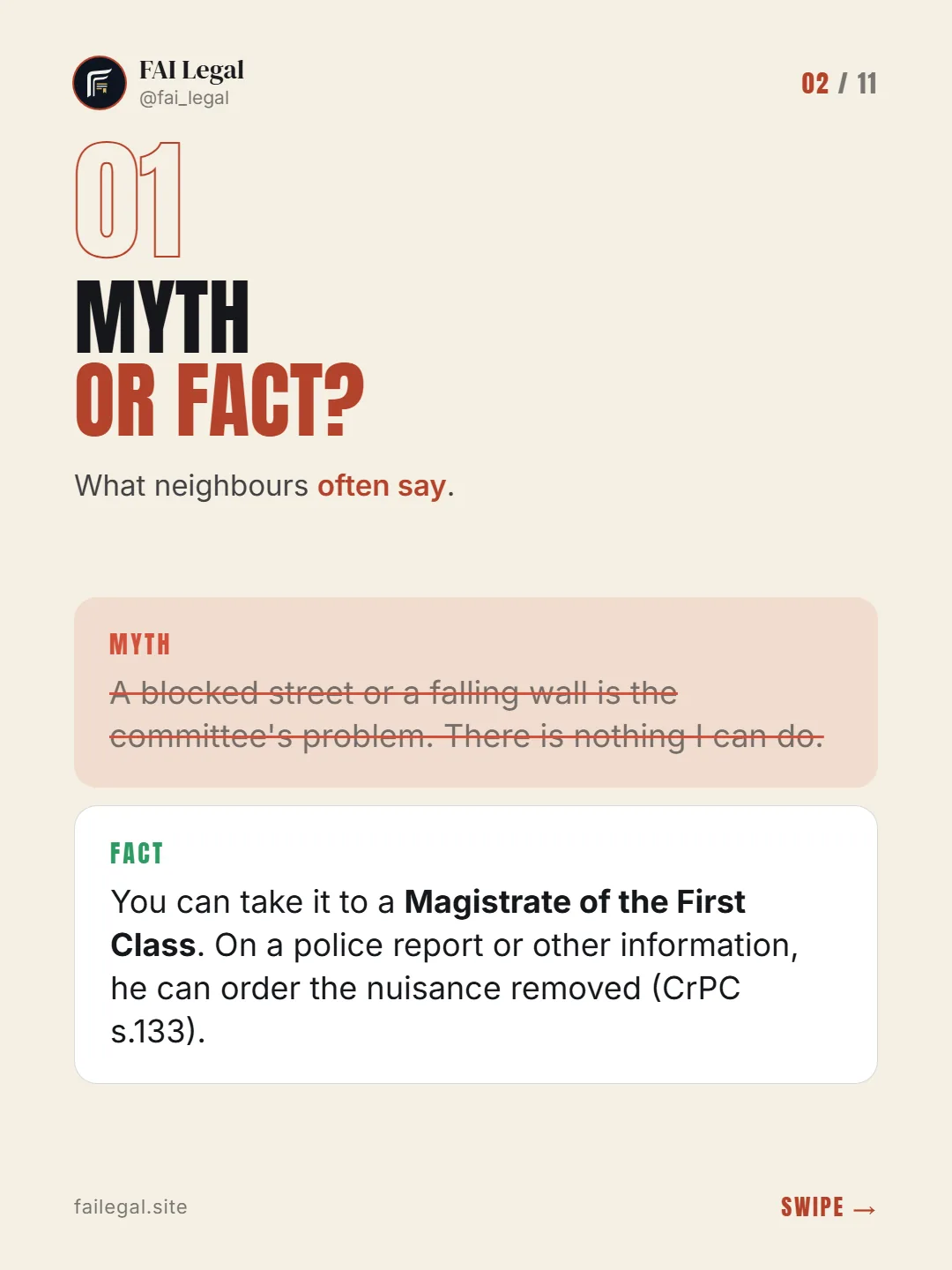

Myth or fact?
What neighbours often say.
- Myth: A blocked street or a falling wall is the committee's problem. There is nothing I can do.
- Fact: You can take it to a Magistrate of the First Class. On a police report or other information, he can order the nuisance removed (CrPC s.133).
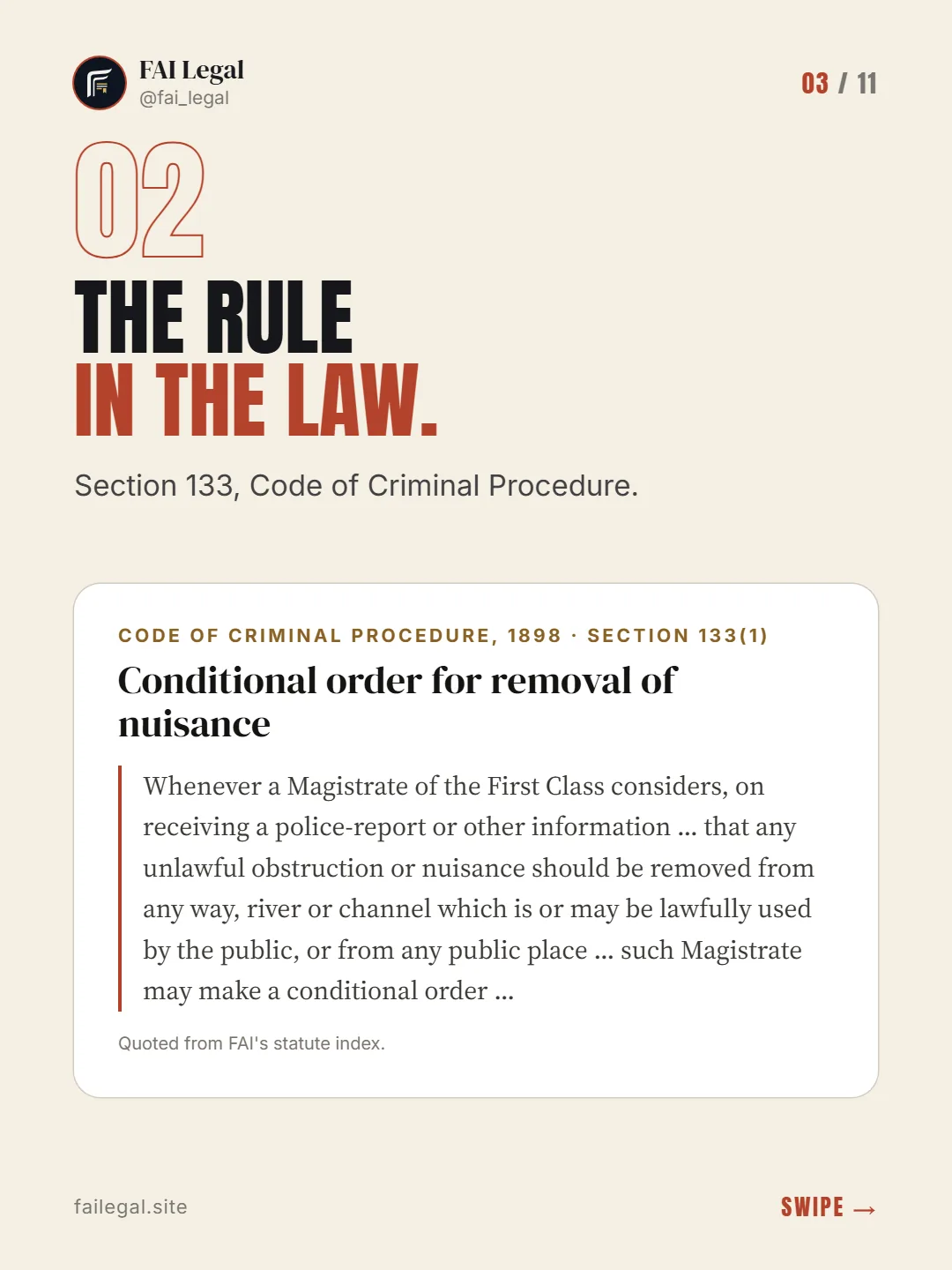
The rule in the law.
Section 133, Code of Criminal Procedure.
“Whenever a Magistrate of the First Class considers, on receiving a police-report or other information … that any unlawful obstruction or nuisance should be removed from any way, river or channel which is or may be lawfully used by the public, or from any public place … such Magistrate may make a conditional order”
Code of Criminal Procedure, 1898 · Section 133(1), Conditional order for removal of nuisance
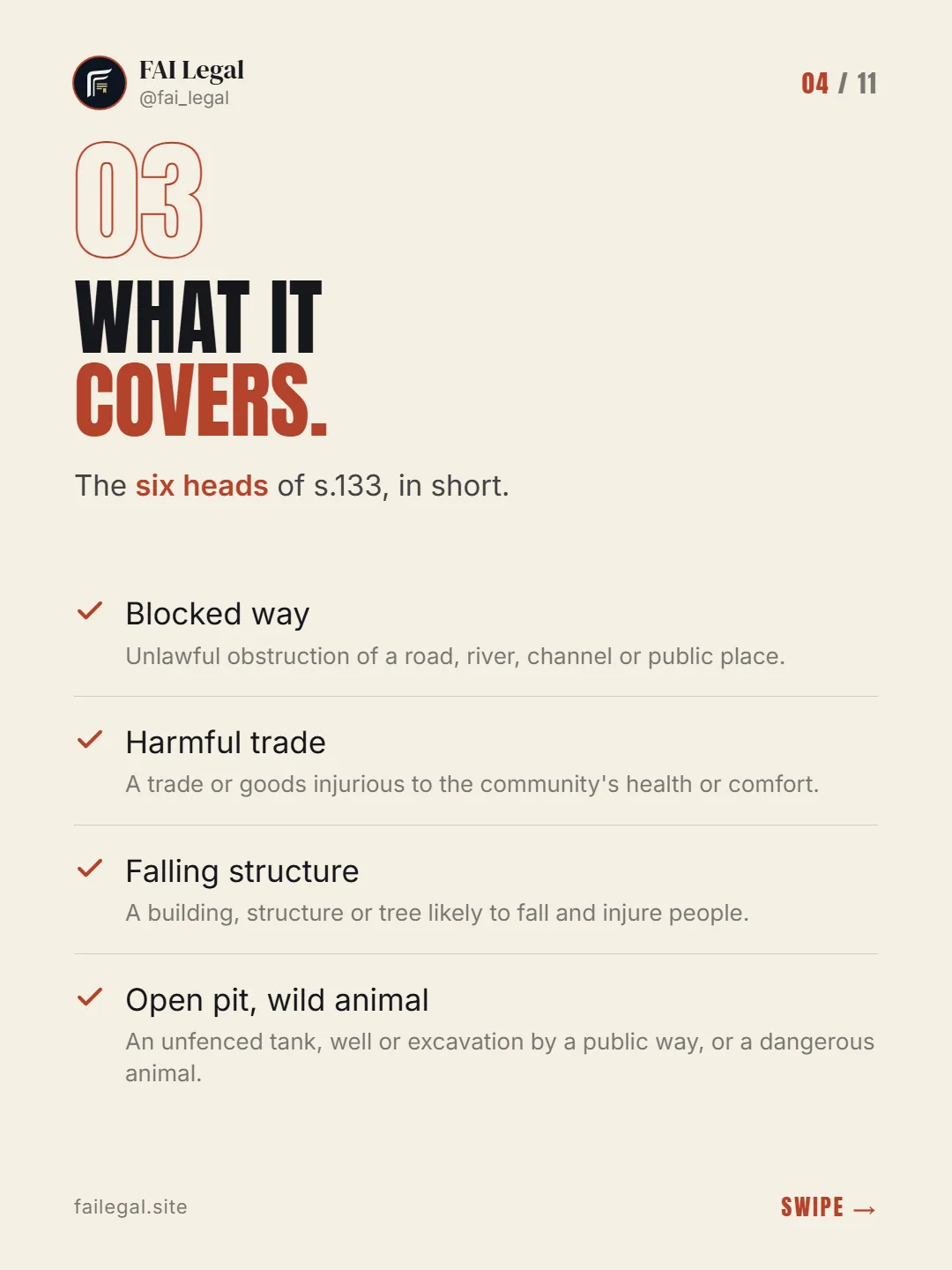
What it covers.
The six heads of s.133, in short.
- Blocked wayUnlawful obstruction of a road, river, channel or public place.
- Harmful tradeA trade or goods injurious to the community's health or comfort.
- Falling structureA building, structure or tree likely to fall and injure people.
- Open pit, wild animalAn unfenced tank, well or excavation by a public way, or a dangerous animal.
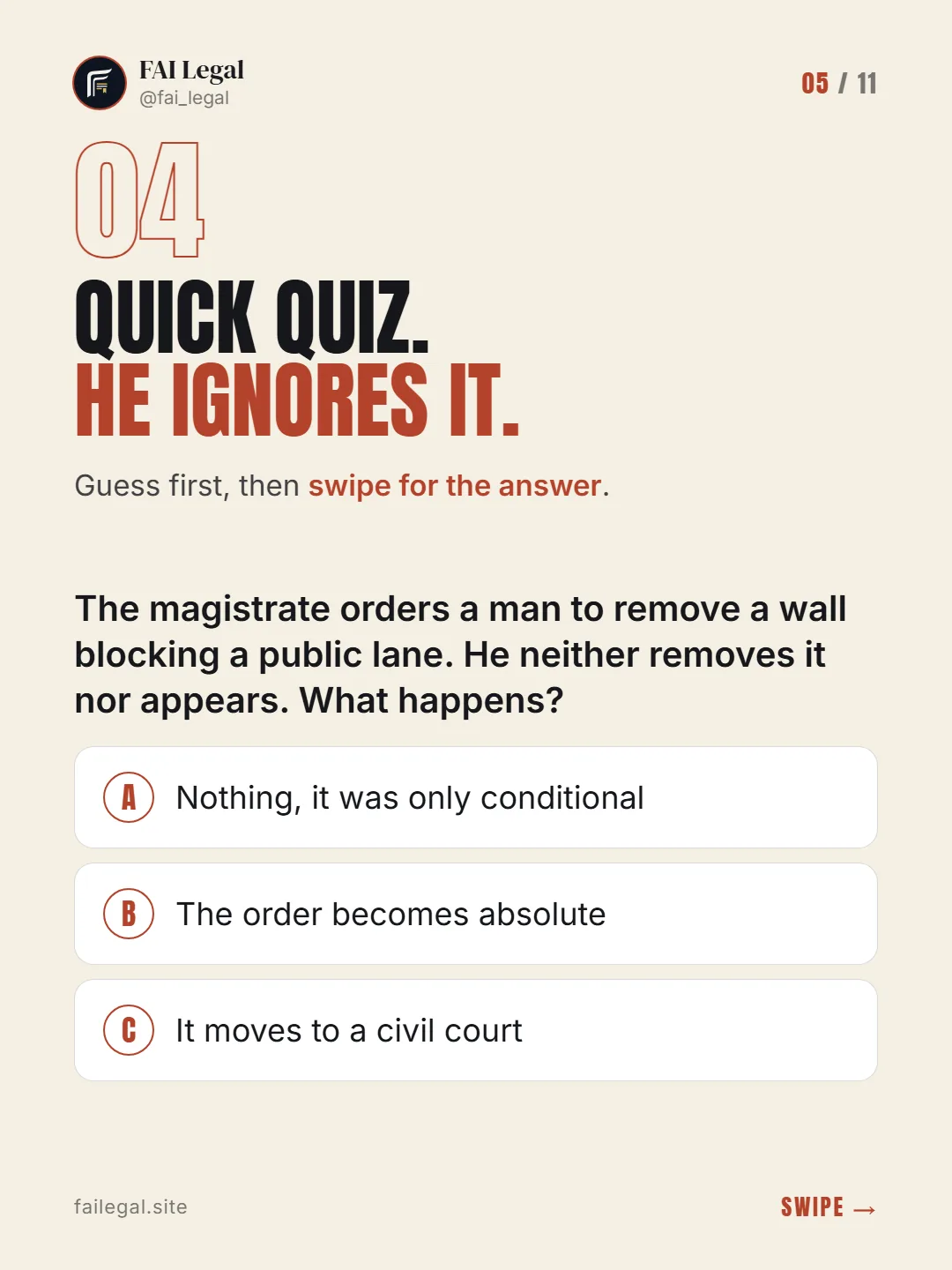
Quick quiz. He ignores it.
Guess first, then swipe for the answer.
- A. Nothing, it was only conditional
- B. The order becomes absolute
- C. It moves to a civil court
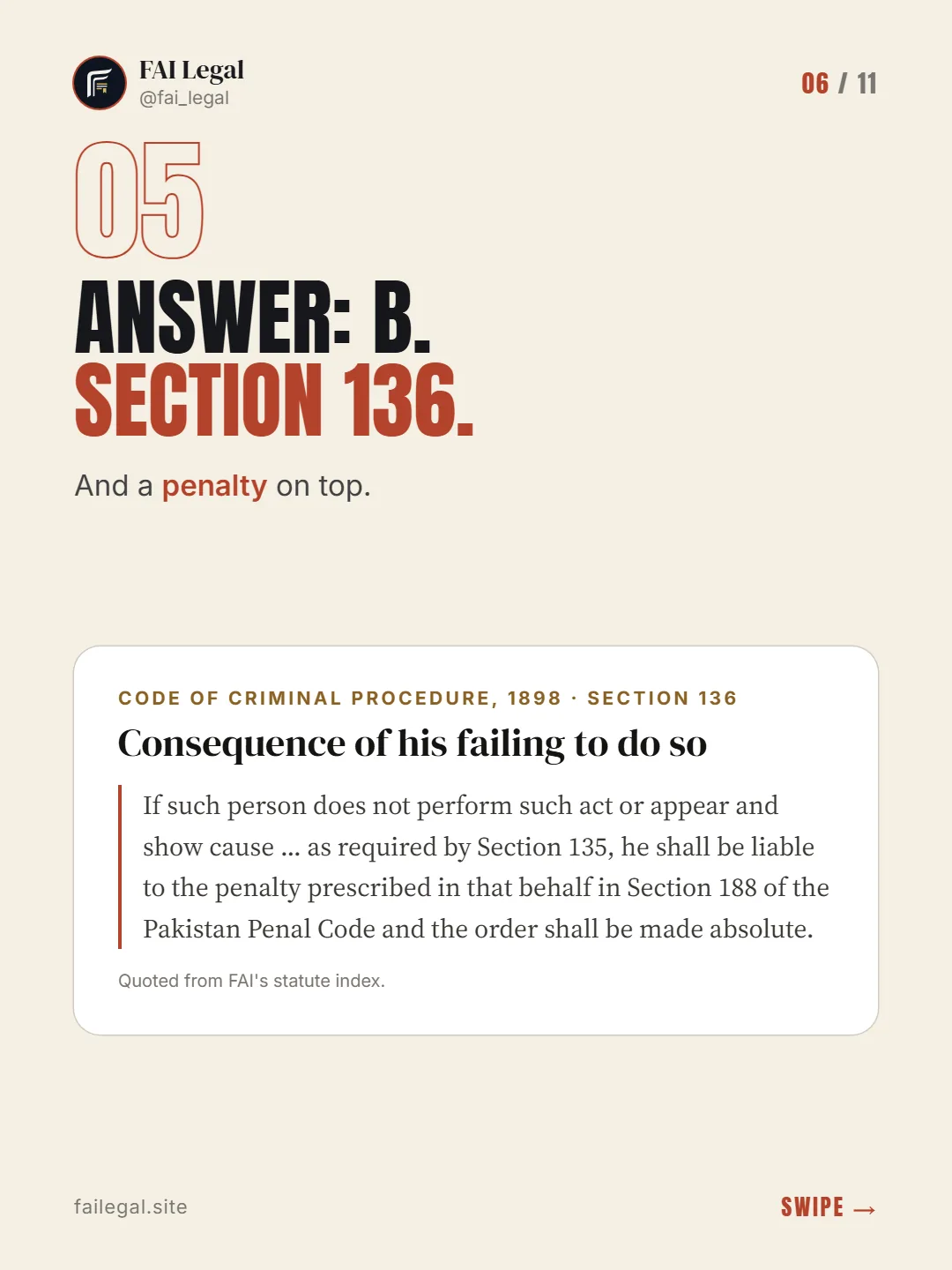
Answer: B. Section 136.
And a penalty on top.
“If such person does not perform such act or appear and show cause … as required by Section 135, he shall be liable to the penalty prescribed in that behalf in Section 188 of the Pakistan Penal Code and the order shall be made absolute.”
Code of Criminal Procedure, 1898 · Section 136, Consequence of his failing to do so
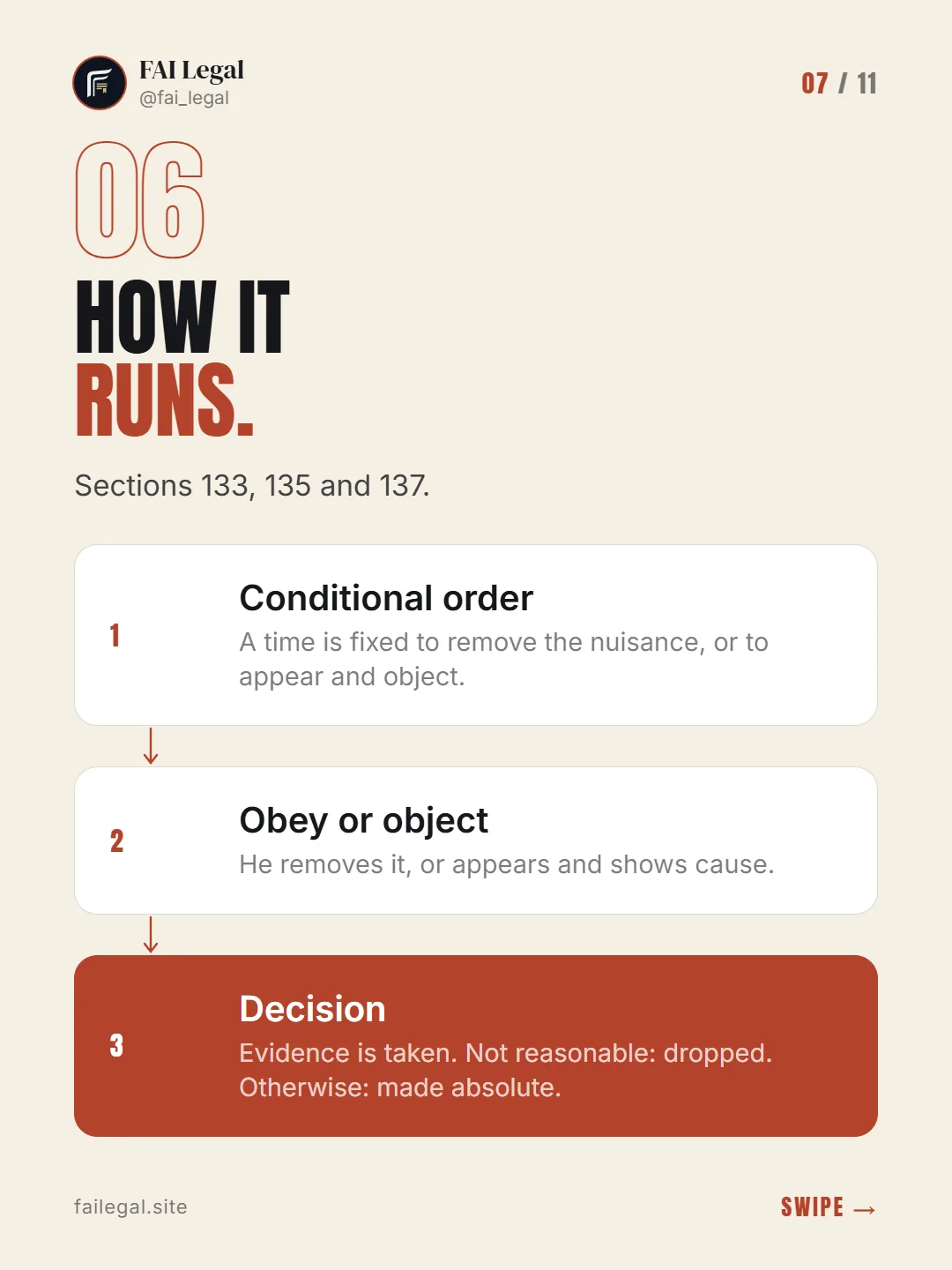
How it runs.
Sections 133, 135 and 137.
- Conditional orderA time is fixed to remove the nuisance, or to appear and object.
- Obey or objectHe removes it, or appears and shows cause.
- DecisionEvidence is taken. Not reasonable: dropped. Otherwise: made absolute.
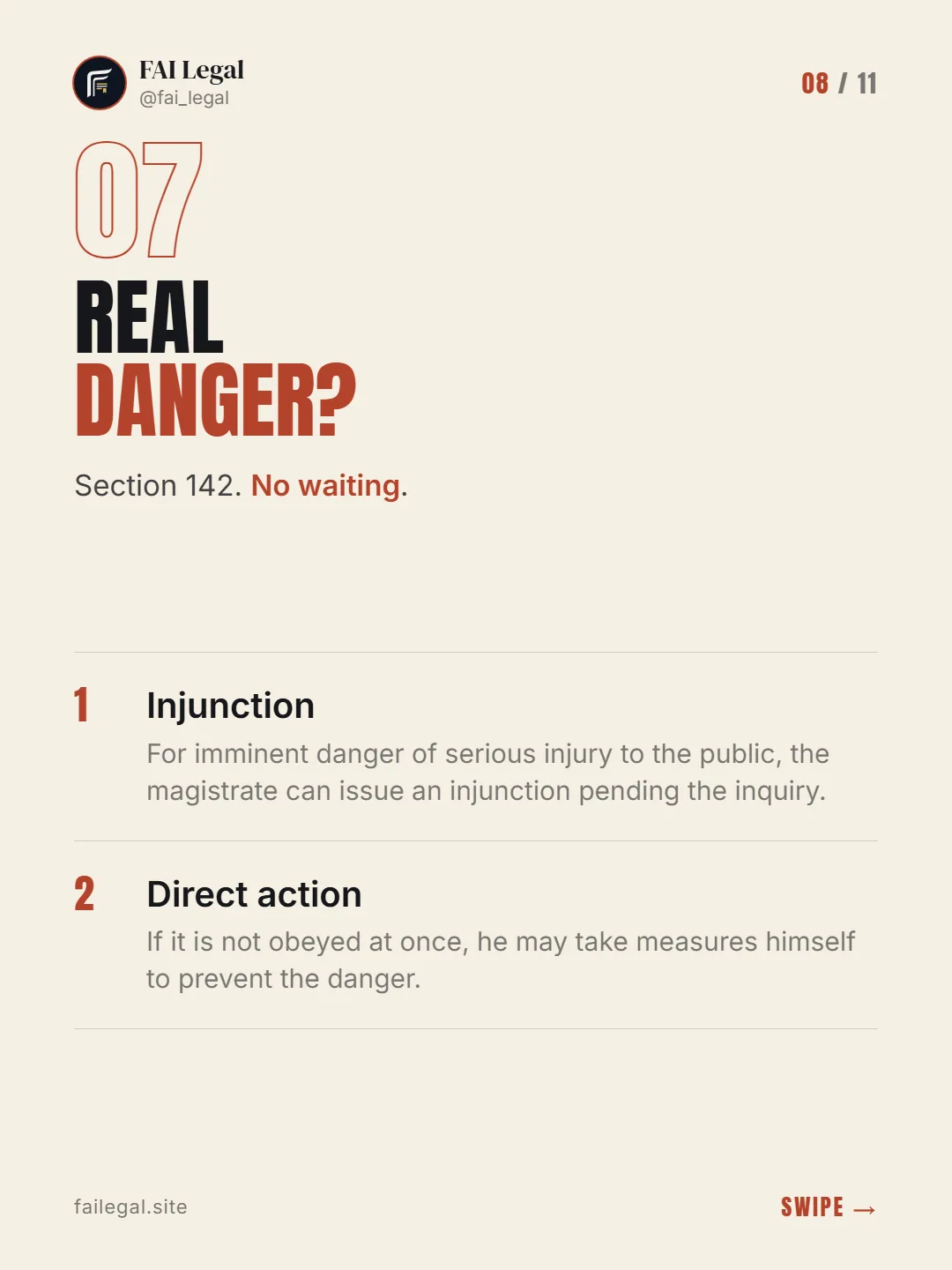
Real danger?
Section 142. No waiting.
- InjunctionFor imminent danger of serious injury to the public, the magistrate can issue an injunction pending the inquiry.
- Direct actionIf it is not obeyed at once, he may take measures himself to prevent the danger.
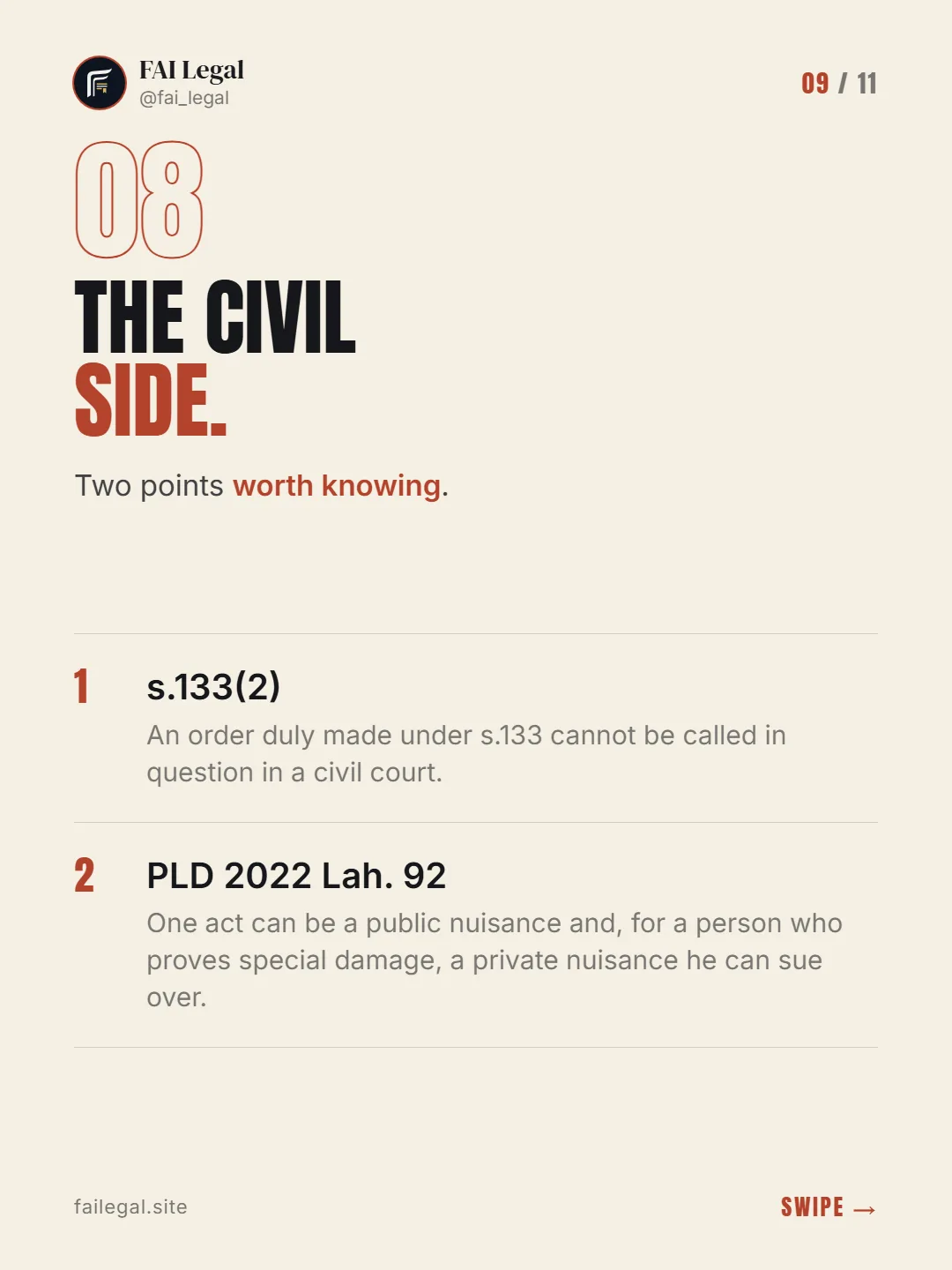
The civil side.
Two points worth knowing.
- s.133(2)An order duly made under s.133 cannot be called in question in a civil court.
- PLD 2022 Lah. 92One act can be a public nuisance and, for a person who proves special damage, a private nuisance he can sue over.
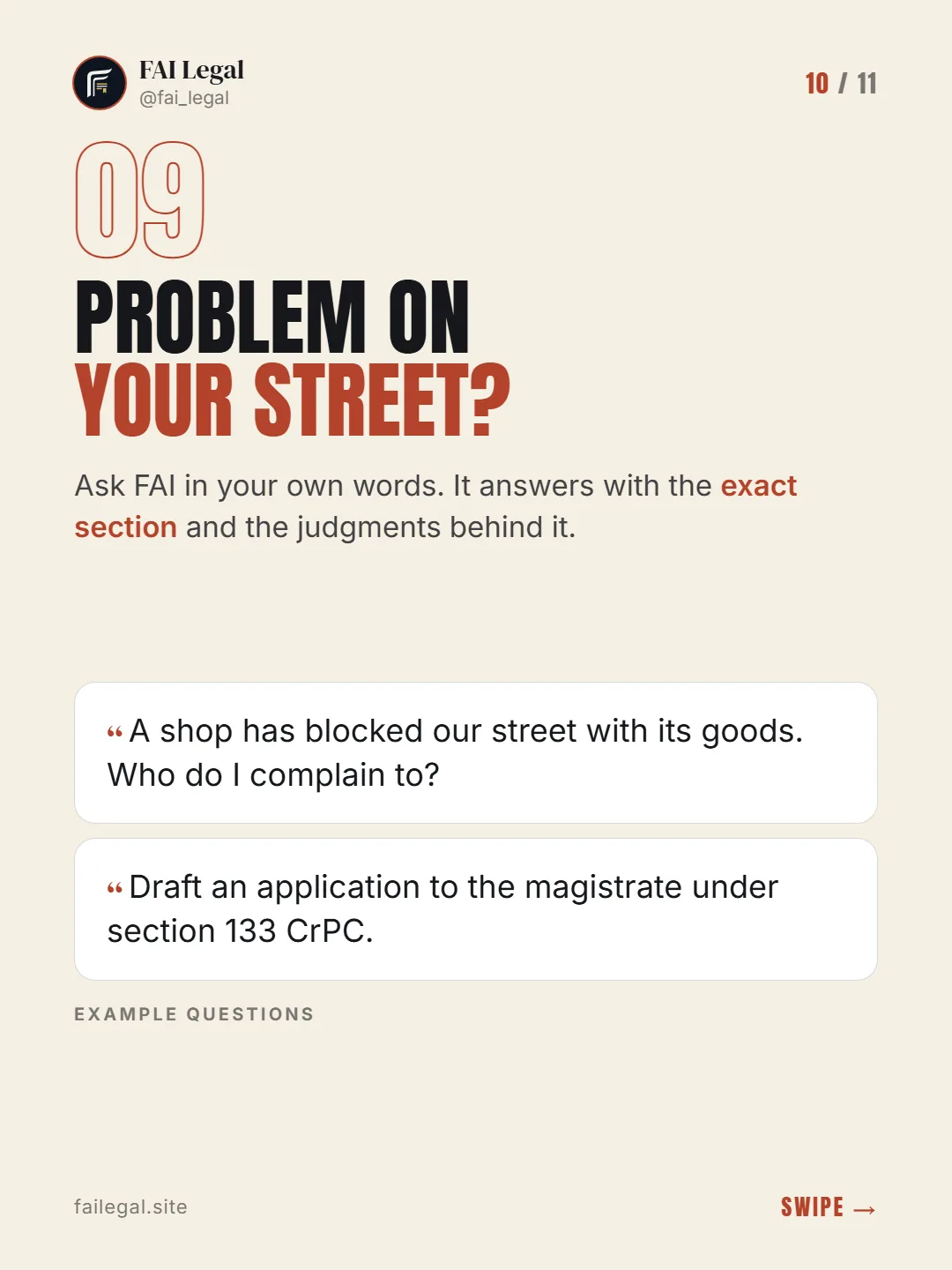
Problem on your street?
Ask FAI in your own words. It answers with the exact section and the judgments behind it.
- A shop has blocked our street with its goods. Who do I complain to?
- Draft an application to the magistrate under section 133 CrPC.
Example questions
What this does not mean
- The power under section 133 CrPC belongs to a Magistrate of the First Class. It is not a power of the police or a housing committee.
- A conditional order is not final at once. The person can remove the nuisance or appear and show cause, and if the order is found not reasonable it is dropped.
- Section 133 covers public ways, public places and the listed dangers. A person who wants to sue for a private nuisance must prove special damage (PLD 2022 Lah. 92).
Questions people ask
Who can I complain to if a shop blocks our street in Pakistan?
A Magistrate of the First Class. On a police report or other information he can make a conditional order to remove an unlawful obstruction from a public way or place (CrPC s.133).
What is section 133 CrPC?
It lets a Magistrate of the First Class order the removal of public nuisances, such as a blocked road, a harmful trade, a building or tree likely to fall, an unfenced tank, well or pit by a public way, or a dangerous animal.
What happens if the person ignores the magistrate order?
If he does not obey or appear and show cause, the order is made absolute and he is liable to the penalty in section 188 PPC (CrPC s.136).
Can the magistrate act fast if a wall is about to fall?
Yes. For imminent danger of serious injury to the public, the magistrate can issue an injunction pending the inquiry, and take measures himself if it is not obeyed at once (s.142).
Can a section 133 order be challenged in a civil court?
No. An order duly made under section 133 cannot be called in question in a civil court (s.133(2)).
Sources
- Code of Criminal Procedure, 1898 · Section 133(1)
Conditional order for removal of nuisance Pakistan Code - Code of Criminal Procedure, 1898 · Section 136
Consequence of his failing to do so Pakistan Code
Educational legal information, not legal advice. Every case turns on its own facts. Speak to a qualified lawyer about your situation. Review status: Pending advocate review. How we check.