Property and inheritance · Supreme Court of Pakistan
Family took over your house? How to get it back
The myth: “If your own family takes over your house, the qabza law can't touch them: it is only for the land mafia.”Wrong
The short answer
Niaz Ahmed and another v. Aijaz Ahmed and others, Supreme Court of Pakistan, PLD 2024 SC 1152, Criminal Petitions Nos. 66-K and 67-K of 2024, decided 15 July 2024. Bench: Syed Hasan Azhar Rizvi and Aqeel Ahmed Abbasi, JJ. The limit: Abbas Asif Zaman v. The State, Supreme Court, Criminal Petition No. 61-K of 2025, announced 15 October 2025. The law: Illegal Dispossession Act 2005, sections 2 to 8.
Niaz Ahmed and another v. Aijaz Ahmed and others · Supreme Court of Pakistan · PLD 2024 SC 1152 · decided 15 July 2024
By the FAI Legal editorial desk · 25 October 2026 · 8 min read
Yes, the qabza law can be used against family. The Illegal Dispossession Act 2005 is not only for the land mafia: in July 2024 the Supreme Court said it covers "any illegal occupant" and upheld an order to put a Karachi man back in the top floor of his own house, which his brother and the brother's wife had taken by breaking the locks (PLD 2024 SC 1152).
In plain words: if anyone, even a relative, forces their way into your house or land without any right, you can file a complaint directly in the Sessions Court. The law tells the court to decide in 60 days, and during the case the court must put you back in if, at first look, they have no right to be there. The catch: in October 2025 the Supreme Court said that family members who lived there with your permission, with no force used, are a matter for the civil court (Criminal Petition No. 61-K of 2025).
Key points
- Section 3 of the Illegal Dispossession Act 2005 says no one shall enter any property to dispossess, grab, control or occupy it without lawful authority. The punishment is up to ten years and a fine, with compensation for the victim (section 3(2)). Since 2017, other forcible and wrongful dispossession carries up to three years, or a fine, or both (section 3(3)).
- The law protects the owner and the person in lawful possession (section 2). It is not limited to land mafias or qabza groups: the Supreme Court called that argument "misconceived" and held the Act covers "any illegal occupant" (PLD 2024 SC 1152, para 8), family members included (paras 4 and 22).
- You file a complaint in the Court of Session, not an FIR at the police station. The court can have the police investigate and report within 15 days, and can order the accused's arrest at any stage (sections 4 and 5).
- During the trial, if the occupier is prima facie not in lawful possession, the court shall order them to put you back in, with police help if needed (section 7). The Supreme Court said the court is then "duty bound" to give this relief (PLD 2024 SC 1152, para 13), and a pending civil case is no bar (para 11).
- The limit: where relatives lived in the house with your consent and no force was used, the Act does not fit; the remedy is a civil suit for possession, partition or an injunction (Supreme Court, Criminal Petition No. 61-K of 2025, paras 9 and 10). A false complaint can cost up to Rs 500,000 (section 5(4)).
Family took over your house? The short answer
You can use the qabza law against anyone who grabs your house without a right, family included. Its real name is the Illegal Dispossession Act 2005. Section 3 says no one shall enter any property to dispossess, grab, control or occupy it without lawful authority, and the punishment is up to ten years in prison and a fine, with compensation for the victim.
In July 2024 the Supreme Court rejected the argument that this law is only for the land mafia and cannot be used against family members. It called that argument "misconceived" and said the Act covers "any illegal occupant" (PLD 2024 SC 1152, para 8). It also upheld an order, made while the case was still running, to give a Karachi man back the top floor of his own house. One limit matters for families: if relatives lived there with your permission and no force was used, the Supreme Court said in October 2025 that the civil court is the right place.
Karachi, 2020: the top floor
Three brothers. One of them, unmarried and disabled, bought a four storey house in Shah Faisal Colony, Karachi, and lived there with another brother. On 30 September 2008 he transferred the house to that brother by a registered declaration and confirmation of an oral gift; he died in 2015. The brother who received it went on living there as its owner (PLD 2024 SC 1152, para 2).
On 7 November 2020, while the owner was away, the third brother and his wife broke the locks and occupied the fourth floor. The owner went to the police, which "proved ineffective". He filed a complaint under sections 3 and 4 of the Illegal Dispossession Act before the Additional Sessions Judge, Karachi East, with an application under section 7. On 18 September 2021 the court allowed the application and directed the brother and his wife to restore the fourth floor to him. Their application for acquittal under section 265-K of the Criminal Procedure Code was dismissed on 22 October 2022, and the Sindh High Court dismissed both their challenges on 23 February 2024 (paras 1 and 2).
What the Supreme Court said in July 2024
Before the Supreme Court the brother argued that the house was inherited, that no case could be brought against legal heirs, and that the Act is only for the Qabza Mafia or land grabbers, not family members (para 4). The court disagreed. The Act protects the owner and the lawful occupier; to make out a case the complainant has to show, at first sight, that he was the owner or lawful occupier, that the accused entered without lawful authority, and that they meant to dispossess, grab, control or occupy the property (paras 6 and 7). The argument that the Act is limited to land grabbers was "misconceived" (para 8).
A civil case between the parties does not stop the complaint: the court quoted its five member bench in 2016 SCMR 1931 that no one can take the law into their own hands, dispossess an owner and then use civil litigation as a shield (para 11). On the interim order, it said section 7 works during the trial, that "prima facie" is a lighter test than proving the offence, and that once the section applies the court "is duty bound" to give the relief (para 13). Here the charge had been framed and the petitioners "could not justify their possession on the fourth floor" (para 14). The petitions were dismissed on 15 July 2024; the court added that its observations were tentative and that the trial court would decide the complaint on its merits (para 24).
How a qabza complaint works, step by step
You file a complaint in the Court of Session. The offence is non-cognizable, so it is not an FIR case at the police station, but the court can order the police to arrest the accused at any stage (section 4). On the complaint the court can direct the police to investigate and report within fifteen days, or have a Magistrate or revenue officer hold a local inquiry (section 5(1)).
Once the court takes cognizance it must hear the trial day to day, decide within sixty days with reasons for any delay, and grant no adjournment longer than seven days (section 5(2) and (3)). During the trial it can order the occupier to hand back possession as interim relief, using force and police help if needed; an officer in charge of a police station who refuses to help commits misconduct (section 7). At the end, if the offence is proved, the court orders the property restored (section 8). A complaint found false, frivolous or vexatious can cost the complainant up to Rs 500,000 (section 5(4)).
The catch: family who lived there with your permission
On 15 October 2025 the Supreme Court decided a different family case from Karachi. A retired doctor said his two adult children had pushed him out of his house. The children had lived there since birth with his permission, and they said he had moved out on his own after his second marriage (Criminal Petition No. 61-K of 2025, paras 2, 4 and 7). The court set aside the case under section 3: there was no force and no material showing a guilty intention to dispossess or grab (paras 7, 9 and 18).
The court was clear that relatives get no free pass: "This is not to say that close kin enjoy an exemption from the Act." Where someone is pushed out "by force or intimidation" and the other ingredients are there, "criminal accountability may follow despite blood ties" (para 10). But where possession began with consent, the remedies are civil, such as a suit for possession, partition or an injunction, or the domestic violence law (para 9). In the court's words, the Act's "provisions operate as protections, not weapons" (para 12). The father kept his right to enter and live in the house (para 18).
If someone takes over your house: what to do
Do not break back in or use force yourself; the courts have said no one may take the law into their own hands (2016 SCMR 1931, quoted in PLD 2024 SC 1152, para 11). Collect proof that you own the house or lawfully live in it: the registry, gift or sale deed, mutation, lease or rent agreement, bills in your name. Photograph the broken locks with the date, note the names of witnesses, and report it to the police so there is a record.
Then file a complaint in the Sessions Court under sections 3 and 4 of the Illegal Dispossession Act, with an application under section 7 for interim possession; a lawyer can draft it for you. If the people inside are family who came in with your permission, the civil court is the route: a suit for possession (Specific Relief Act 1877, section 9, or a regular suit), partition or an injunction. If the house is still owned jointly by all the heirs and was never divided, take advice first: each co-owner has a share in all of it until it is divided. In Punjab there is now a second route: since June 2026, special property tribunals run by additional district and sessions judges hear illegal occupation and fraud cases under the provincial law on protecting ownership of immovable property; ask a lawyer which forum fits your case. The 2005 Act applies across Pakistan.
For law students and lawyers
PLD 2024 SC 1152 settles three points for practice. First, the Act is not confined to qabza groups or land mafias: its scope is "wide enough to cover any illegal occupant" (para 8), following Mumtaz Hussain v. Dr. Nasir Khan, 2010 SCMR 1254, and Mst. Gulshan Bibi v. Muhammad Sadiq, PLD 2016 SC 769, where the words "anyone" and "whoever" in section 3(1) were read as covering every offender (paras 9 and 10). Second, a pending civil case is no bar (para 11, following Shaikh Muhammad Naseem v. Mst. Farida Gul, 2016 SCMR 1931). Third, section 7 needs a trial in progress, which begins with the framing of the charge because taking cognizance is not the start of the trial (para 14, following Haqnawaz v. The State, 2000 SCMR 785), and a prima facie view that the accused is not in lawful possession; the court is then duty bound to act (para 13).
The same judgment restates the test for acquittal under section 265-K CrPC: it is available at any stage, but only where careful evaluation of the evidence shows no probability of conviction, and the arguments that family members are outside the Act or that a civil suit is pending do not meet it (paras 15 to 22). Criminal Petition No. 61-K of 2025 adds the counterweight: the Act needs force or intimidation and a culpable intention, and it does not fit a permissive, intra-family occupation, which belongs to the civil and protective forums (paras 6 to 10, 12 and 17). Before filing in a family setting, check how the occupier came into possession.
The case at a glance
- Facts
- A house in Shah Faisal Colony, Karachi, was transferred in 2008 to one brother by a registered declaration of an oral gift from another brother, who died in 2015. On 7 November 2020 the third brother and his wife broke the locks and occupied the fourth floor. The owner's complaint under the Illegal Dispossession Act led to an interim order on 18 September 2021 restoring the floor to him; the acquittal application and the High Court challenges failed.
- The question
- Is the Illegal Dispossession Act limited to qabza groups and land grabbers, so that it cannot be used against family members or legal heirs? And was the interim order under section 7 rightly made?
- What the Court held
- No. The Act covers any illegal occupant, family included, and a pending civil case is no bar. The interim order was right: the trial had begun, the petitioners could not justify their possession, and section 7 then obliges the court to restore possession. Leave to appeal refused.
- Why
- Sections 2 and 3 protect owners and lawful occupiers against anyone who enters without lawful authority to dispossess, grab, control or occupy (paras 6 and 7); the Supreme Court has settled that the Act is not limited to mafias (paras 8 to 10); civil and criminal proceedings are independent (para 11); section 7's prima facie test is lighter than proof of the offence (paras 12 to 14).
- Limits
- The observations were tentative and the trial court decides the complaint on its merits (para 24). In Criminal Petition No. 61-K of 2025 the Supreme Court held that the Act does not fit a family member's possession that began with consent and involved no force; those disputes go to civil or protective forums (paras 9, 10 and 17).
In the Court’s words
“scope of IDA, 2005 is wide enough to cover any illegal occupant and is not limited to the mafia or Qabza Groups only”
PLD 2024 SC 1152, para 8
“if the court finds that section 7 is applicable then it is duty bound to provide interim relief specified therein”
PLD 2024 SC 1152, para 13
The law it relies on
"No one shall enter into or upon any property to dispossess, grab, control or occupy it without having any lawful authority to do so with the intention to dispossess, grab, control or occupy the property from owners or occupier of such property" (subsection (1)). Punishment: imprisonment up to ten years and fine, with compensation for the victim under section 544-A CrPC (subsection (2)). Added in 2017: forcible and wrongful dispossession not covered by subsection (1), up to three years, or fine, or both (subsection (3)).
"Court" means the Court of Session; "occupier" means "the person who is in lawful possession of a property"; "owner" means the person who actually owns the property at the time of the dispossession, otherwise than through a process of law; "property" means immovable property.
Tried by the Court of Session on a complaint; the offence is non-cognizable; the court may direct the police to arrest the accused at any stage (section 4). The court may have the police investigate and report within fifteen days, or a Magistrate or revenue officer make a local inquiry; after cognizance, a day-to-day trial decided within sixty days, reasons recorded for any delay, no adjournment beyond seven days; costs of up to Rs 500,000 for a false, frivolous or vexatious complaint (section 5).
"If during trial the Court is satisfied that a person is found prima facie to be not in lawful possession, the Court shall, as an interim relief direct him to put the owner or occupier, as the case may be, in possession" (section 7(1)); the court may take further steps, authorise an official to take possession with necessary force, and call on the police, whose refusal is misconduct (section 7(2) to (5)). At the end of the trial the court may order the property restored (section 8).
"If any person is dispossessed without his consent of immoveable property otherwise than in due course of law, he or any person claiming through him may, by suit recover possession thereof, notwithstanding any other title that may be set up in such suit." No such suit lies against the Federal or a Provincial Government, and no appeal or review lies from the decree; a regular suit on title remains open.
What this does not mean
- It does not mean every family quarrel over a house is a crime. If relatives lived there with your consent and no force was used, the Supreme Court says the civil court is the place (Criminal Petition No. 61-K of 2025, paras 9 and 17).
- It does not decide who owns the house. The Act is about unlawful entry and possession; title disputes still go to the civil court, and the Supreme Court said its observations in PLD 2024 SC 1152 were tentative, leaving the trial court to decide the complaint on its merits (para 24).
- It does not mean you can break back in. Taking the law into your own hands is exactly what the courts condemn; use the court (2016 SCMR 1931, quoted in PLD 2024 SC 1152, para 11).
- It does not mean 60 days is guaranteed. The law tells the court to decide within 60 days and to record reasons for any delay (section 5(2)); in the Karachi case the interim order came about ten months after the break-in.
Questions people ask
How to remove illegal possession from your property in Pakistan?
File a complaint in the Sessions Court under the Illegal Dispossession Act 2005 (sections 3 and 4) with an application under section 7. If the court finds at first look that the occupier is not in lawful possession, it must order them to put you back in, with police help if needed. You can also sue in the civil court for possession.
Can I file an illegal dispossession case against my brother or another relative?
Yes, if they entered or took over without any lawful right. The Supreme Court rejected the argument that the Act is only for land mafias and not for family members (PLD 2024 SC 1152, paras 4, 8 and 22). If they lived there with your permission and no force was used, the civil court is the route (Criminal Petition No. 61-K of 2025).
What is the punishment for illegal possession of property in Pakistan?
Up to ten years and a fine, plus compensation for the victim, for entering to grab or occupy without lawful authority (section 3(2)); up to three years, or a fine, or both, for other forcible and wrongful dispossession (section 3(3)).
Where is a complaint under the Illegal Dispossession Act filed?
In the Court of Session (section 4). It is a complaint case, not an FIR case, but the court can ask the police to investigate and report within 15 days (section 5(1)) and can order arrest at any stage (section 4(3)).
How long does an illegal dispossession case take?
The law says the trial runs day to day, with no adjournment longer than seven days, and a decision within 60 days, with reasons recorded for any delay (section 5(2) and (3)). In practice it can take longer, which is why the interim order under section 7 matters.
Is the qabza law only for the qabza mafia?
No. The Supreme Court has settled that the Illegal Dispossession Act covers any illegal occupant, not only mafias or qabza groups (PLD 2024 SC 1152, para 8; PLD 2016 SC 769; 2016 SCMR 1931).
Check yourself
True or false? “If your own family takes over your house, the qabza law can't touch them: it is only for the land mafia.”
Wrong. Niaz Ahmed and another v. Aijaz Ahmed and others, Supreme Court of Pakistan, PLD 2024 SC 1152, Criminal Petitions Nos. 66-K and 67-K of 2024, decided 15 July 2024. Bench: Syed Hasan Azhar Rizvi and Aqeel Ahmed Abbasi, JJ. The limit: Abbas Asif Zaman v. The State, Supreme Court, Criminal Petition No. 61-K of 2025, announced 15 October 2025. The law: Illegal Dispossession Act 2005, sections 2 to 8.
Next one: true or false? “Whoever is the nominee gets everything.”
Sources
- Niaz Ahmed and another v. Aijaz Ahmed and others, PLD 2024 SC 1152 (Supreme Court of Pakistan, 15 July 2024), paras 1, 2, 4, 6-14, 22, 24
The Illegal Dispossession Act covers any illegal occupant, family included; a pending civil case is no bar; an interim order under section 7 restoring the top floor upheld. verified against full text - Abbas Asif Zaman and another v. The State and others, Criminal Petition No. 61-K of 2025 (Supreme Court of Pakistan, 15 October 2025 (heard 26 September 2025)), paras 2, 4, 6-12, 17, 18
The Act does not fit a family member's possession that began with permission and involved no force; close kin get no exemption where someone is ousted by force or intimidation. verified against the official PDF, supremecourt.gov.pk/downloads_judgements/crl.p._61_k_2025.pdf (last checked 25 October 2026); approved for reporting, not yet in the FAI archive - Shaikh Muhammad Naseem v. Mst. Farida Gul, 2016 SCMR 1931 (Supreme Court of Pakistan (five member bench), 22 July 2016), paras 5
Civil and criminal proceedings are independent; a pending civil suit does not bar a complaint under the Act. as quoted by the Supreme Court in PLD 2024 SC 1152, para 11 - Mst. Gulshan Bibi and others v. Muhammad Sadiq and others, PLD 2016 SC 769 (Supreme Court of Pakistan), paras 7, 8
No precondition limits the Act to a class of offenders: section 3(1) says "anyone" and "whoever". as quoted by the Supreme Court in PLD 2024 SC 1152, para 10 - Illegal Dispossession Act, 2005, Sections 2, 3, 4, 5, 7 and 8 (as amended in 2017) text checked in FAI Statute Search, 25 October 2026 Pakistan Code
- Specific Relief Act, 1877, Section 9 text checked in FAI Statute Search, 25 October 2026 Pakistan Code
Every quote and section above is traced to the full judgment or statute text by an automatic check that runs on every update.
What the reel says
Read the words of the reel
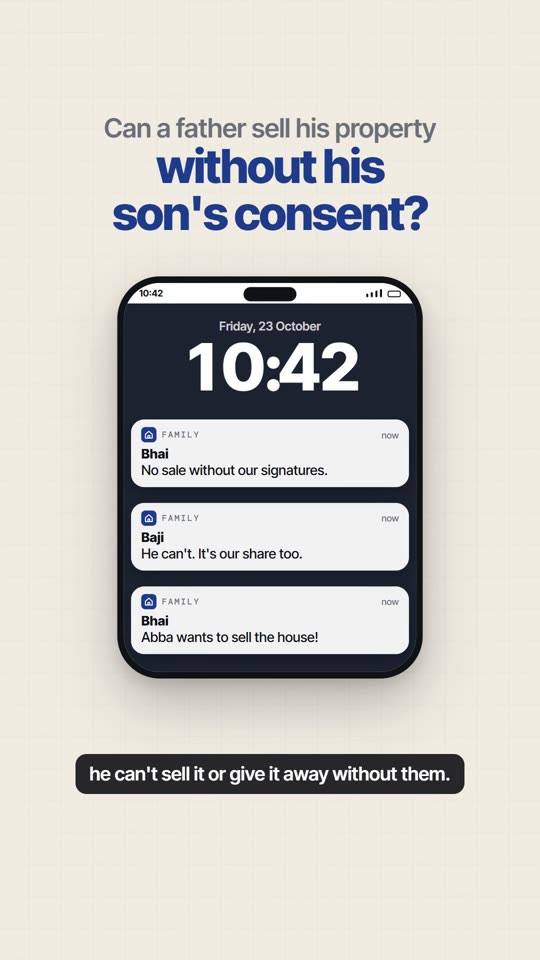
Someone took over your house, even your own brother? Here is what you can do.
Ghar par najaiz qabza ho jaye to kya karein?
People say the qabza law is only for the land mafia, not for family. Wrong.
Karachi, November 2020: a man's brother and the brother's wife broke the locks and moved into the top floor of his house. The Sessions Court ordered the floor back to him while the case was still running. In July 2024 the Supreme Court said the law covers "any illegal occupant", not only the mafia (PLD 2024 SC 1152).
If your house is taken over:
1. Don't break back in yourself.
2. Keep your papers, bills, photos and witnesses, and report it to the police.
3. File a complaint in the Sessions Court under the Illegal Dispossession Act 2005, with an application under section 7.
4. The law says decide in 60 days, and the punishment goes up to 10 years.
One catch: family who lived there with your permission, with no force used, go to the civil court instead (Supreme Court, October 2025).
Educational legal information, not legal advice. Every case turns on its own facts. Speak to a qualified lawyer about your own matter. Reading this page does not create a lawyer-client relationship. Review status: Pending advocate review. How we check.