Criminal law · Sindh High Court
False FIR punishment in Pakistan: when the person who filed it pays
The myth: “Nothing happens to someone who files a false FIR.”Wrong: a court can make him pay damages
The short answer
Something can happen. A man in Karachi who was acquitted after a false FIR sued the man who filed it for malicious prosecution, and the courts made him pay: Rs. 12 million decreed, reduced to Rs. 5 million on appeal, and in March 2025 the Sindh High Court refused to cut it further. The court said: "Lodging of false FIRs has unfortunately become a norm which can only be curbed by awarding damages in favour of the individual who was wronged."
A v. B (names withheld) · Sindh High Court · IInd Appeal No. 245 of 2024 · decided 26 March 2025
By the FAI Legal editorial desk · 7 November 2026 · 6 min read

But an acquittal alone does not win damages. The person suing must show that the case was started without reasonable and probable cause and out of malice, and the suit has a one-year limit from the acquittal. In September 2025 the Supreme Court added that a complaint made in good faith that could not be proved is "not proved and not false".
Key points
- Damages for a false FIR are possible: the trial court decreed Rs. 12 million, the appellate court reduced it to Rs. 5 million, and the High Court kept it (paras 3, 4 and 17).
- The court's reason: false FIRs have become a norm, and only awarding damages to the person wronged can curb them (para 11).
- The tests the courts applied: prosecuted by the defendant, ended in your favour, no reasonable and probable cause, malice, harm to your liberty and reputation, and loss (para 5).
- The criminal trial's own words mattered: "This is case of no evidence" (para 5).
- The limit: a suit for compensation for malicious prosecution must be filed within one year of the acquittal (Limitation Act 1908, First Schedule, Article 23).
- The judgment does not say whether the damages have been paid.
False FIR punishment in Pakistan: the short answer
A false FIR can cost the person who filed it. The person falsely accused can sue for damages for malicious prosecution after the case ends in his favour, and the courts decide the amount. In this Karachi case the trial court decreed Rs. 12 million, the appellate court reduced it to Rs. 5 million, and on 26 March 2025 the Sindh High Court dismissed the complainant's second appeal.
People search this as false fir punishment in pakistan, jhooti fir ki saza, can i file fir against false fir and malicious prosecution law in pakistan. Besides a damages suit, the law has criminal routes: section 182 of the Pakistan Penal Code (false information to a public servant), which the Supreme Court says needs the public servant's own written complaint, and section 211 (a false charge made with intent to injure). For the steps when a false FIR is first lodged, see FAI Media's guide on what to do.
Karachi, 2018: arrested, eighteen months, no evidence
In 2018 an FIR was lodged at a Karachi police station under sections 420, 448 and 506-B of the Pakistan Penal Code: cheating, house-trespass and criminal intimidation (para 3). The man named in it was arrested and later released on bail; the prosecution examined six witnesses before a Judicial Magistrate (para 5).
On 2 December 2019 the magistrate acquitted him under section 245(i) of the Code of Criminal Procedure, recording: "This is case of no evidence." (para 5). His counsel told the High Court that the trial had taken about eighteen months and that an appeal against the acquittal was also dismissed (para 6).
He sued the man who filed it
He then filed a civil suit for Rs. 12 million as damages for malicious prosecution. The trial court decreed it in full on 20 January 2024, "decreeing the suit of the Respondent as prayed for Rs.12 million" (para 3). On appeal the amount was reduced to Rs. 5 million (paras 1 and 4).
The man who filed the FIR went to the High Court in second appeal. By the end of the hearing his counsel conceded the acquittal and "only seeks a reduction of damages awarded on the basis of his financial constraints" (para 14). He had filed his own evidence in the suit but never appeared to be cross-examined, so the trial court did not rely on it (para 10).
We checked it in FAI Legal
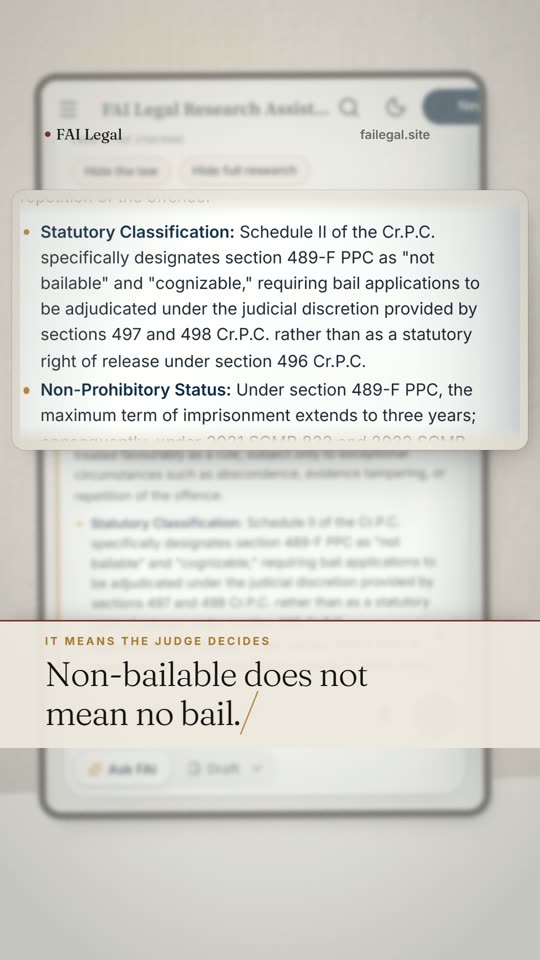
The judgment is on FAI Legal's Judgment Search, marked as a citation from the court record, with every paragraph open in the judgment reader. The paragraphs quoted on this page are paras 3, 4, 5, 11, 14 and 17. The Supreme Court's judgment of 5 September 2025 is there too (para 10 is quoted below), and so is the High Court order that quotes Article 23 of the Limitation Act.
Sindh High Court, March 2025: the damages stay
The High Court found that the courts below had applied the test correctly and that there was no substantial error or defect for a second appeal (paras 9, 10 and 14). It added: "The Hon'ble Supreme Court has time and again disparaged the tendency of frivolous litigation. Lodging of false FIRs has unfortunately become a norm which can only be curbed by awarding damages in favour of the individual who was wronged" (para 11).
It adopted the Islamabad High Court's reasoning that a false prosecution harms liberty, dignity and reputation, and that "no one is allowed to wield the law as a weapon to settle scores with another by abusing legal processes" (para 11). The second appeal was dismissed and the appellate decree upheld (para 17).
The catch: an acquittal alone is not enough
Damages are not automatic. The courts asked whether the defendant prosecuted the plaintiff, whether the case ended in his favour, whether the defendant acted without reasonable and probable cause and out of malice, and whether the plaintiff's liberty and reputation suffered (para 5). Here the magistrate had found "no evidence", and the complainant never stood cross-examination in the damages suit.
On 5 September 2025 the Supreme Court drew the same line for section 182: information laid with a bona fide belief "cannot be termed as false unless it is proved in accordance with law through judicial proceedings. Such information can be termed as not proved and not false" (Cr.P.L.A. No. 147-K of 2025, para 10). An honest complaint that failed for want of evidence is not a false one.
Time matters: the Limitation Act gives one year from the acquittal, or from the end of the prosecution, to sue for compensation for malicious prosecution (First Schedule, Article 23, as quoted by the Sindh High Court in Suit No. 2320 of 2016). Our practical advice: keep certified copies of the FIR, the bail order, the acquittal judgment and your costs, and see a lawyer soon after the acquittal.
Find rulings like this on FAI Legal
FAI Legal is a website: open failegal.site in your phone's browser, there is nothing to download. Read these judgments in full on Judgment Search, or ask your own question in plain words, for example "Someone filed a false FIR against me and I was acquitted. Can I make him pay?", and see the law and the judgments behind the answer. Start free.
The case at a glance
- Facts
- An FIR under sections 420, 448 and 506-B PPC was lodged against the plaintiff in Karachi in 2018; he was arrested, bailed and, after six prosecution witnesses, acquitted under section 245(i) CrPC on 2 December 2019 as a "case of no evidence" (paras 3 and 5). His suit for Rs. 12 million damages for malicious prosecution was decreed in full; the appellate court reduced it to Rs. 5 million (paras 1 to 4).
- The question
- Whether the test for malicious prosecution was correctly applied by the courts below, and whether the appellate judgment suffered from a substantial error or defect (para 7).
- What the Court held
- The test was correctly applied; no substantial error or defect was shown; the second appeal was dismissed and the decree for Rs. 5 million upheld (paras 9, 14 and 17).
- Why
- The prosecution ended in the plaintiff's favour on a finding of no evidence; the defendant's examination-in-chief, never tested in cross-examination, was rightly ignored; concurrent findings are not re-weighed in second appeal; and false FIRs can only be curbed by awarding damages (paras 10 to 13).
- Limits
- A single-judge decision of the Sindh High Court on the facts of one case. It does not make every acquittal a ground for damages; the plaintiff must prove want of reasonable and probable cause and malice, within one year of the acquittal. It does not say whether the damages were paid.
In the Court’s words
“even the reduction of damages to Rs.5 million by the Appellate Court is unwarranted.”
IInd Appeal No. 245 of 2024, para 4
The law it relies on
A suit for compensation for a malicious prosecution must be filed within one year from the date the plaintiff is acquitted or the prosecution otherwise ends (as quoted by the Sindh High Court; not returned by FAI's statute index).
Section 182: giving a public servant information one knows or believes to be false, to make him use his lawful power to another's injury. Section 211: instituting a criminal proceeding or making a false charge with intent to injure, knowing there is no just or lawful ground. A complaint under section 182 needs the public servant's written complaint (CrPC section 195).
No court takes cognizance of an offence under sections 172 to 188 PPC except on the written complaint of the public servant concerned or his superior.
What this does not mean
- It does not mean every acquittal earns damages. The courts applied a test: no reasonable and probable cause, malice, and harm (para 5); the Supreme Court says what could not be proved is "not proved and not false".
- It does not mean the money has been paid: the judgment upholds the decree and says nothing about payment.
- It does not mean you can sue while the criminal case is still pending: the claim arises when the prosecution ends in your favour, and the one-year limit runs from then.
- It does not punish the police here: the suit was against the person who filed the FIR.
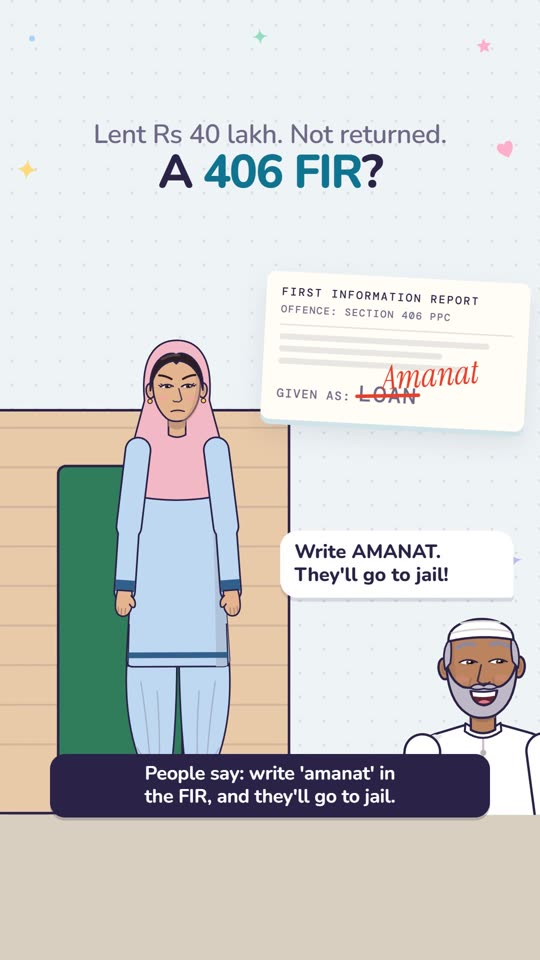
- The reel's opening scene, a lock-up and a friend's bad advice, is a drawing of the common belief, not the case's own scene.
Questions people ask
What is the punishment for a false FIR in Pakistan?
There are civil and criminal routes. The person falsely accused can sue for damages for malicious prosecution after an acquittal; in this case the courts kept Rs. 5 million (para 17). Criminally, section 182 PPC (false information to a public servant) needs the public servant's own written complaint (CrPC section 195), and section 211 PPC covers a false charge made with intent to injure.
Can I file an FIR against a false FIR?
Not for section 182: the Supreme Court said proceedings under section 182 can only be started by the public servant before whom the information was laid, and only when it was found false through judicial process (Cr.P.L.A. No. 147-K of 2025, paras 10 and 11). A suit for damages is your own remedy.
How much can I claim for malicious prosecution?
There is no fixed amount. The courts look at loss of liberty, reputation, time, costs and mental anguish; here Rs. 12 million was claimed and decreed, and the appellate court reduced it to Rs. 5 million (paras 2 to 4, 11).
What is the time limit for a malicious prosecution suit?
One year from the acquittal, or from the date the prosecution otherwise ends (Limitation Act 1908, First Schedule, Article 23).
Is an acquittal enough to win damages?
No. You must also show the case was started without reasonable and probable cause and out of malice, and that it harmed you (para 5). A complaint made in good faith that could not be proved is "not proved and not false" (Supreme Court, 2025).
Malicious prosecution kya hota hai?
It is a civil wrong: setting the law in motion against someone without reasonable cause and out of malice, so that he suffers. The person who was wronged can claim damages once the case ends in his favour (para 5).
Check yourself
True or false? “Nothing happens to someone who files a false FIR.”
Wrong: a court can make him pay damages. Something can happen. A man in Karachi who was acquitted after a false FIR sued the man who filed it for malicious prosecution, and the courts made him pay: Rs. 12 million decreed, reduced to Rs. 5 million on appeal, and in March 2025 the Sindh High Court refused to cut it further. The court said: "Lodging of false FIRs has unfortunately become a norm which can only be curbed by awarding damages in favour of the individual who was wronged."
Next one: true or false? “A bounced cheque means jail until you pay.”
Sources
- A v. B (names withheld), IInd Appeal No. 245 of 2024 (Sindh High Court, 26 March 2025)
Damages for malicious prosecution after a false FIR (sections 420, 448 and 506-B PPC) kept at Rs. 5 million: "Lodging of false FIRs has unfortunately become a norm which can only be curbed by awarding damages". - A v. B (names withheld), Cr.P.L.A. No. 147-K of 2025 (Supreme Court of Pakistan, 5 September 2025)
Information laid in good faith is "not proved and not false" unless proved false through judicial proceedings; section 182 PPC needs the public servant's written complaint. - Limitation Act, 1908, First Schedule, Article 23 quoted by the Sindh High Court (Suit No. 2320 of 2016, order of 2 April 2024, para 5); not returned by FAI's statute index Pakistan Code
- Pakistan Penal Code, 1860, Sections 182 and 211 text checked in FAI Statute Search, 7 November 2026 (the index holds s.182 as it stood before Act IV of 2017) Pakistan Code
Every quote and section above is traced to the full judgment or statute text by an automatic check that runs on every update.
What the reel says
Read the words of the reel
False FIR punishment in Pakistan: does the man who filed it get away with it?
Jhooti FIR katwane wale ka kuch nahi bigarta?
Wrong. A court in Karachi made one man pay Rs 50 lakh in damages.
In 2018 an FIR accused a man of cheating, trespass and threats. He was arrested, faced eighteen months of trial, and the magistrate wrote: "This is case of no evidence." After his acquittal he sued the man who filed it for malicious prosecution: Rs 1.2 crore decreed, cut to Rs 50 lakh on appeal, and in March 2025 the Sindh High Court refused to cut it further: "Lodging of false FIRs has unfortunately become a norm which can only be curbed by awarding damages in favour of the individual who was wronged."
But an acquittal alone is not enough:
1. The Supreme Court (September 2025): information that could not be proved is "not proved and not false". You must show it was false, with no reasonable cause, and out of malice.
2. A suit for malicious prosecution has a one-year limit from your acquittal (Limitation Act, Article 23).
3. Talk to a lawyer about your own case.
Educational legal information, not legal advice. Every case turns on its own facts. Speak to a lawyer about your own case. Last checked: 7 November 2026. Review status: Pending advocate review. How we check.