Property and inheritance · Supreme Court of Pakistan
Can a registry be cancelled in Pakistan? Registry, intiqal and who really owns the land
The myth: “Registry and intiqal in my name, so nobody can touch it.”Wrong: a court can undo both
The short answer
Yes. A court can cancel a registry, and an intiqal on its own does not make anyone the owner. On 20 January 2026 the Supreme Court said "Mutation entries are primarily maintained for fiscal purposes and do not by themselves create, extinguish, or confer title", and buyers who held an intiqal in their names lost 66 kanals because the paper showing how their seller got the land never came to court (Supreme Court of Pakistan, C.P.L.A. No. 1600-L of 2014, paras 6, 8 and 13).
A v. B (names withheld) · Supreme Court of Pakistan · C.P.L.A. No. 1600-L of 2014 · decided 20 January 2026
By the FAI Legal editorial desk · 6 November 2026 · 7 min read
A registry is strong proof, but not a shield either. In March 2025 the Supreme Court kept a registered sale deed cancelled because the buyers could not prove the deal: "presumption of truth is attached to the registered sale deed, which is a public document but the said presumption is rebuttable" (Supreme Court of Pakistan, Civil Appeal No. 671-L of 2013, para 4).
Key points
- An intiqal (mutation) is mainly a revenue record: entries are kept "for fiscal purposes" and do not by themselves give title. Once someone disputes it, the person relying on it must go back to the original transaction and prove it (January 2026, para 8).
- The buyers' intiqal could not save them: "the mutation, even if attested, could not become a substitute for title" (January 2026, para 8). The record of the seller's allotment was never produced in evidence (para 6).
- A registered sale deed carries a presumption of truth, but it can be rebutted. When the original owner alleged fraud, the buyers had to prove the deal was genuine, and they brought neither the Registrar nor the bank record of the payment (March 2025, para 4).
- A registry is cancelled through the courts: under section 39 of the Specific Relief Act a person against whom an instrument is void or voidable "may sue to have it adjudged void or voidable", and for a registered deed the court sends its decree to the registering officer, who notes the cancellation.
- Before you buy: check how the seller got the land, all the way back, and pay through the bank so you can prove it. That is our practical advice from what sank each case, not a rule from the judgments.
Can a registry be cancelled? The short answer
Yes. A registry (a registered sale deed) is strong evidence, and an intiqal (the mutation entry in the revenue record) is part of the land record, but neither is a final shield. A civil court can declare a deed void and order it cancelled, and it can refuse to treat an intiqal as ownership when the transaction behind it is not proved.
People search this as can a registry be cancelled, registry cancel ho sakti hai kya, registry cancel kaise hoti hai and what is registry intiqal. The two Supreme Court decisions below answer it: one for the intiqal (January 2026) and one for the registry (March 2025).
66 kanals, two intiqals: what happened
Some buyers said 66 kanals 9 marlas in a chak of Bhakkar district "had earlier been allotted in favour of respondent No.9 through R.L-II No.188, and consequently Mutation No.1 was sanctioned in his favour", and that they then bought the land from him (para 1). The government said the land was its own and could never have been allotted that way (paras 1 and 9).
The buyers had first got a declaratory decree based mainly on the seller's own statement, without the government as a party, and on its strength they "succeeded in getting mutation sanctioned in their favour, which was subsequently reversed and the land stood resumed and restored in favour of the Government" (para 9). They sued again; the trial court decreed in their favour in 2004, the appellate court dismissed the suit in 2006, and the Lahore High Court restored their decree in 2014 (para 1). The government took the case to the Supreme Court.
We checked it in FAI Legal
Both decisions are on FAI Legal's Judgment Search, marked as citations from the court record, with every paragraph open in the judgment reader. The paragraphs quoted on this page are paras 1, 2, 6, 8, 9, 10, 13 and 14 of the January 2026 order and para 4 of the March 2025 judgment. Section 39 of the Specific Relief Act is quoted from FAI's Statute Search. We cite both decisions by the court's case number and date.
Supreme Court, January 2026: an intiqal is not ownership
Shahid Bilal Hassan, J, writing for a bench of two, put the question as "whether the respondents were able to establish a valid allotment and lawful title" (para 2). The answer turned on one missing paper: "the pivotal document R.L-II No.188 itself was never produced in evidence", so the buyers "could not succeed merely on the basis of mutation entries or oral assertions" (para 6).
On the intiqal itself: "Mutation entries are primarily maintained for fiscal purposes and do not by themselves create, extinguish, or confer title. Once a mutation is disputed, the party relying upon such mutation is bound to revert to the original transaction and prove it through lawful evidence" (para 8). With the allotment unproved, "the entire superstructure raised thereupon could not be allowed to stand and was liable to fall" (para 10). The Court converted the petition into an appeal, allowed it, and held that "the suit filed by respondents Nos. 1 to 8 stands dismissed with costs throughout" (para 13). It added that courts must make sure "fiscal mutations do not become instruments for the unlawful deprivation of State land" (para 14).
The catch: a registry can be cancelled too
A registry carries more weight than an intiqal, but it is not untouchable. In March 2025 an elderly widow said her house had been put in her relatives' names by a registered sale deed after she was told the papers were for Zakat; the trial and appellate courts declared the deed void and ordered it cancelled, and the High Court reversed them (Civil Appeal No. 671-L of 2013, paras 2 and 4).
The Supreme Court restored the cancellation. "It is true that presumption of truth is attached to the registered sale deed, which is a public document but the said presumption is rebuttable." Once fraud was alleged, "it was duty of the respondents being beneficiaries to prove the genuineness of the transaction"; they produced neither the Registrar nor anyone from his office, and no bank statement or bank official for the payment they said they had made (para 4). The appeal was allowed (para 5).
The law behind a registry being cancelled is section 39 of the Specific Relief Act, 1877: a person against whom a written instrument is void or voidable, and who fears it may cause serious injury if left outstanding, "may sue to have it adjudged void or voidable; and the Court may, in its discretion, so adjudge it and order it to be delivered up and cancelled". If the deed is registered, "the Court shall also send a copy of its decree to the officer in whose office the instrument has been so registered", who notes the cancellation in his books.
Before you buy land
Check how the seller got the land: the allotment, the inheritance or the earlier sale, and the intiqal and registry for each step back, not only the latest entry. In the January 2026 case the buyers lost because that first link was never proved. For land that may be government land, or a plot in a housing scheme, ask the authority concerned before you pay.
Pay through the bank and keep the record, with the deed's details and your witnesses. In the March 2025 case the buyers could not prove the payment they claimed. This is practical advice, not part of the judgments, and a lawyer can check the record for your plot.
Find rulings like this on FAI Legal
Read both decisions in full on FAI Legal's Judgment Search, read section 39 of the Specific Relief Act in Statute Search, or ask FAI Legal your own question about a registry, an intiqal or a land dispute, with answers from Pakistan's laws and judgments. Start free at failegal.site.
The case at a glance
- Facts
- Buyers claimed 66 kanals 9 marlas bought from a man said to hold an allotment (R.L-II No.188) and Mutation No.1; the government said it was its own land; the buyers' later mutation was reversed and the land resumed for the government; the Lahore High Court restored a decree in the buyers' favour (paras 1 and 9).
- The question
- Whether the buyers were able to establish a valid allotment and lawful title (para 2).
- What the Court held
- No. The allotment record was never produced, and mutation entries do not by themselves confer title; the petition was converted into an appeal and allowed, and the buyers' suit dismissed with costs throughout (paras 6, 8 and 13).
- Why
- A party who asserts a fact must prove it, and a document merely mentioned in cross-examination is not proved (paras 6 and 7); once a mutation is disputed, the party relying on it must prove the original transaction (para 8); government land cannot be lost through the lapses of subordinate officials (para 9); the suit was also prima facie out of time and re-opened matters already decided by the revenue authorities (paras 11 and 12).
- Limits
- An order of two judges about land the government said was its own, where the seller's allotment was never proved; it does not decide every mutation dispute. Paras 11 and 12 also rest on limitation and on the proper route after the revenue authorities decide. The registry point comes from a separate 2025 judgment on a fraud claim.
The law it relies on
When cancellation may be ordered: a person against whom a written instrument is void or voidable, and who reasonably fears it may cause him serious injury if left outstanding, "may sue to have it adjudged void or voidable; and the Court may, in its discretion, so adjudge it and order it to be delivered up and cancelled". For a registered instrument, "the Court shall also send a copy of its decree to the officer in whose office the instrument has been so registered", who notes the cancellation.
What this does not mean
- It does not make a registry or an intiqal worthless. A registered deed carries a presumption of truth and an intiqal is part of the record; what the decisions say is that both can be challenged, and then the transaction behind them has to be proved.
- The January 2026 order is about land the government said was its own and an allotment that was never proved. It does not decide every mutation dispute, and it also rested on limitation and on how the revenue authorities' orders should have been challenged (paras 11 and 12).
- The March 2025 judgment is about a fraud claim by an elderly owner against relatives. It does not mean any seller can undo a sale by saying "fraud": the buyers there lost because they could not prove the deal.
- It does not tell you whether your own land is safe. That depends on how your seller got it and what the record shows; a lawyer can check.
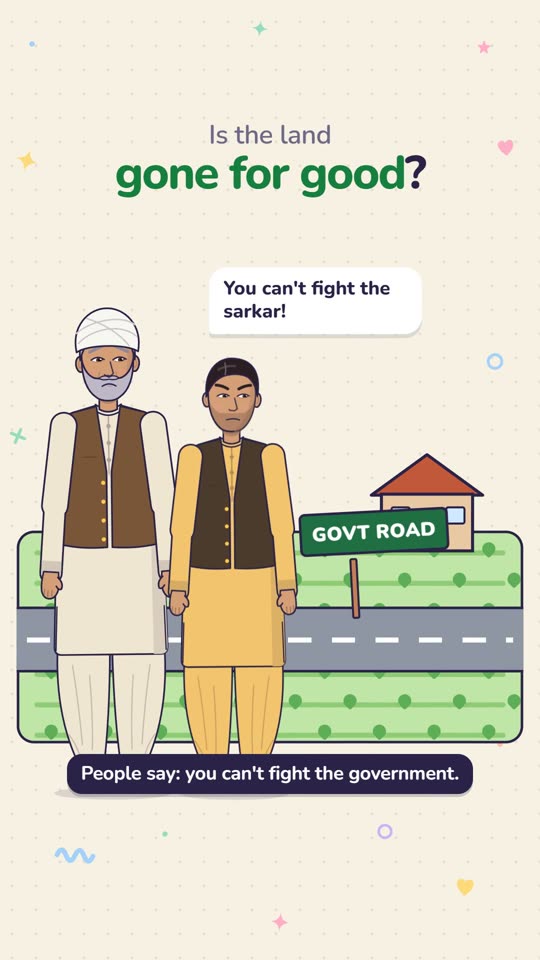
- The reel's opening scene, a GOVERNMENT LAND board slamming into a field while a seller says nobody can touch it, is a drawing of the common claim, not the case's own words.
Questions people ask
Can a registry be cancelled in Pakistan?
Yes. Under section 39 of the Specific Relief Act a person against whom a written instrument is void or voidable can sue to have it adjudged void and cancelled, and for a registered deed the court sends its decree to the registering officer. In March 2025 the Supreme Court kept a registered sale deed cancelled (Civil Appeal No. 671-L of 2013).
Is intiqal proof of ownership?
Not by itself. On 20 January 2026 the Supreme Court said mutation entries are primarily maintained for fiscal purposes and do not by themselves create, extinguish, or confer title (C.P.L.A. No. 1600-L of 2014, para 8).
What is the difference between a registry and an intiqal?
A registry is a sale deed registered with the registering officer, a public document with a presumption of truth that can be rebutted (March 2025, para 4). An intiqal is the mutation entry in the revenue record, kept mainly for fiscal purposes (January 2026, para 8).
How is a registry cancelled?
Through a civil suit asking the court to adjudge the deed void or voidable and to order it cancelled (Specific Relief Act, section 39). If the court decrees it, it sends a copy of its decree to the registering officer, who notes the cancellation. Time limits apply, so speak to a lawyer early.
If the owner says the sale was a fraud, who has to prove it?
In the March 2025 case, once the original owner alleged fraud, the buyers as beneficiaries had to prove the transaction was genuine; they produced neither the Registrar nor the bank record of the payment, and the deed stayed cancelled (para 4).
Can my intiqal be reversed?
It can be challenged. In the January 2026 case the buyers' mutation was reversed and the land resumed for the government, and the Supreme Court held that their suit failed because the seller's allotment was never proved (paras 6, 8 and 9).
Check yourself
True or false? “Registry and intiqal in my name, so nobody can touch it.”
Wrong: a court can undo both. Yes. A court can cancel a registry, and an intiqal on its own does not make anyone the owner. On 20 January 2026 the Supreme Court said "Mutation entries are primarily maintained for fiscal purposes and do not by themselves create, extinguish, or confer title", and buyers who held an intiqal in their names lost 66 kanals because the paper showing how their seller got the land never came to court (Supreme Court of Pakistan, C.P.L.A. No. 1600-L of 2014, paras 6, 8 and 13).
Next one: true or false? “Once the brothers sell the land, the sisters' share is gone.”
Sources
- A v. B (names withheld), C.P.L.A. No. 1600-L of 2014 (Supreme Court of Pakistan, 20 January 2026)
Mutation entries are primarily maintained for fiscal purposes and do not by themselves confer title; once disputed, the original transaction must be proved; the buyers' suit dismissed with costs. - A v. B (names withheld), Civil Appeal No. 671-L of 2013 (Supreme Court of Pakistan, 18 March 2025)
The presumption of truth attached to a registered sale deed is rebuttable; once fraud is alleged by the original owner, the beneficiaries must prove the transaction; the deed's cancellation restored. - Specific Relief Act, 1877, Section 39 text checked in FAI Statute Search, 6 November 2026 Pakistan Code
Every quote and section above is traced to the full judgment or statute text by an automatic check that runs on every update.
What the reel says
Read the words of the reel
Can a registry be cancelled? Registry and intiqal in your name, so nobody can touch it?
Registry cancel ho sakti hai kya? Registry aur intiqal naam hai to kya zameen mehfooz hai?
Wrong. The Supreme Court says: both can be undone.
A man said the government had allotted him 66 kanals. The intiqal was in his name. Some buyers bought it and got the intiqal in their names too. Then the government said: this is government land, and took it back. The buyers won in the High Court, but in January 2026 the Supreme Court said "Mutation entries are primarily maintained for fiscal purposes and do not by themselves create, extinguish, or confer title." The paper showing how the seller got the land never came to court, so the intiqal "could not become a substitute for title". The buyers lost, with costs.
And a registry? Strong proof, but it can be cancelled too: in March 2025 the Supreme Court kept one cancelled because the buyers could not prove the deal.
Buying land?
1. Check how the seller got it: the allotment, the inheritance or the earlier sale, all the way back.
2. Pay through the bank and keep the record.
3. For possible government land or a housing-scheme plot, ask the authority before you pay, and have a lawyer check the record.
Educational legal information, not legal advice. Every case turns on its own facts. Speak to a lawyer about your own case. Last checked: 6 November 2026. Review status: Pending advocate review. How we check.