Property and inheritance · Supreme Court of Pakistan
Sister's share in property: if the brothers sell it, who keeps the land?
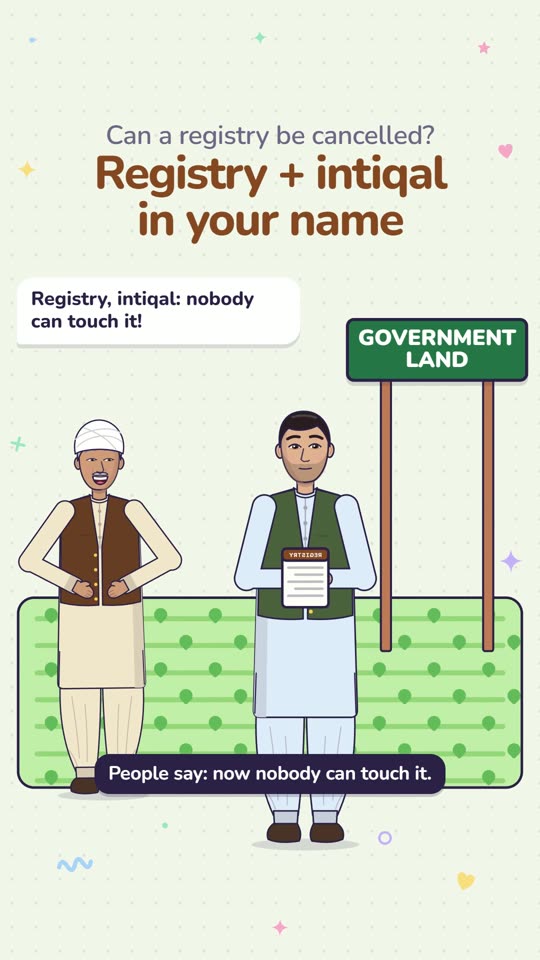
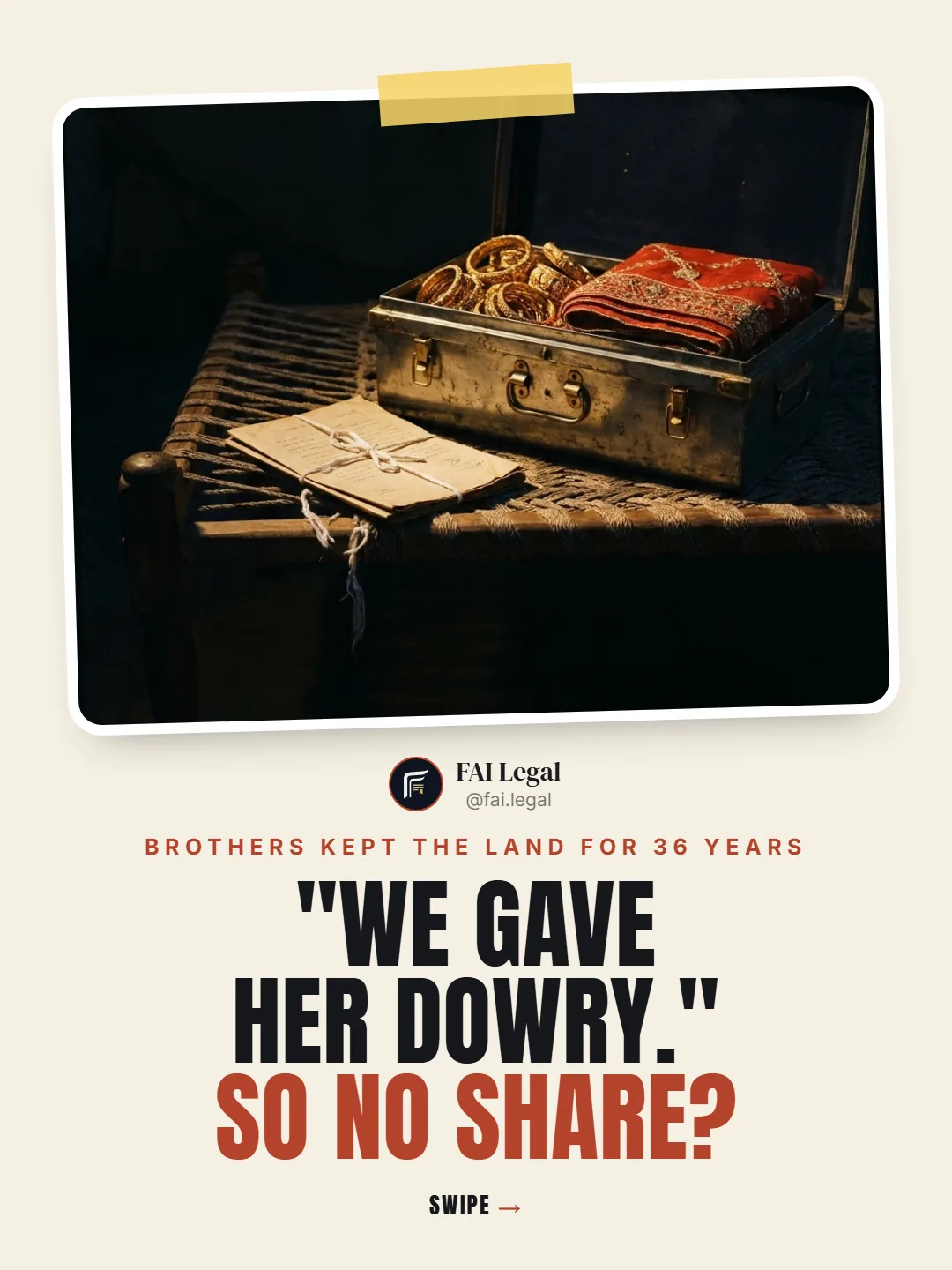
The myth: “Once the brothers sell the land, the sisters' share is gone.”Wrong: the buyers keep it, and the brothers pay the sisters
The short answer
Neither side loses: the good-faith buyers keep the land, and the brothers pay each sister her share with bank-rate profit.
A v. B (names withheld) · Supreme Court of Pakistan · Civil Appeals Nos. 10-Q and 1273 of 2021 · decided 31 March 2022
By the FAI Legal editorial desk · 9 November 2026 · 6 min read
A sister's share in her father's property is hers from the day he dies, even if her brothers sell the land. In a case from Quetta, two brothers sold part of their late father's land; the buyers had checked the land record, which showed the brothers as owners. On 31 March 2022 the Supreme Court decided that the buyers keep the land, and the brothers must pay each sister the equivalent of her share of the sale price, with mark-up at the bank rate from the date of sale until they pay.
The Court also held that the father's will, which gave the sons "the lion's share" and every business, was void: a will cannot be used to cut the daughters out. The buyers' protection has a limit too: it covers only a buyer who took reasonable care and acted in good faith.
Key points
- A will that favours the sons over the daughters is void: the wills were "contrary to the principles of Sharia and are, as a result, null and void" (para 12).
- The daughters' right is to a share of everything their father left, at his death: "The daughters were just as entitled as their brothers to a share in their father's businesses and other properties at the time the estate would have opened up" (para 12).
- A buyer who checked the land record and paid in good faith is protected: "the Purchasers exercised due diligence by approaching the revenue records for ascertaining title of the properties" (para 13; s.41, Transfer of Property Act).
- The brothers who sold pay the sisters in money: "The sons will pay mark up from the date of sale at the Bank rate to the daughters on their respective shares till the time of payment" (para 14).
- Everything else the parents left goes to all the sons and daughters by their shares under Sharia (para 14).
Sister's share in property: the short answer
Can a sister claim her share if her brothers have already sold the property? Yes. Her share is hers from the moment her father dies. If the land was sold to a buyer who checked the land record and paid in good faith, the Supreme Court has let that buyer keep it and made the brothers who sold it pay the sister her share of the price, with profit at the bank rate from the day of the sale. If the buyer did not act in good faith, the sale can be undone.
People search this as sister share in property in pakistan, right of sister in property, can sister claim brother's property and, in Roman Urdu, wirasat me behan ka hissa. How big each share is, and the steps to claim it, are in our guide to the daughters' share in a father's property: failegal.site/media/daughters-share-in-fathers-property-pakistan-legal-heirs.
Quetta, 1977: a will that left the daughters out
The father died on 2 June 1977. He left agricultural, residential and revenue-generating properties and businesses, and his heirs were his widow, two sons and four daughters (para 3). Two registered wills of 24 December 1970, by the father and the mother, had been acted upon in their lifetimes (paras 5 and 10).
The Court found that the father's will "has been drawn up with an obvious bias in favour of the sons. The sons have been given the lion's share in the inheritable pool of properties especially with respect to lucrative revenue-generating properties/businesses to the complete exclusion of the daughters" (para 12). The daughters said that "despite multiple requests, the brothers refused to partition the estate between the brothers and sisters according to their Quranic shares" (para 3).
Seventeen years in court
The daughters filed their suit for declaration, possession, partition and accounts on 13 December 2005. The trial court dismissed it on 21 March 2014. After a remand and a first trip to the Supreme Court, the High Court of Balochistan decreed the suit on 30 June 2021, and it also protected the people who had bought some of the properties from the brothers (para 3). Both sides appealed.
We checked it in FAI Legal
The judgment is on FAI Legal's Judgment Search, marked as a citation from the court record, with every paragraph open in the judgment reader. The paragraphs quoted on this page are paras 3, 12, 13 and 14. Section 41 of the Transfer of Property Act and section 498-A of the Pakistan Penal Code are on Statute Search.
You be the judge: the buyers or the sisters?
The buyers argued that they had bought in a lawful way and paid for the land, at a time when the brothers' right came from wills nobody had challenged. The Court tested that against section 41 of the Transfer of Property Act, which protects a transfer by an "ostensible owner" where the buyer, "after taking reasonable care to ascertain that the transferor had power to make the transfer, has acted in good faith". All four parts must exist together: an ostensible owner, the consent of the real owners, payment, and good faith with reasonable care (para 13).
Here they did: the mutations were in the sons' names under the unchallenged wills, the buyers paid, and "the Purchasers exercised due diligence by approaching the revenue records for ascertaining title of the properties" (para 13). So the Court held that "despite the fact that sale by the sons was unauthorized and voidable, the sale per se could not be set aside or annulled" against the buyers (para 14).
And the sisters lost nothing: "The only viable solution appears to be that the sons be directed to pay for the equivalent of respective shares of the daughters in the said property in monetary terms". The sale price was on record, and the sons had kept and used all of it, so "The sons will pay mark up from the date of sale at the Bank rate to the daughters on their respective shares till the time of payment" (para 14). Everything else in the estate goes to all the sons and daughters by their shares under Sharia (para 14).
Why the will could not cut the daughters out
The Court relied on two rules of Muslim law as Mullah's Mohammadan Law states them: a bequest to an heir is not valid unless the other heirs consent after the testator's death, and a Muslim cannot bequeath more than a third of the estate (para 11). A will that settles the heirs' shares in advance, in favour of some of them, cannot stand: "The daughters were just as entitled as their brothers to a share in their father's businesses and other properties at the time the estate would have opened up" (para 12). Both wills "are contrary to the principles of Sharia and are, as a result, null and void" (para 12). For the one-third rule in more detail, see failegal.site/media/wasiyat.
Find rulings like this on FAI Legal
FAI Legal is a website: open failegal.site in your phone's browser, there is nothing to download. Ask your question in plain words, read section 41 on Statute Search, and see this judgment in full on Judgment Search. Your case may be different: talk to a lawyer about your own family's property.
The case at a glance
- Facts
- The father died on 2 June 1977, leaving properties and businesses to his widow, two sons and four daughters; registered wills of 1970 favoured the sons; the brothers sold some properties to buyers; the daughters sued on 13 December 2005; the trial court dismissed the suit on 21 March 2014 and the High Court decreed it on 30 June 2021, protecting the buyers (paras 3, 5, 10).
- The question
- Whether the wills complied with Sharia, what followed for the heirs if they did not, and whether the daughters' inheritance rights override the protection of bona fide purchasers under section 41 of the Transfer of Property Act (para 9).
- What the Court held
- The wills were void; the purchasers were protected under section 41; the sons must pay the daughters the equivalent of their shares in the sold property, with mark-up from the date of sale at the bank rate until payment; the rest of the estate devolves on all the sons and daughters by Sharia. The daughters' appeal was partly allowed and the sons' appeal and the contempt appeal were dismissed (paras 12 to 18).
- Why
- A will that regulates heirs' shares in advance in favour of some heirs is not Sharia-compliant (paras 11 and 12); the four ingredients of section 41 co-existed, the buyers having checked the revenue records, which showed the sons as owners under unchallenged wills (para 13); the sale was unauthorized and voidable but could not be set aside against bona fide purchasers, so the sons, who received and used the whole price, pay the daughters in money with mark-up (para 14).
- Limits
- The buyers were protected because all four parts of section 41 were met, including reasonable care and good faith; a buyer who did not check, or knew of the sisters' rights, may not be protected. The Court did not decide the sons' late claim that some properties were bought with their own money, because it was not raised in the lower courts (para 15).
The law it relies on
Where, with the consent of the persons interested in immovable property, a person is its ostensible owner and transfers it for consideration, the transfer is not voidable on the ground that he was not authorised to make it, provided the transferee, after taking reasonable care to ascertain that the transferor had power to make the transfer, has acted in good faith.
Whoever by deceitful or illegal means deprives any woman from inheriting any movable or immovable property at the time of opening of succession: imprisonment of five to ten years, or a fine of one million rupees, or both. Not part of this judgment; it is the criminal side of the same wrong.
What this does not mean
- It does not mean brothers can sell a sister's share and simply pay her later: the buyers here were protected only because they checked the record and acted in good faith, and the brothers had to pay mark-up from the date of sale. Depriving a woman of her inheritance by deceitful or illegal means is also a crime under section 498-A PPC.
- It does not mean every buyer is safe: section 41 protects a buyer only when all four parts are met, including reasonable care and good faith.
- It does not mean a Muslim can never make a will: a bequest to a non-heir of up to a third is allowed; what this will could not do was favour some heirs over others.
- The reel's opening scene, a field with a SOLD board, is a drawing of the question, not the case's own scene; the case concerned several properties and businesses in Quetta.
Questions people ask
Can a sister claim her share if her brother has already sold the property?
Yes. Her share is hers from her father's death. In this 2022 case the Supreme Court let buyers who had checked the land record in good faith keep the land, and made the brothers pay each sister her share of the price with mark-up at the bank rate from the date of sale (Civil Appeals Nos. 10-Q and 1273 of 2021, para 14).
Can a father give all his property to his sons by will in Pakistan?
No. Under Muslim law a bequest to an heir is not valid unless the other heirs consent after the death, and a will cannot go beyond one third of the estate. The Supreme Court held a will that gave the sons the lion's share to the exclusion of the daughters null and void (para 12).
What is a bona fide purchaser?
A buyer who paid for the property and, after taking reasonable care to check that the seller could sell, acted in good faith. Section 41 of the Transfer of Property Act protects such a buyer when the seller was the ostensible owner with the consent of the real owners.
Is denying a sister her inheritance a crime?
Yes. Under section 498-A of the Pakistan Penal Code, depriving a woman of inheriting property by deceitful or illegal means is punishable with five to ten years' imprisonment, or a fine of one million rupees, or both.
Wirasat me behan ka hissa bech diya jaye to kya hoga?
Behan ka hissa walid ki wafat se uska hai. Is faisle mein Supreme Court ne kaha ke jin khareedaron ne neik niyati se record dekh kar qeemat di, zameen unki rahegi, aur bhai har behan ko qeemat mein se uska hissa bank rate par munafe ke sath denge (31 March 2022).
Check yourself
True or false? “Once the brothers sell the land, the sisters' share is gone.”
Wrong: the buyers keep it, and the brothers pay the sisters. Neither side loses: the good-faith buyers keep the land, and the brothers pay each sister her share with bank-rate profit.
Next one: true or false? “If a sister didn't ask for her share for years, it's gone.”
Sources
- A v. B (names withheld), Civil Appeals Nos. 10-Q and 1273 of 2021 (Supreme Court of Pakistan, 31 March 2022)
A will favouring the sons is void; buyers who checked the revenue record in good faith are protected under s.41 TPA; the sons pay the daughters the equivalent of their shares with mark-up at the bank rate from the date of sale. - Transfer of Property Act, 1882, Section 41 text checked in FAI Statute Search, 9 November 2026 Pakistan Code
- Pakistan Penal Code, 1860, Section 498-A text checked in FAI Statute Search, 9 November 2026 Pakistan Code
Every quote and section above is traced to the full judgment or statute text by an automatic check that runs on every update.
What the reel says
Read the words of the reel
Sister's share in property: if the brothers sell it, who keeps the land?
You be the judge. In Quetta a father died in 1977. His will gave his sons the lion's share and every business. In 2005 the sisters went to court. The trial court said no; in 2021 the High Court said the sisters were right. But the brothers had already sold land, and the buyers said: we checked the land record, it showed the brothers, and we paid.
On 31 March 2022 the Supreme Court said neither side loses.
1. The will was void: a will can't cut the daughters out.
2. The buyers keep the land: they checked the record and paid in good faith (Transfer of Property Act, s.41).
3. The brothers pay each sister her share of the sale price, plus profit at the bank rate from the day of the sale.
4. Everything else the parents left is shared by Sharia among all the sons and daughters.
The limit: only a buyer who checked in good faith is safe; otherwise the sale can be undone. For your own case, talk to a lawyer.
Full story: failegal.site/media/sister-share-in-property-sold-by-brother-2022 Was the court fair to both sides? Tell us in the comments, no names.
Educational legal information, not legal advice. Every case turns on its own facts. Speak to a lawyer about your own case. Last checked: 9 November 2026. Review status: Pending advocate review. How we check.