Courts and procedure · For citizens (anyone who signs an affidavit for a court)
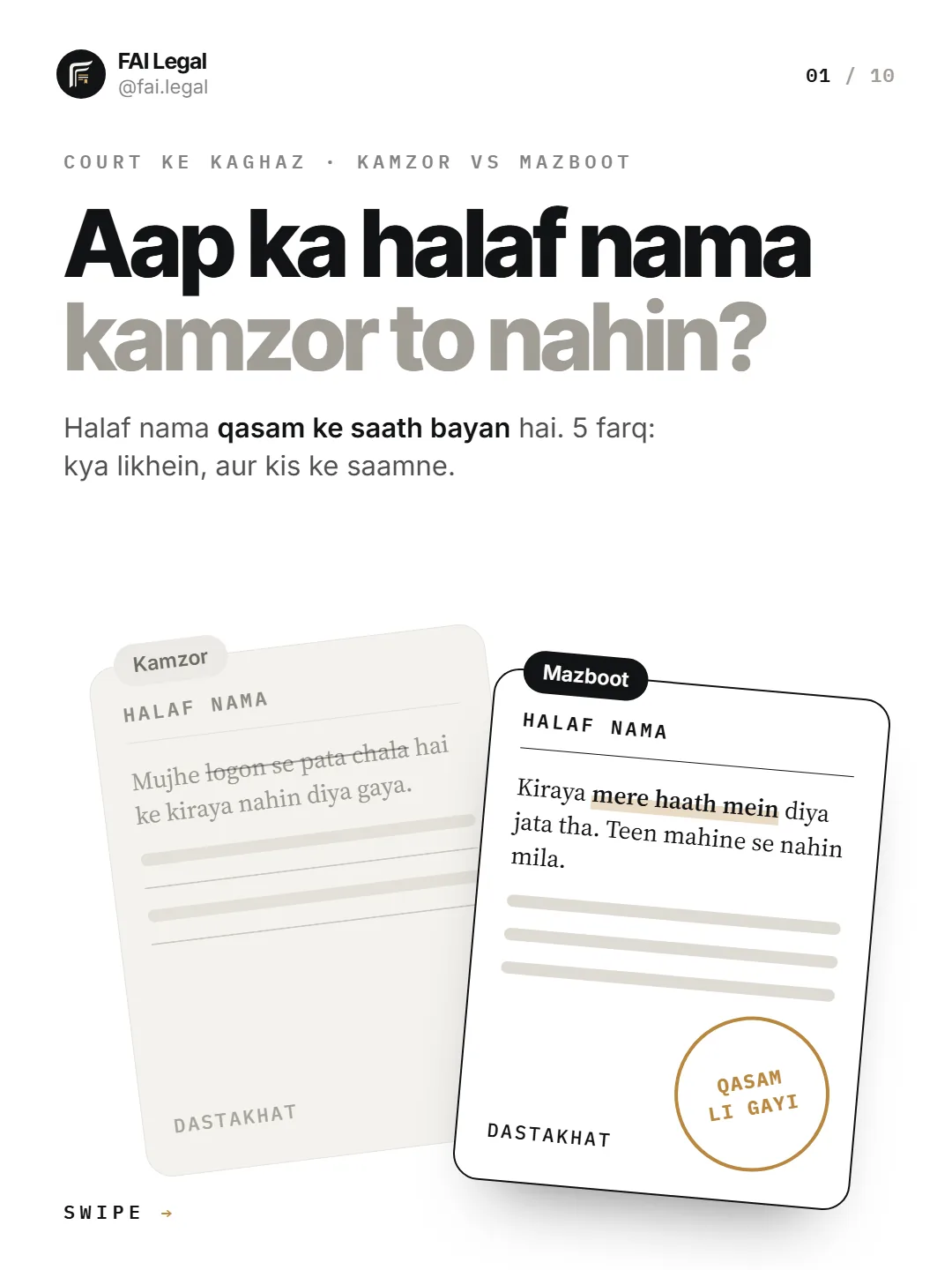
Aap ka halaf nama kamzor to nahin?
In short
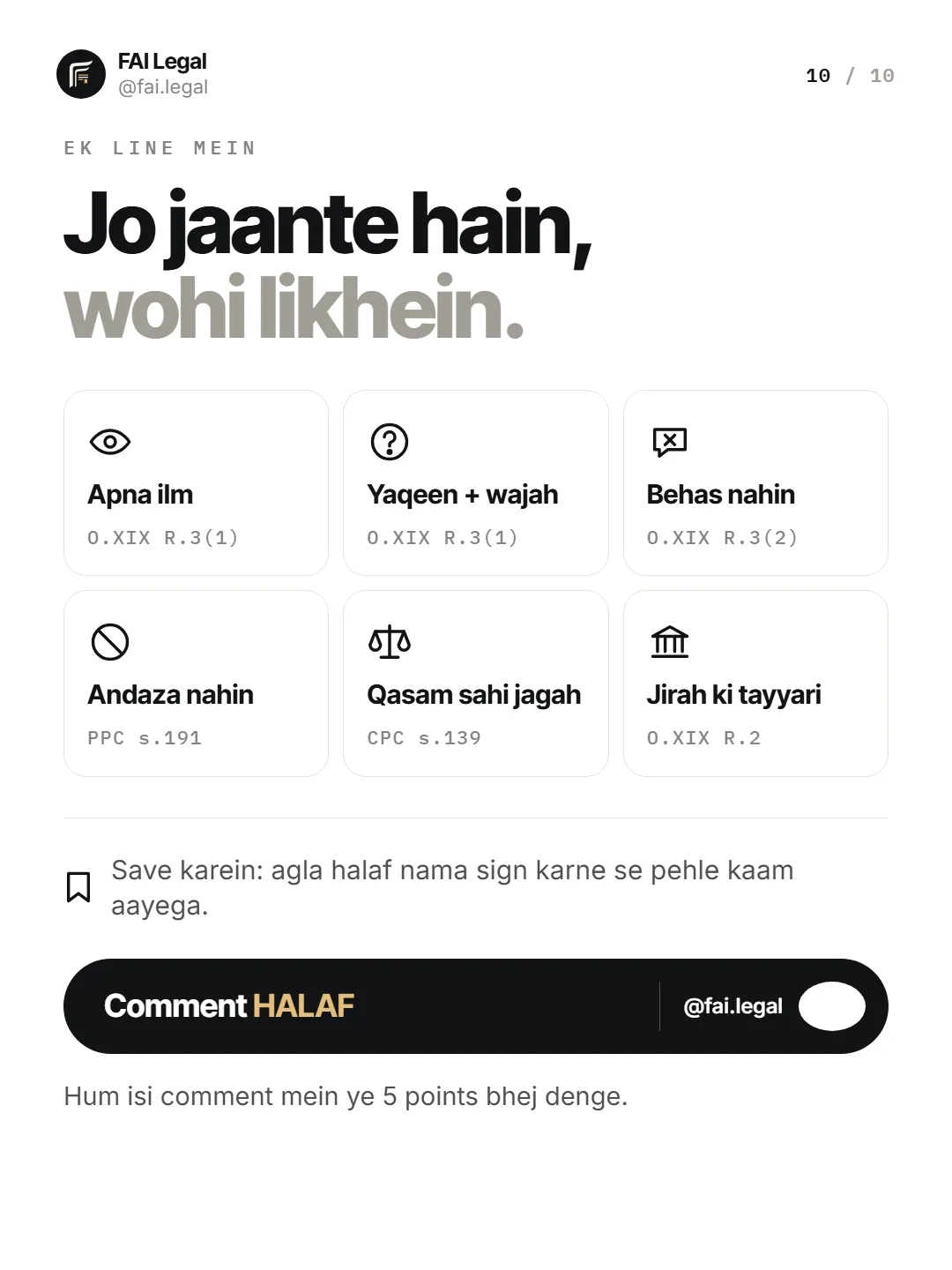
An affidavit is a statement on oath, not a form. The Civil Procedure Code confines it to facts you can prove from your own knowledge; belief is allowed only on interim applications, and only with its grounds. Hearsay and argument can cost you the affidavit's costs, the court can call you for cross-examination, and saying you know or believe what you don't is false evidence (PPC sections 191 and 193).
By the FAI Legal editorial desk · 20 November 2026 · 10 slides · 4 min read
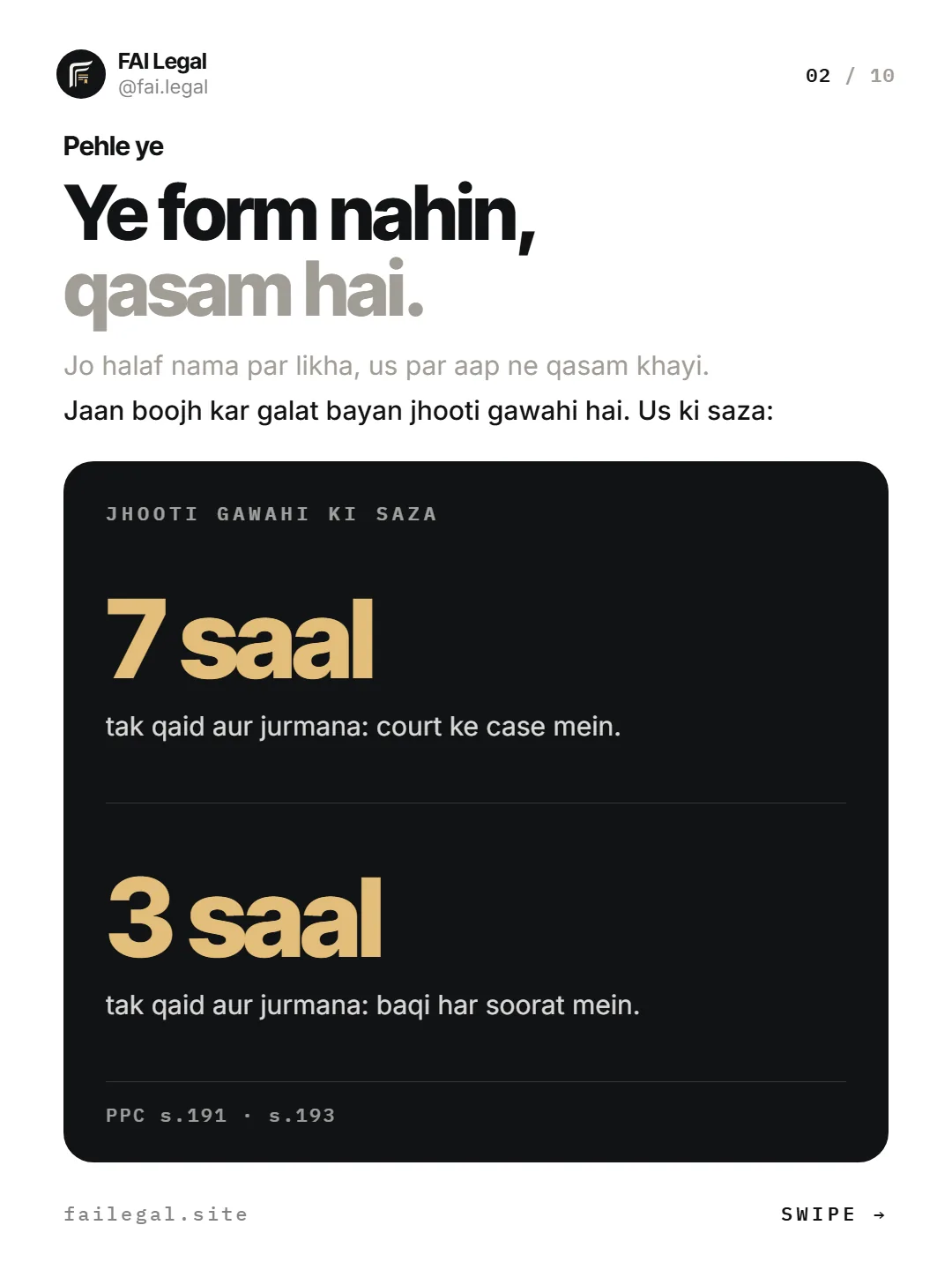
Ye form nahin, qasam hai.
Jo halaf nama par likha, us par aap ne qasam khayi.Jaan boojh kar galat bayan jhooti gawahi hai. Us ki saza:
“Whoever being legally bound by an oath or by an express provision of law to state the truth, or being bound by law to make a declaration upon any subject, makes any statement which is false, and which he either knows or believes to be false or does not believe to be true, is said to give false evidence.”
Pakistan Penal Code, 1860 · Section 191, Giving false evidence
“Whoever intentionally gives false evidence in any stage of a judicial proceeding … shall be punished with imprisonment of either description for a term, which may extend to seven years, and shall also be liable to fine; and whoever, intentionally gives or fabricates false evidence in any other case, shall be punished with imprisonment of either description for a term which may extend to three years, and shall also be liable to fine.”
Pakistan Penal Code, 1860 · Section 193, Punishment for false evidence
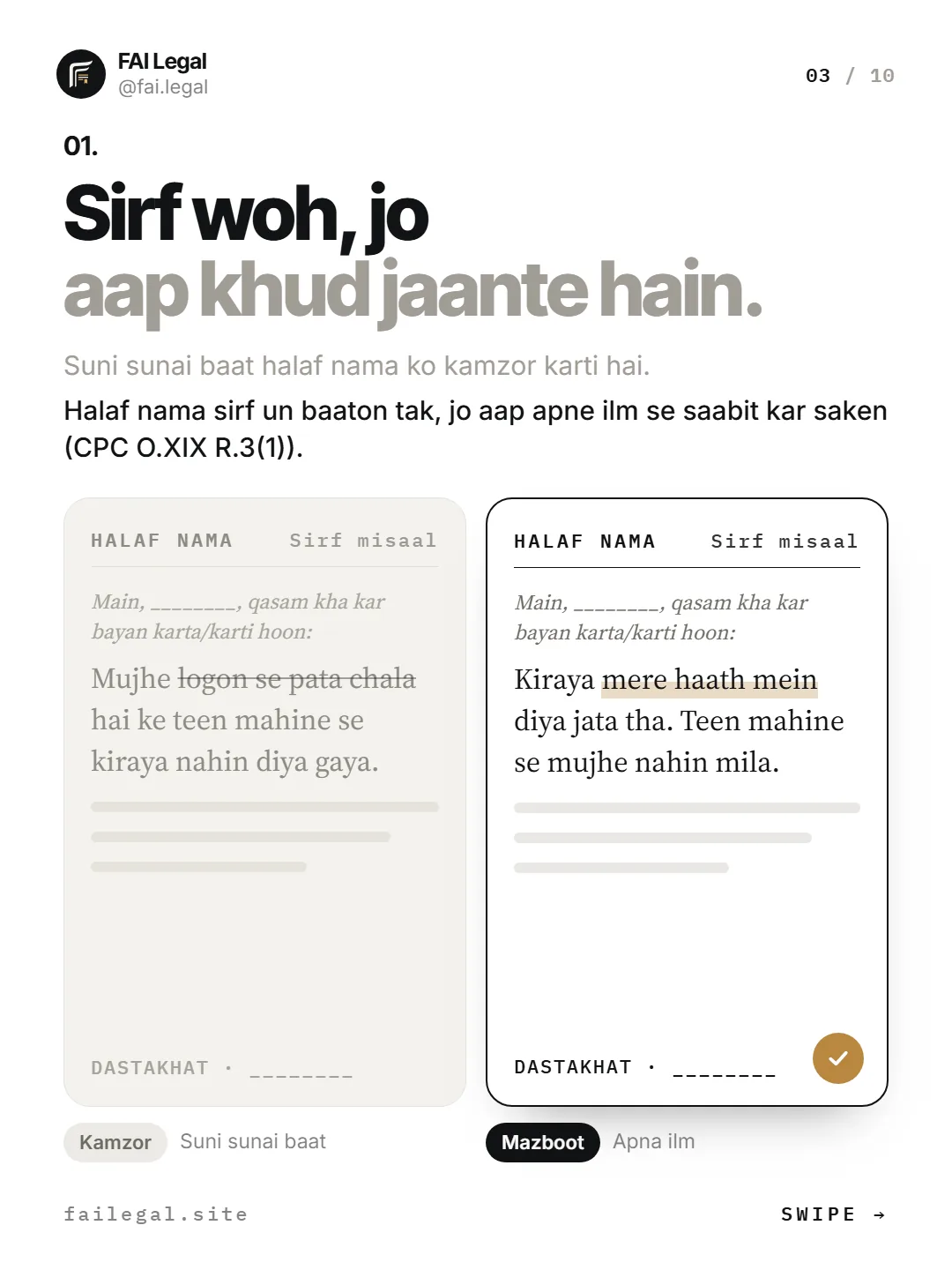
Sirf woh, jo aap khud jaante hain.
Suni sunai baat halaf nama ko kamzor karti hai.Halaf nama sirf un baaton tak, jo aap apne ilm se saabit kar saken (CPC O.XIX R.3(1)).
“Affidavits shall be confined to such facts as the deponent is able of his own knowledge to prove, except on interlocutory applications, on which statements of his belief may be admitted: Provided that the grounds thereof are stated.”
Code of Civil Procedure, 1908 · Order XIX Rule 3(1), Matters to which affidavit shall be confined
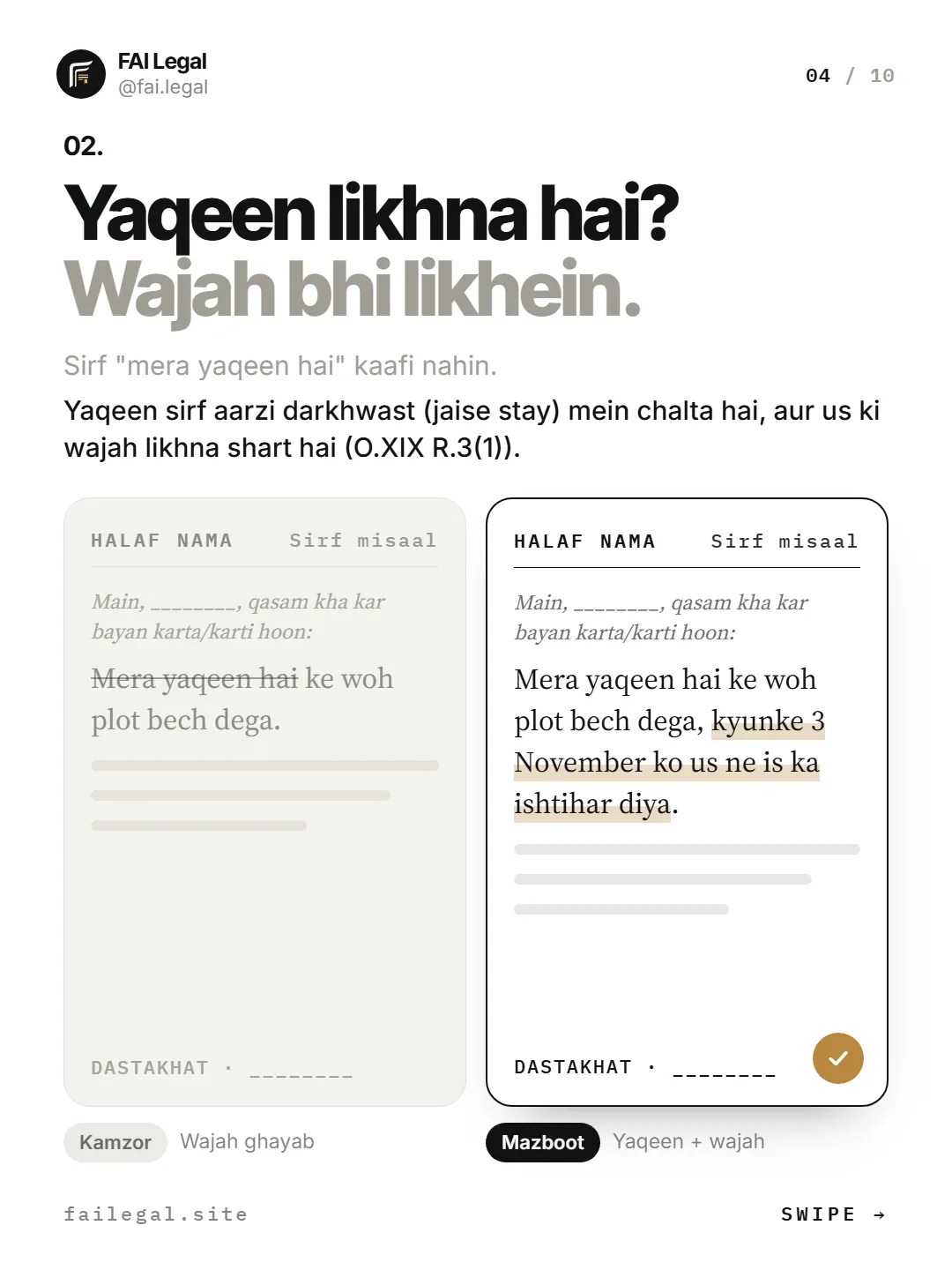
Yaqeen likhna hai? Wajah bhi likhein.
Sirf "mera yaqeen hai" kaafi nahin.Yaqeen sirf aarzi darkhwast (jaise stay) mein chalta hai, aur us ki wajah likhna shart hai (O.XIX R.3(1)).
“except on interlocutory applications, on which statements of his belief may be admitted: Provided that the grounds thereof are stated.”
Code of Civil Procedure, 1908 · Order XIX Rule 3(1), Matters to which affidavit shall be confined
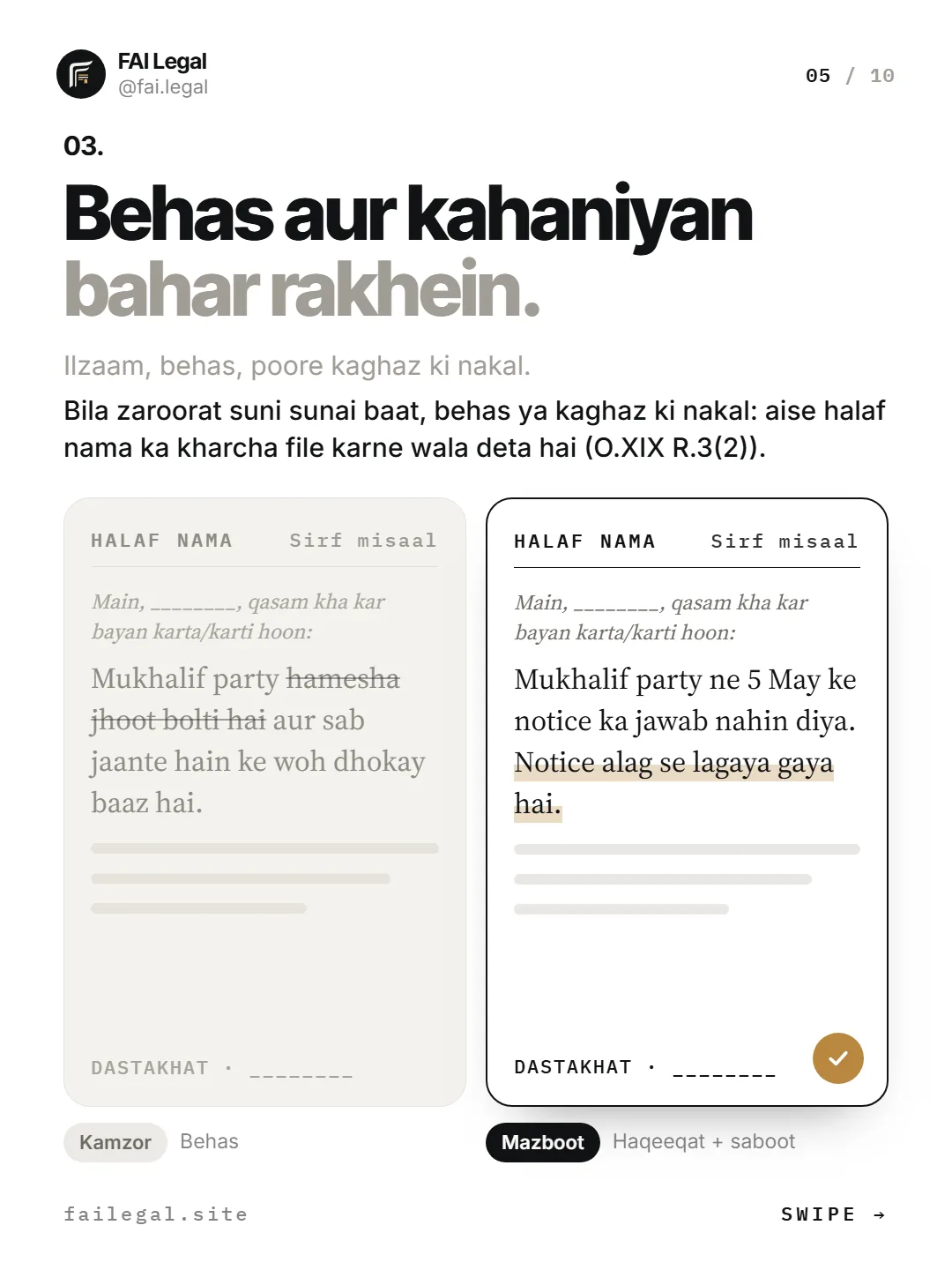
Behas aur kahaniyan bahar rakhein.
Ilzaam, behas, poore kaghaz ki nakal.Bila zaroorat suni sunai baat, behas ya kaghaz ki nakal: aise halaf nama ka kharcha file karne wala deta hai (O.XIX R.3(2)).
“The cost of every affidavit which shall unnecessarily set forth matter of hearsay or argumentative matter, or copies of or extracts from documents, shall (unless the Court otherwise directs) be paid by the party filing the same.”
Code of Civil Procedure, 1908 · Order XIX Rule 3(2), Matters to which affidavit shall be confined
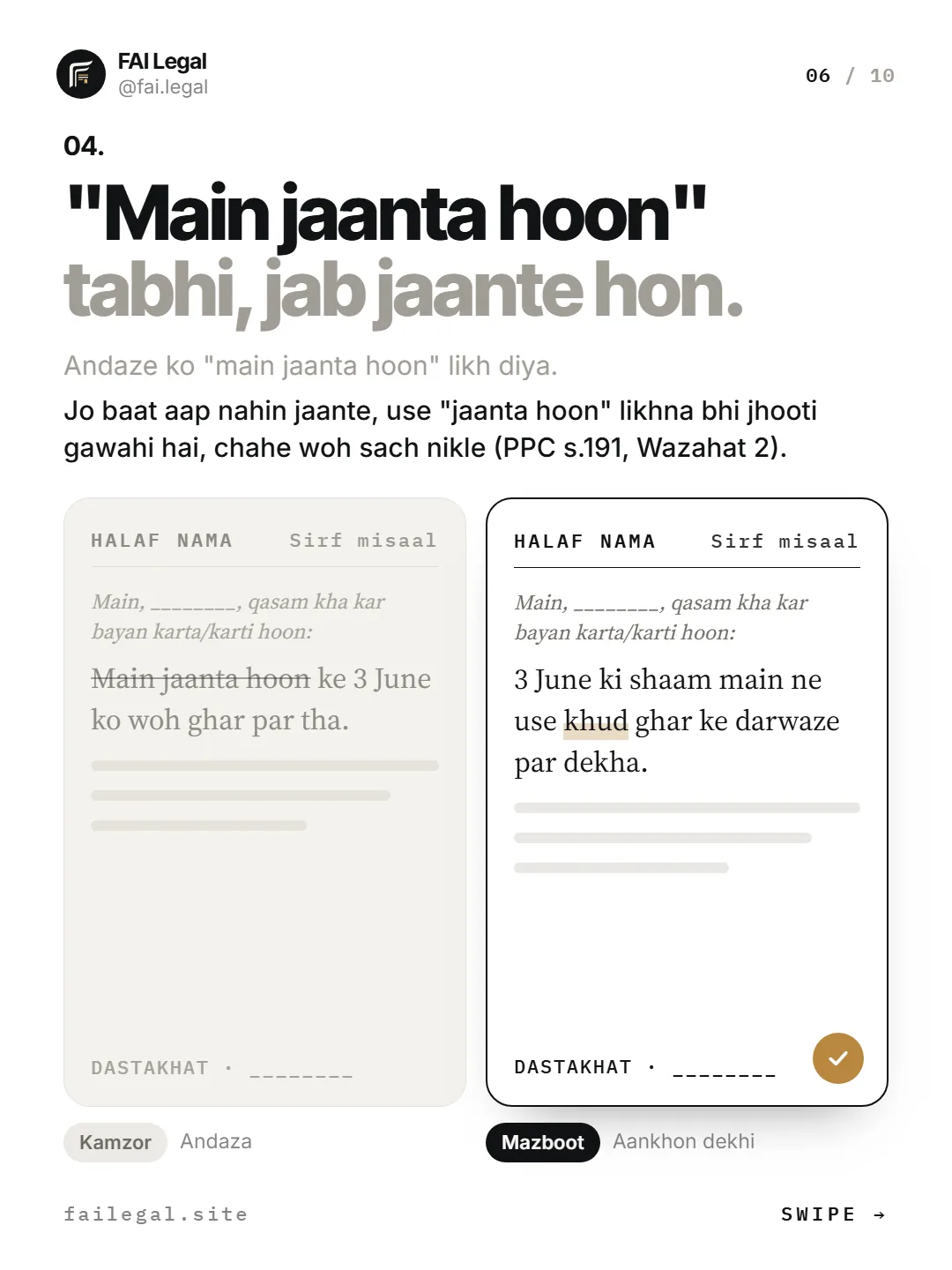
"Main jaanta hoon" tabhi, jab jaante hon.
Andaze ko "main jaanta hoon" likh diya.Jo baat aap nahin jaante, use "jaanta hoon" likhna bhi jhooti gawahi hai, chahe woh sach nikle (PPC s.191, Wazahat 2).
“A false statement as to the belief of the person attesting is within the meaning of this section, and a person may be guilty of giving false evidence by stating that he believes a thing which he does not believe, as well as by stating that he knows a thing which he does not know.”
Pakistan Penal Code, 1860 · Section 191, Giving false evidence, Explanation 2
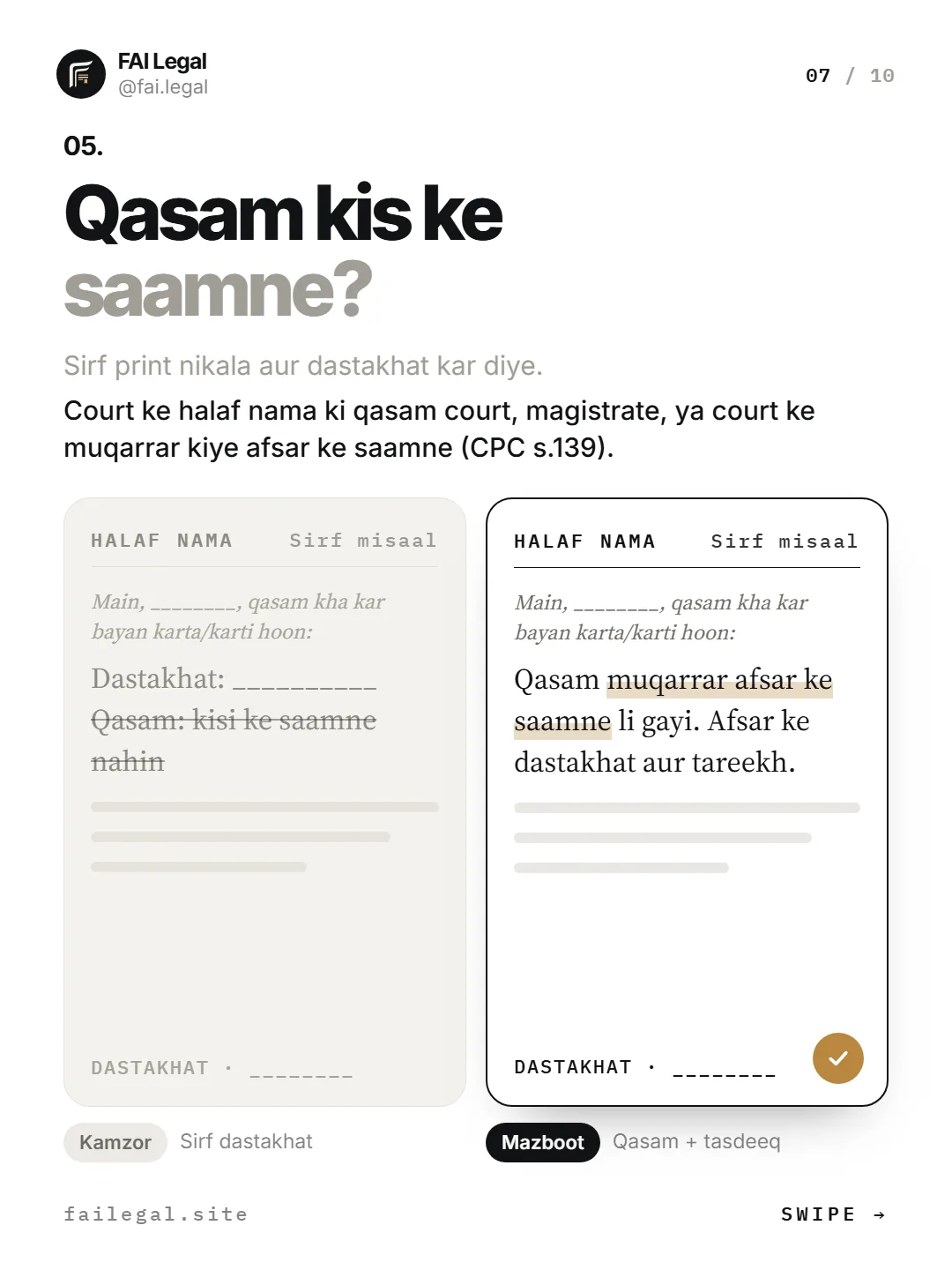
Qasam kis ke saamne?
Sirf print nikala aur dastakhat kar diye.Court ke halaf nama ki qasam court, magistrate, ya court ke muqarrar kiye afsar ke saamne (CPC s.139).
“In the case of any affidavit under this Code … any Court or Magistrate, or … any officer or other person whom a High Court may appoint in this behalf … may administer the oath to the deponent.”
Code of Civil Procedure, 1908 · Section 139, Oath on affidavit by whom to be administered
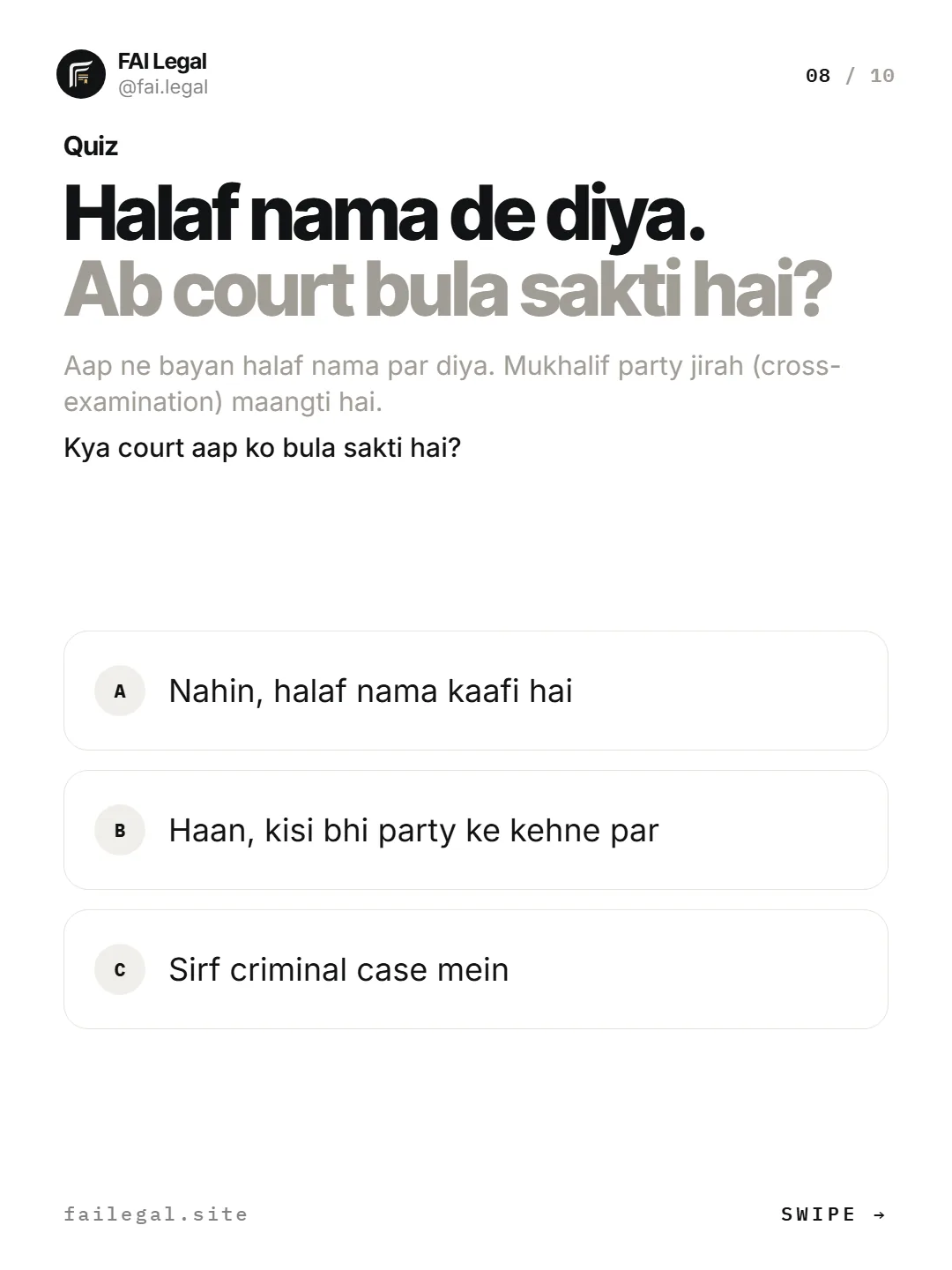
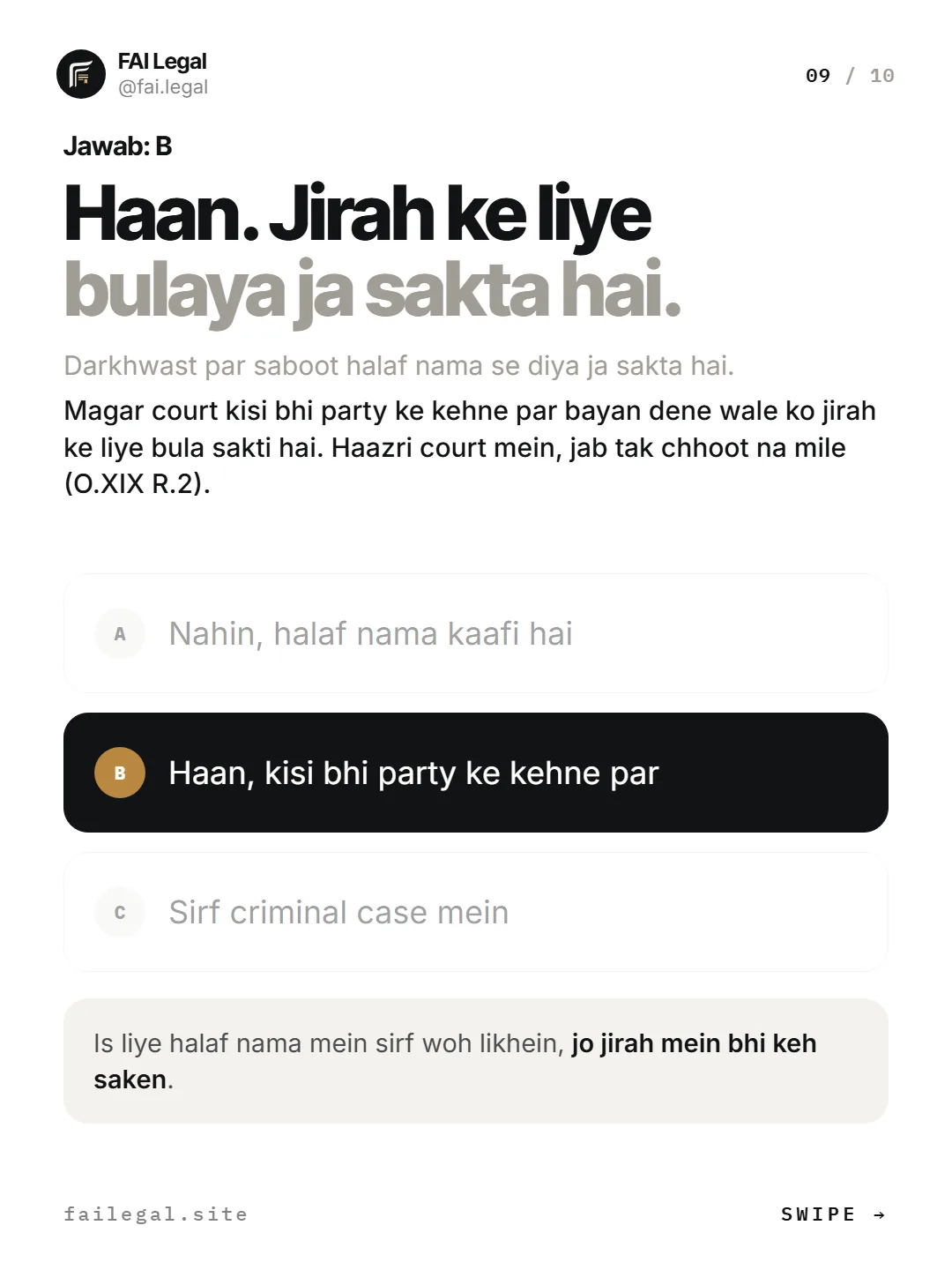
Halaf nama de diya. Ab court bula sakti hai?
Aap ne bayan halaf nama par diya. Mukhalif party jirah (cross-examination) maangti hai.Kya court aap ko bula sakti hai?
Haan. Jirah ke liye bulaya ja sakta hai.
Darkhwast par saboot halaf nama se diya ja sakta hai.Magar court kisi bhi party ke kehne par bayan dene wale ko jirah ke liye bula sakti hai. Haazri court mein, jab tak chhoot na mile (O.XIX R.2).
“Upon any application evidence may be given by affidavit, but the Court may, at the instance of either party, order the attendance for cross-examination of the deponent. … Such attendance shall be in Court, unless the deponent is exempted from personal appearance in Court, or the Court otherwise directs.”
Code of Civil Procedure, 1908 · Order XIX Rule 2, Power to order attendance of deponent for cross-examination
What this does not mean
- It does not mean you can never state a belief. On interlocutory applications a statement of belief may be admitted, provided its grounds are stated (CPC Order XIX Rule 3(1)).
- It does not cover every affidavit you sign. These are the Civil Procedure Code's rules for affidavits in civil courts; an office such as NADRA or the passport office may use its own forms and rules, which were not checked here.
- It does not mean an affidavit always takes the place of your evidence. The court may order you to attend for cross-examination at either party's request (CPC Order XIX Rule 2).
Questions people ask
How do you make an affidavit for a court in Pakistan?
Write only the facts you can prove from your own knowledge (CPC Order XIX Rule 3(1)). A statement of belief is allowed only on interlocutory applications, and only with its grounds stated. Leave out hearsay, argument and copies of documents: the party filing such an affidavit pays its costs unless the court directs otherwise (Rule 3(2)). Then swear it before a person who may administer the oath (section 139).
Who can administer the oath on an affidavit?
For an affidavit under the Civil Procedure Code: any court or magistrate; an officer or other person whom a High Court appoints for this; or an officer appointed by any other court that the Provincial Government has empowered (CPC section 139).
What is the penalty for a false affidavit in Pakistan?
Intentionally giving false evidence in any stage of a judicial proceeding is punishable with imprisonment of up to seven years and fine; in any other case, up to three years and fine (PPC section 193). Giving false evidence includes a false statement made while legally bound by an oath to state the truth (section 191).
Is it false evidence to write "I believe" or "I know" about something you are not sure of?
It can be. Under PPC section 191, Explanation 2, a person may give false evidence by stating that he believes a thing which he does not believe, as well as by stating that he knows a thing which he does not know. Illustration (d) shows it is false evidence even if the thing turns out to be true.
Can the court call me after I file an affidavit?
Yes. On any application evidence may be given by affidavit, but the court may, at the instance of either party, order the deponent to attend for cross-examination. The attendance is in court unless the deponent is exempted from personal appearance or the court directs otherwise (CPC Order XIX Rule 2).
Sources
- Pakistan Penal Code, 1860 · Section 191
Giving false evidence Pakistan Code - Pakistan Penal Code, 1860 · Section 193
Punishment for false evidence Pakistan Code - Code of Civil Procedure, 1908 · Order XIX Rule 3(1)
Matters to which affidavit shall be confined Pakistan Code - Code of Civil Procedure, 1908 · Order XIX Rule 3(2)
Matters to which affidavit shall be confined Pakistan Code - Code of Civil Procedure, 1908 · Section 139
Oath on affidavit by whom to be administered Pakistan Code - Code of Civil Procedure, 1908 · Order XIX Rule 2
Power to order attendance of deponent for cross-examination Pakistan Code
Educational legal information, not legal advice. Every case turns on its own facts. Speak to a qualified lawyer about your situation. Review status: Pending advocate review. How we check.