Criminal law · Balochistan High Court
406, 420, 489-F and 9C punishment in Pakistan
The myth: “406, 420, 489-F and 9C all mean seven years.”Half right: 406 and 420 carry up to 7 years, 489-F up to 3, and 9C goes by drug and weight
The short answer
Two of them carry up to seven years, one up to three, and the fourth now goes by the drug and its weight. The date of the offence decides which table applies.
A v. The State (name withheld) · Balochistan High Court · Criminal Jail Appeal No. 63 of 2022 · decided 16 June 2023
By the FAI Legal editorial desk · 12 November 2026 · 7 min read
In Pakistan, section 406 of the Penal Code (criminal breach of trust) and section 420 (cheating) each carry up to seven years; section 489-F (a dishonest cheque that bounces) carries up to three years, or a fine, or both; and a "9C" narcotics case is now punished by the drug and its weight, under the table that came in on 6 September 2022. That table applies only to offences committed after it: the Balochistan High Court said so on 16 June 2023.
This page answers a question our followers sent us: what the section numbers on their papers mean. Our earlier piece on umar qaid covers 302 and 324.
Key points
- Section 406, criminal breach of trust: up to seven years, or a fine, or both.
- Section 420, cheating: up to seven years, and a fine as well.
- Section 489-F, a dishonest cheque for a loan or an obligation that bounces: up to three years, or a fine, or both.
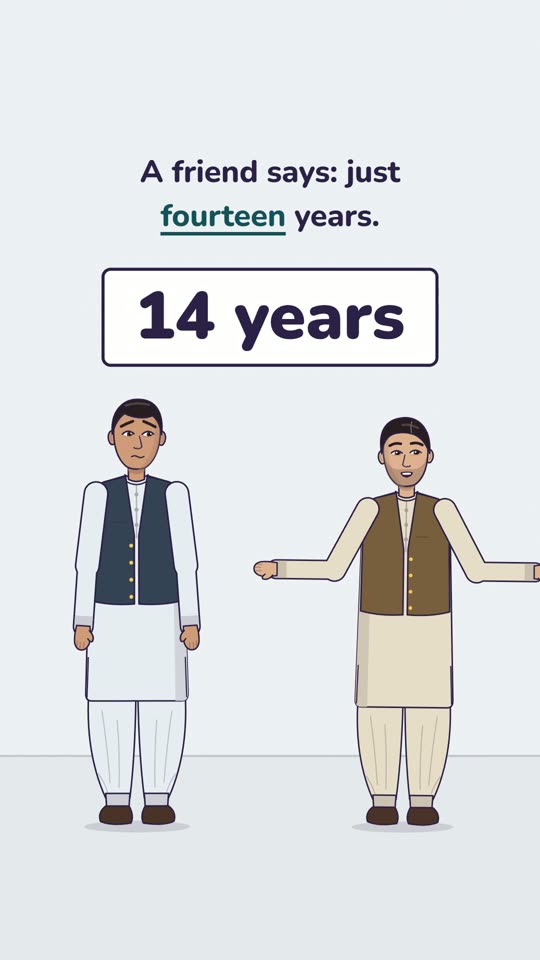
- 9C: since 6 September 2022 the punishment goes by the drug and its weight. Charas from 1,000 to 4,999 grams: nine to fourteen years; 10,000 grams or more: twenty years to life, and life under this Act means twenty-five years in jail.
- The date of the offence decides the table: "the newly inserted amendment made through the Act of 2022 could not be retrospectively applied and enforced" (Balochistan High Court, para 9).
406, 420, 489-F and 9C punishment in Pakistan: the short answer
They do not all mean seven years. Sections 406 and 420 of the Pakistan Penal Code each allow up to seven years. Section 489-F allows up to three years, or a fine, or both. And "9C", the name people use for a narcotics case, now means a table: since 6 September 2022 the punishment depends on the drug and its weight. Seven years is also a ceiling, not a fixed sentence: a court can give less.
People search this as dafa 420 kya hai, 406 ppc in urdu, 489 f ppc punishment in urdu, 9c case kya hota hai and 9c case punishment in pakistan. The answers for all four are on this page, with the law's own words checked in FAI Legal.
Section 406: criminal breach of trust
Section 405 of the Penal Code describes the offence: someone is entrusted with property, or with control over it, and dishonestly misappropriates it or converts it to his own use. Section 406 punishes it with imprisonment of up to seven years, or a fine, or both.
Whether an unpaid loan can be a case under 406 is a separate question: see our FAI Media pieces on criminal breach of trust and on a 406 FIR for a loan that was not returned.
Section 420: cheating
Section 415 defines cheating: deceiving a person and so fraudulently or dishonestly inducing them to deliver property. Section 420 punishes cheating that induces delivery of property with imprisonment of up to seven years, and the offender is also liable to a fine.
When a broken deal is only a civil dispute and when it is cheating is covered in our FAI Media piece on cheating under section 420.
Section 489-F: a cheque that bounces
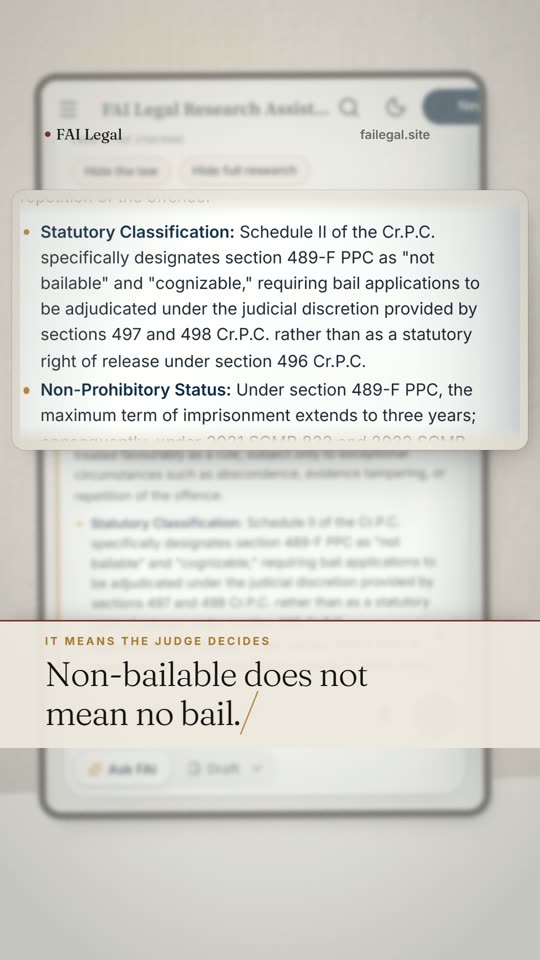
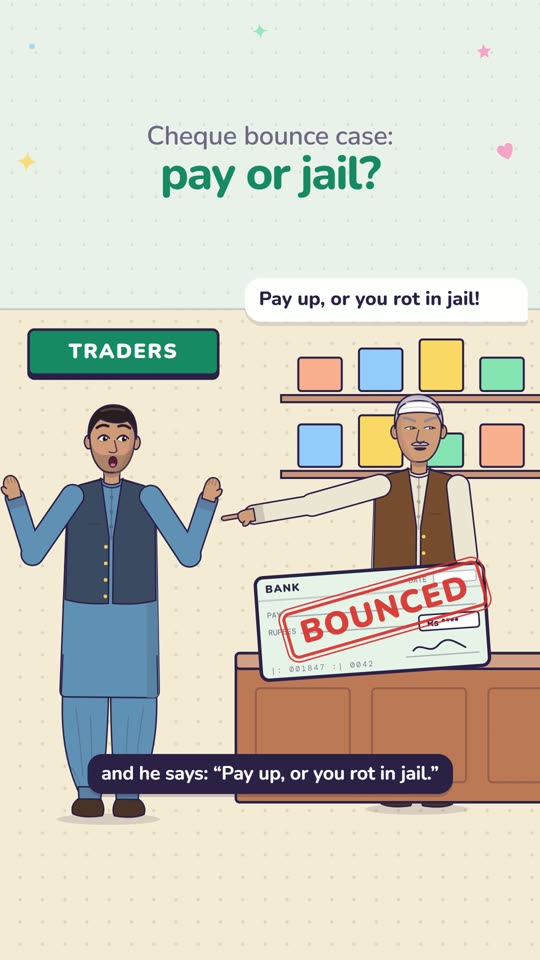
Section 489-F covers a person who dishonestly issues a cheque towards repayment of a loan or fulfilment of an obligation, and the cheque is dishonoured on presentation. The punishment is imprisonment of up to three years, or a fine, or both. It is not an offence if he shows that he had made arrangements with his bank to ensure payment and that the bank was at fault.
Bail and the defence in a cheque bounce case have their own FAI Media pieces: cheque bounce punishment, bail in 489-F cases, and the three elements of the offence.
9C: the narcotics table since 6 September 2022
"9C case" is the name people use for a narcotics case, after clause (c) of the old section 9 of the Control of Narcotic Substances Act, 1997. The Control of Narcotic Substances (Amendment) Act 2022, promulgated on 6 September 2022, replaced section 9 with a table: the punishment now depends on the substance and its quantity.
For charas, the High Court summarised the new band for 1,000 to 4,999 grams: "the imprisonment may extend to fourteen years and it shall not be less than nine years along with a fine, which may be up to Rs.400,000/- but not less than Rs.80,000/-." (para 9). For 10,000 grams or more, the table says the imprisonment may extend to life imprisonment but shall not be less than twenty years. Under section 9A(3), imprisonment for life under this Act means imprisonment in jail for twenty-five years.
Bail in a 9C case and the rules on keeping the samples safe have their own FAI Media pieces.
The case: Hub, June 2022
On 12 June 2022 police on patrol at Balochabad Hub stopped a man in the street who tried to run. In the polythene sack he was holding they found three packets of charas of 1,000 grams each, 3,000 grams in all (para 5).
The trial court, the Special Judge at Hub, decided the case on 26 September 2022. It convicted him and sentenced him to nine years of rigorous imprisonment and a fine of Rs 80,000 (para 1), the new minimum for that weight under the table of 6 September 2022 (para 9).
We read it in FAI Legal
The judgment is on FAI Legal's Judgment Search, with every paragraph open in the judgment reader. The paragraphs quoted on this page are paras 1, 5, 8, 9, 11 and 12. Sections 405, 406, 415, 420 and 489-F of the Penal Code and sections 9 and 9A of the narcotics law are on Statute Search.
The Balochistan High Court, 16 June 2023: the date decides
The High Court did not doubt the case itself: "the prosecution has successfully proved the case to the hilt" (para 8). The problem was the sentence. The offence was committed in June; the new table came in September: "As the amendment was brought on 06.09.2022 and the offence was committed on 12.06.2022 prior to the promulgation of the amendment, therefore, the newly inserted amendment made through the Act of 2022 could not be retrospectively applied and enforced" (para 9).
The Court quoted Article 12 of the Constitution, which forbids punishing a person "for an offence by a penalty greater than, or of a kind different from, the penalty prescribed by law for that offence at the time the offence was committed." and held that "the sentence awarded by the Trial Court is in utter violation of Article 12 of the Constitution of Islamic Republic of Pakistan, 1973" (para 9).
It then looked at the man himself: "the punishment awarded to the appellant is harsh for a first offender, who has no previous criminal record, therefore, the appellant deserves leniency." (para 11). The order: "reducing the sentence of the appellant from nine years to three years and fine of Rs.80,000/- to Rs.30,000/- with the premium of section 382-B, Cr.P.C." (para 12). The Court also sent the judgment to every Sessions Judge, Additional Sessions Judge and Judicial Magistrate in Balochistan.
Search these sections on FAI Legal
FAI Legal is a website: open failegal.site in your phone's browser, there is nothing to download. Every section on this page is one search away on Statute Search, and the ruling on Judgment Search. Ask what the section on your paper means, in plain words. Start free.
The case at a glance
- Facts
- On 12 June 2022 a man was found at Balochabad Hub with 3,000 grams of charas in three packets (para 5). On 26 September 2022 the trial court convicted him and sentenced him to nine years of rigorous imprisonment and a fine of Rs 80,000 under the new table of the Control of Narcotic Substances (Amendment) Act 2022, promulgated on 6 September 2022 (paras 1 and 9).
- The question
- Whether the conviction was safe, and whether the penalty table that came in after the offence could be applied to it (paras 3, 8 and 9).
- What the Court held
- The conviction was upheld (para 8). The new table could not be applied retrospectively, and the sentence breached Article 12 of the Constitution (para 9). For a first offender, the sentence was reduced from nine years to three and the fine from Rs 80,000 to Rs 30,000, with the benefit of section 382-B (paras 11 and 12).
- Why
- Article 12(1)(b) forbids a penalty greater than the one prescribed by law when the offence was committed. The offence (12 June 2022) came before the amendment (6 September 2022), so its harsher minimums could not be used (para 9). The Court relied on earlier rulings of the Supreme Court and two High Courts that penal laws cannot be enforced retrospectively (para 10), and found the sentence harsh for a man with no previous record (para 11).
- Limits
- The ruling turns on the date of the offence: for an offence after 6 September 2022 the new table applies. The three-year sentence followed from this man's own record as a first offender; it is not a fixed answer for every older case. Bail, and the rules on safe custody of the samples, are separate questions.
The law it relies on
Section 406 (punishment for criminal breach of trust): imprisonment of either description for up to seven years, or a fine, or both. Section 405 defines the offence: being entrusted with property, or with control over it, and dishonestly misappropriating it or converting it to one's own use.
Section 420 (cheating and dishonestly inducing delivery of property): imprisonment of either description for up to seven years, and the offender is also liable to a fine. Section 415 defines cheating: deceiving a person and so fraudulently or dishonestly inducing them to deliver property.
Section 489-F (dishonestly issuing a cheque): whoever dishonestly issues a cheque towards repayment of a loan or fulfilment of an obligation which is dishonoured on presentation is punished with imprisonment of up to three years, or a fine, or both, unless he shows that he had made arrangements with his bank to ensure payment and that the bank was at fault.
Section 9, as substituted by the Control of Narcotic Substances (Amendment) Act 2022: a table by substance and quantity. For charas, 1,000 to 4,999 grams carries up to fourteen years but not less than nine, with a fine; 10,000 grams or more carries up to life imprisonment but not less than twenty years. Section 9A(3): imprisonment for life under this Act means imprisonment in jail for twenty-five years.
What this does not mean
- It does not mean 406 and 420 always bring seven years. Seven years is the most the law allows; a court can give less, and under 406 a fine alone.
- It does not mean every narcotics case from before September 2022 ends in three years. The Court applied the law in force on the day of the offence and then looked at this man's record as a first offender (paras 9 and 11).
- It does not mean the man was cleared. The Court found the case proved (para 8) and changed only the sentence and the fine.
- The reel's pictures (the paper with four numbers, the cheque, the table card) only illustrate the law. Nobody in the case is named here, and no drug is shown.
Questions people ask
What is the punishment for 406 PPC in Pakistan?
Up to seven years of imprisonment, or a fine, or both. Section 406 punishes criminal breach of trust: dishonestly misappropriating property that was entrusted to you (section 405).
What is the punishment for 420 PPC in Pakistan?
Up to seven years of imprisonment, and the offender is also liable to a fine. Section 420 covers cheating that dishonestly induces a person to deliver property.
What is the punishment for 489-F PPC?
Up to three years of imprisonment, or a fine, or both, for dishonestly issuing a cheque for a loan or an obligation that is dishonoured, unless the person shows he had arranged payment with his bank and the bank was at fault.
What is the punishment in a 9C case now?
Since 6 September 2022 it depends on the drug and its weight. For charas, 1,000 to 4,999 grams carries nine to fourteen years with a fine of Rs 80,000 to Rs 400,000; 10,000 grams or more carries twenty years to life, and life under this Act means twenty-five years in jail.
Can a new, harsher law apply to an older offence?
No. Article 12(1)(b) of the Constitution forbids a penalty greater than the one prescribed when the offence was committed. The Balochistan High Court applied this on 16 June 2023 (Criminal Jail Appeal No. 63 of 2022, para 9).
Dafa 420 kya hai? 9C case kya hota hai?
Dafa 420 dhoka de kar kisi ki cheez hasil karna hai: saat saal tak qaid, aur jurmana bhi. 9C log manshiyat ke case ko kehte hain; 6 September 2022 se saza nashe ki qisam aur wazan se tay hoti hai. Charas ek se paanch kilo: nau se chaudah saal.
Check yourself
True or false? “406, 420, 489-F and 9C all mean seven years.”
Half right: 406 and 420 carry up to 7 years, 489-F up to 3, and 9C goes by drug and weight. Two of them carry up to seven years, one up to three, and the fourth now goes by the drug and its weight. The date of the offence decides which table applies.
Next one: true or false? “Non-bailable means no bail.”
Sources
- A v. The State (name withheld), Criminal Jail Appeal No. 63 of 2022 (Balochistan High Court, 16 June 2023)
A man caught on 12 June 2022 with 3,000 grams of charas was sentenced under the narcotics table that came in on 6 September 2022. The harsher table could not apply to an earlier offence (Article 12(1)(b)); for a first offender, nine years were reduced to three and the fine from Rs 80,000 to Rs 30,000. - Pakistan Penal Code, 1860, Sections 405, 406, 415, 420 and 489-F text checked in FAI Statute Search, 12 November 2026 Pakistan Code
- Control of Narcotic Substances Act, 1997, Section 9 (as substituted in 2022) and section 9A(3) text checked in FAI Statute Search, 12 November 2026
Every quote and section above is traced to the full judgment or statute text by an automatic check that runs on every update.
What the reel says
Read the words of the reel
406, 420, 489-F and 9C punishment in Pakistan: what does each section carry?
You asked what the section numbers on your paper mean. A lot of people say they all mean seven years. That's half right.
1. 406, criminal breach of trust (keeping what was handed to you in trust): up to seven years, or a fine, or both.
2. 420, cheating (a lie that gets someone to hand property over): up to seven years, and a fine as well.
3. 489-F, a cheque given dishonestly for a loan or an obligation that bounces: up to three years, or a fine, or both.
4. 9C is the name people still use for a drug case. Since 6 September 2022 the punishment goes by the drug and its weight: charas from one to five kilos, nine to fourteen years; ten kilos or more, twenty years to life. Under this law, life means twenty-five years in jail.
5. But the date decides. In June 2022 a man was caught in Hub with three kilos of charas. The trial court used the new table of September 2022 and gave him nine years. On 16 June 2023 the Balochistan High Court said a harsher law can't reach back to an offence committed before it (Article 12 of the Constitution). For a first offender, nine years became three.
Your paper may say more than a section number, so talk to a lawyer about your own case.
Full story: failegal.site/media/406-420-489f-9c-punishment-pakistan Should a tougher new law ever reach an older case? Tell us what you think, no names.
Educational legal information, not legal advice. Every case turns on its own facts. Speak to a lawyer about your own case. Last checked: 12 November 2026. Review status: Pending advocate review. How we check.