Criminal law · Lahore High Court
What are your rights if police arrest you in Pakistan?
The myth: “Police can hold you for 24 hours without telling anyone.”Wrong: the High Court called it a common fallacy
The short answer
The police cannot quietly keep you for 24 hours. The Lahore High Court (20 February 2024) called that belief "both incorrect and contrary to the law": every arrest without a warrant must be reported, custody past 24 hours needs a magistrate's order, and the court set out the rights of every arrested person.
A v. Inspector General of Police and others (names withheld) · Lahore High Court · W.P. No. 8709 of 2024 · decided 20 February 2024
By the FAI Legal editorial desk · 19 November 2026 · 5 min read

A man asked the Lahore High Court to free his brother from police custody. Twice the court ordered the police to produce him. Instead, the evening before the hearing, the police showed him arrested at six and brought before a magistrate at eight. The jail's own report then showed he reached the jail the next evening, so on the day of the hearing the police still had him.
We read the judgment in full in FAI's Judgment Search (Lahore High Court, W.P. No. 8709 of 2024, decided 20 February 2024) and the Code of Criminal Procedure and the Constitution in FAI's Statute Search. The people in the case are not named here.
Key points
- The belief that police can keep a person for twenty-four hours without informing any authority is, the Lahore High Court said, "both incorrect and contrary to the law" (20 February 2024, para 6).
- Section 62 of the Code of Criminal Procedure makes the officer in charge of a police station report every arrest made without a warrant, whether the person was granted bail or not; the court read it with rule 26.8 of the Punjab Police Rules (para 5).
- No one arrested without a warrant can be held for more than twenty-four hours, journey time aside, without a magistrate's special order (s.61; Constitution, Article 10(2)).
- In this case the police showed the arrest on paper the evening before the hearing; the jail's report showed he arrived the next evening, and the district police chief's own inquiry proved the custody was illegal (paras 2 and 3).
- The court listed the rights of an arrested person: to be told the grounds, to contact family, to have legal advice at once, an arrest report, a magistrate after twenty-four hours, no torture, and all of it on the police record (para 14).
Can police keep you for 24 hours without telling anyone?
No. The Lahore High Court said it plainly in its judgment of 20 February 2024: "The common fallacy that police can retain custody of an accused for twenty-four hours without informing any authority is both incorrect and contrary to the law" (para 6).
Section 62 of the Code of Criminal Procedure makes the officers in charge of police stations report the cases of all persons arrested without warrant, whether they were granted bail or not. Reading it with rule 26.8 of the Punjab Police Rules, the court said "an Arrest Report must be sent to the concerned authorities during the first twenty-four hours of the arrest" (para 5).
What happened in this case?
A man filed a petition under Article 199 of the Constitution to recover his brother from police custody. By orders of 7 and 9 February 2024 the High Court directed the police to produce him (para 2). On 14 February an SHO reported that he had been arrested on 13 February and sent to judicial lock-up for an identification parade in a robbery case.
The arrest came after the court's direction to produce him, which the court found "sufficient to raise eyebrows" (para 2). The record showed an ASI arrested him at 6:00 p.m. on 13 February and produced him before the Area Magistrate at 8:00 p.m. the same day, "in a slipshod manner", because the case was fixed in the High Court for the next day. The court said: "It was seemingly done to legalize the custody of the detenu to avoid the legal consequences of keeping someone in illegal custody and to defeat the directions issued by this Court for the production of the detenu" (para 2).
What did the jail's report show?
The District Police Officer's report said the man was lodged in jail on 13 February. The jail superintendent's report said he was received in the prison on 14 February at 7:10 p.m., "meaning thereby that on 14.02.2024 the detenu was in the police custody but he was not produced before the Court" (para 2).
Faced with this, the District Police Officer promised the court an independent inquiry into what his officers had done (para 2).
What did the police inquiry find?
At the next hearing the District Police Officer told the court that the fact-finding inquiry had proved the man was kept in illegal custody, that he had been discharged from the robbery case, and that "strict action stands initiated against the delinquent police officials involved in keeping the detenu in illegal custody" (para 3).
The court withdrew the show-cause notice it had issued to the SHO, leaving the matter to "the internal mechanism of accountability in the police department" (para 3).
What did the court say about magistrates and remand?
A magistrate deciding a remand for an identification parade must look at the case diaries and give reasons. Here the order was "a non-speaking order" with no reference to the case diaries (para 11), and the court added: "Had the Magistrate adequately assessed the facts and circumstances of this case, he would have been in a better position to protect an innocent person from police oppression" (para 11).
Producing an accused after court hours has been "deprecated by the Courts"; requests for remand should be heard "in open court during court hours" unless there are extraordinary reasons, recorded in the order. Producing an accused at a magistrate's residence restricts his access to a lawyer, which the court said violates Articles 10 and 10-A of the Constitution (para 12).
What are your rights if police arrest you?
The court set them out in para 14. In plain words: the police must tell you the grounds of your arrest promptly; you should be allowed to contact your family; you have a right to legal advice at once, and the police must help you contact your lawyer; an arrest report must be sent under section 62 and rule 26.8; if the investigation goes past twenty-four hours, you must be brought before a magistrate for any further custody under section 167; the magistrate must protect your rights; no torture to get evidence or a confession (Article 14 of the Constitution); and all of this must be written in the police record.
The court ended: "Every accused person, irrespective of the charges against him, is entitled to fundamental rights which must be protected and respected throughout the criminal justice system" (para 15).
What can a family do if police hold someone?
Note the time and place of the arrest and who took the person. A family can ask the High Court to have the person produced: here the brother filed a petition under Article 199 of the Constitution, and the court ordered the police to produce him. Ask whether the arrest was reported, and speak to a lawyer at once.
Ask FAI Legal
Don't go by what you hear: read the ruling yourself. FAI Legal is a website: search judgments and laws, ask your question in plain words, and get answers from Pakistan's laws and judgments. Start free at failegal.site.
The case at a glance
- Facts
- A man sought his brother's release from police custody in the Lahore High Court. After two orders to produce him, the police showed him arrested at 6:00 p.m. the evening before the hearing and produced before a magistrate at 8:00 p.m.; the jail's report showed he reached the jail at 7:10 p.m. the next day, so he was in police custody on the day of the hearing.
- The question
- Was the custody lawful, and what must police and magistrates do when a person is arrested?
- What the Court held
- The district police chief's own inquiry proved the custody was illegal; the man was discharged from the case and action was started against the officials. The court said the belief that police can hold someone for twenty-four hours without informing any authority is incorrect and contrary to law, and listed the rights of an arrested person.
- Why
- Articles 4, 9, 10, 10-A and 14 of the Constitution protect liberty and fair process (para 4). Sections 61, 62 and 167 of the Code require production before a magistrate within twenty-four hours and a report of every arrest (paras 5 to 7). Magistrates must not grant remand mechanically, and production after court hours or at a residence undermines the right to a lawyer (paras 9 to 13).
- Limits
- A judgment of the Lahore High Court in a habeas petition, on its own facts; it binds Punjab. It does not decide the robbery case, and the action against the officials was left to the police department (para 3).
In the Court’s words
“An accused has an undeniable right to have legal advice instantly after his arrest”
W.P. No. 8709 of 2024, para 14
The law it relies on
Officers in charge of police stations shall report the cases of all persons arrested without warrant within their stations, whether admitted to bail or not.
No police officer shall detain a person arrested without warrant for more than twenty-four hours, journey time aside, without a magistrate's special order under section 167.
A person arrested must be told the grounds as soon as may be, may consult a lawyer of his choice, and must be produced before a magistrate within twenty-four hours.
What this does not mean
- It does not mean every arrest is illegal: it means an arrest without a warrant must be reported, and custody past twenty-four hours needs a magistrate's order (CrPC ss.61 and 62; Constitution, Article 10(2)).
- It does not mean the officers were convicted: the court was told that strict action had been started against them, and left it to the police department (para 3).
- It does not decide the robbery case: the man was discharged from it, and this judgment says nothing on guilt in it.
- It does not mean these words bind every province: they come from the Lahore High Court, though the Code and the Constitution apply across Pakistan.
Questions people ask
What are the rights of an arrested person in Pakistan?
To be told the grounds of arrest, to contact family, to have legal advice at once, an arrest report under section 62 of the Code of Criminal Procedure, production before a magistrate within twenty-four hours, no torture, and all of it recorded (Lahore High Court, 20 February 2024, para 14; Constitution, Article 10).
Can police keep you for 24 hours without informing anyone?
No. The Lahore High Court called that belief "both incorrect and contrary to the law" (para 6). Every arrest without a warrant must be reported under section 62 of the Code of Criminal Procedure.
How many hours can police hold someone without a magistrate's order?
Not more than twenty-four hours, leaving out the journey to the magistrate's court. Longer custody needs a magistrate's order under section 167 (Code of Criminal Procedure, s.61; Constitution, Article 10(2)).
Can a magistrate send someone to jail for an identification parade without reasons?
The Lahore High Court said the magistrate must review the case diaries and give reasons; a mechanical, non-speaking order fails that duty (paras 9 to 11).
Can police produce an accused before a magistrate at night or at his house?
The court said producing an accused after court hours has been deprecated, remand requests should be heard in open court during court hours unless there are extraordinary reasons recorded in the order, and production at a residence restricts access to a lawyer (para 12).
What can a family do if police hold someone illegally?
Ask the High Court to have the person produced. In this case the brother filed a petition under Article 199 of the Constitution, and the court ordered the police to produce him.
Check yourself
True or false? “Police can hold you for 24 hours without telling anyone.”
Wrong: the High Court called it a common fallacy. The police cannot quietly keep you for 24 hours. The Lahore High Court (20 February 2024) called that belief "both incorrect and contrary to the law": every arrest without a warrant must be reported, custody past 24 hours needs a magistrate's order, and the court set out the rights of every arrested person.
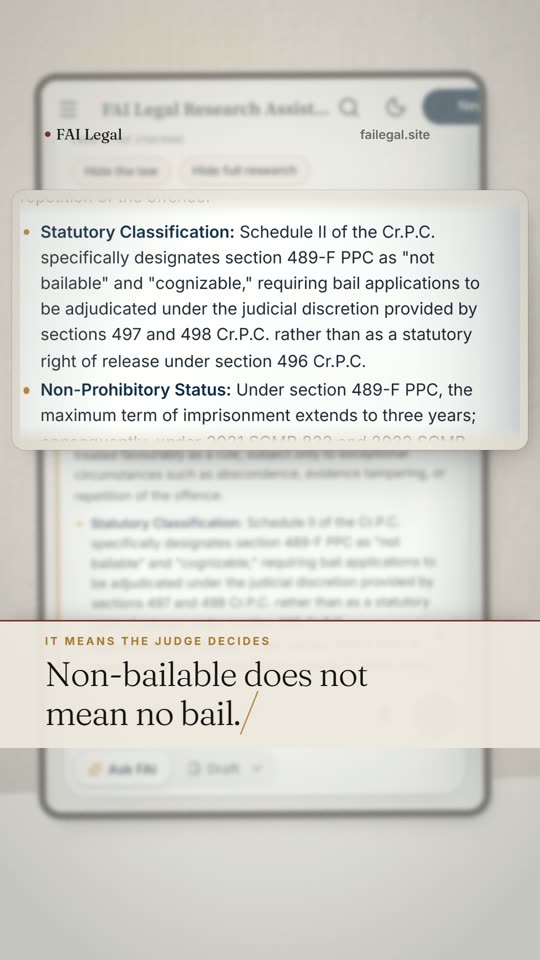
Next one: true or false? “Non-bailable means no bail.”
Sources
- A v. Inspector General of Police and others (names withheld), W.P. No. 8709 of 2024 (Lahore High Court, 20 February 2024)
The belief that police can hold someone for twenty-four hours without informing any authority is incorrect and contrary to law; the custody was proved illegal; the court listed the rights of an arrested person and the duties of magistrates. read in full in FAI Judgment Search - Code of Criminal Procedure 1898, ss.61 and 62 text checked in FAI Statute Search, 18 November 2026
- Constitution of Pakistan 1973, Article 10 text checked in FAI Statute Search, 18 November 2026
Every quote and section above is traced to the full judgment or statute text by an automatic check that runs on every update.
What the reel says
Read the words of the reel
What are the rights of an arrested person in Pakistan?
Police can hold you 24 hours and tell no one? The Lahore High Court (W.P. No. 8709 of 2024, 20 February 2024) called that a common fallacy, "both incorrect and contrary to the law". Every arrest without a warrant must be reported (Code of Criminal Procedure, s.62), and past 24 hours only a magistrate can allow more custody (s.61; Constitution, Article 10).
In this case the court twice ordered the police to produce the man. The evening before the hearing, the police showed him arrested at six and before a magistrate at eight; the jail's own report says he arrived the next evening at 7:10. The district police chief's own inquiry proved illegal custody; the man was discharged from the case, and action started against the officers.
Your rights, in the court's list: be told why, contact your family, talk to a lawyer at once, and no torture. Every accused has these rights, whatever the charge.
Did you know the police must report your arrest? Yes or no?
Educational legal information, not legal advice. Every case turns on its own facts. Speak to a lawyer about your own case. Last checked: 18 November 2026. Review status: Pending advocate review. How we check.