Workplace · Supreme Court of Pakistan
Reinstated in service: do you get pay for the years you were out?
The myth: “Taken back after a dismissal, but the years out stay unpaid.”Wrong: back pay is the rule
The short answer
Yes, as a rule. When a dismissal, removal or compulsory retirement is set aside and you are taken back, the Supreme Court says you are treated as if you never left service: the pay, increments and pension rights of the years you were out come back too (PLD 2026 SC 145, paras 8 and 16). The court called this the doctrine of constructive continuity and said it was setting it out for the first time (para 9).
Tahir Kazmi and another v. Inspector General of Police, Punjab, Lahore and others · Supreme Court of Pakistan · PLD 2026 SC 145 · decided 14 May 2025
By the FAI Legal editorial desk · 2 November 2026 · 7 min read

Back pay is the norm and refusing it is the exception (para 11). Two exceptions matter: clear evidence that you were in paid work elsewhere during those years, and a win only on a procedural point, where the money can wait for a fresh inquiry (paras 5, 11 and 13).
Key points
- Reinstatement wipes out the wrongful order: the civil servant is restored to the previous position as if the dismissal or removal had never happened (para 5).
- Under the doctrine of constructive continuity, a civil servant whose dismissal or removal is declared unlawful is deemed to have remained in continuous service, with the salary, allowances, increments and service benefits of that time, subject to lawful deductions (para 8).
- Back benefits are the norm; refusing them is the exception, and the department needs clear evidence that the employee was gainfully employed elsewhere (para 11).
- When only the penalty is reduced, the lesser penalty counts from the start and the back benefits are worked out under it: here two years of approved service stayed forfeited, and back pay still ran from 29 April 2011 (paras 13 and 16).
- When reinstatement is only for a procedural fault, such as no hearing or an inquiry not held by the rules, the back benefits may be deferred until a fresh inquiry decides the matter (para 13).
Reinstated after dismissal: do you get pay for the years out? The short answer
Yes, as a rule. In PLD 2026 SC 145 the Supreme Court held that once a civil servant's dismissal, removal or compulsory retirement is set aside, he or she is treated for all legal and financial purposes as having continued in service, and is entitled to the salary, benefits and emoluments that would have been earned but for the wrongful order (paras 8 and 10).
Calling the years out "leave without pay" and stopping there is not enough. The court said that denying back benefits to a reinstated civil servant "amounts to continued punishment despite legal vindication" (para 10).
Faisalabad, 2011: a head constable compulsorily retired
The first petitioner was a head constable in the Punjab Police. On 29 April 2011 the Superintendent of Police, Madina Town, Faisalabad, compulsorily retired him after a show-cause notice. His departmental appeal was rejected on 15 December 2017 (para 2).
On review, the Inspector General of Police reduced the penalty to forfeiture of two years of approved service, but ordered the years in between to be treated as leave without pay. The Punjab Service Tribunal then reinstated him in 2019, again treating the intervening period as special casual leave without pay: no back benefits at all (paras 2 and 16).
A second case decided with it: 46 days' absence
The court decided a second petition with it. The petitioner there was removed from service on 25 June 2014 under the Punjab Employees Efficiency, Discipline and Accountability Act 2006 for 46 days of unauthorised absence. The Tribunal reduced the penalty to forfeiture of three years of approved service and reinstated him, but treated the years in between as leave without pay (paras 3 and 17).
We checked it in FAI Legal
The judgment is on FAI Legal's Judgment Search under PLD 2026 SC 145 (type 2026 PLD 145 or PLD 2026 SC 145), with every paragraph open in the judgment reader. The paragraphs quoted on this page are 5, 8, 9, 10, 11, 13 and 16.
Supreme Court, May 2025: the doctrine of constructive continuity
A bench of Syed Mansoor Ali Shah and Aqeel Ahmed Abbasi, JJ decided both petitions on 14 May 2025. Starting from the English idea of a "vanishing dismissal", where a dismissal set aside on appeal vanishes as though it never existed (para 6), the court named the result the doctrine of constructive continuity: the civil servant "shall be deemed to have remained in continuous service during the period of absence" (para 8).
The court tied the rule to the Constitution: the right to life, which includes the right to livelihood (Article 9), the right to a fair trial and due process (Article 10A), dignity (Article 14) and equality (Article 25) (para 10). It also read the second proviso to section 16 of the Punjab Civil Servants Act 1974, which lets the authority setting aside a dismissal determine the arrears of pay, as a discretion that must follow these guarantees (para 12).
For the head constable it granted "full back benefits, including arrears of pay, increments, and pensionary entitlements, subject to the effect of the modified penalty, with effect from 29.04.2011" (para 16). The second petitioner got back benefits worked out under his three-year forfeiture, from 25 June 2014 (para 17).
The catch: when back pay can be cut or delayed
Back pay is the rule, but it has limits. The court kept two exceptions from earlier cases: the department can resist it with clear evidence that you were gainfully employed elsewhere during those years, and it is not automatic where the reinstatement was conditional (paras 5 and 11).
Why you won also matters. If the charges are disproved, full back benefits follow "as a matter of right". If you won only on a procedural point, such as no hearing or an inquiry not held as the rules require, the back benefits "may be deferred, pending the outcome of a fresh disciplinary inquiry" (para 13).
If you are taken back: what to do
Keep both orders: the one that sent you home and the one that brought you back, with their dates. Back pay runs from the date of the original penalty (para 16).
In your appeal or representation, ask for back benefits by name: arrears of pay, increments and pension rights for the whole period. The authority setting the order aside determines the arrears (section 16, Punjab Civil Servants Act 1974; section 17, Civil Servants Act 1973), and the court said that discretion must follow these principles (para 12).
Make sure the years in between are regularised in your service record, so that your service stays unbroken for pension, promotion and seniority; the court said this is needed whatever money is granted (para 14). Keep proof of what you did in those years too, because only clear evidence of paid work elsewhere can cut the back pay (para 11).
Find rulings like this on FAI Legal
The judgment is on FAI Legal's Judgment Search (search for PLD 2026 SC 145), with its paragraphs open in the judgment reader. Ask FAI Legal your own question about a dismissal, a removal or a reinstatement and see the law and the judgments behind the answer.
The case at a glance
- Facts
- 29 April 2011, Faisalabad: a Punjab Police head constable was compulsorily retired; on review the penalty became forfeiture of two years of approved service; the Punjab Service Tribunal reinstated him in 2019 but treated the years out as special casual leave without pay. A second petitioner, removed in 2014 for 46 days' absence, had his penalty cut to forfeiture of three years and the years out treated as leave without pay (paras 2 and 3).
- The question
- Is a civil servant who is reinstated after a dismissal, removal or compulsory retirement is set aside entitled to back benefits, and how is the period in between to be treated (para 1)?
- What the Court held
- Yes. Under the doctrine of constructive continuity the civil servant is deemed to have remained in service and is entitled to back benefits, subject to the effect of any substituted penalty; both petitioners got arrears of pay, increments and pensionary entitlements from the date of the original penalty (paras 8, 13, 16 and 17).
- Why
- Reinstatement nullifies the order (para 5); the doctrine of vanishing dismissal (para 6); constructive continuity named for the first time (paras 7 to 9); Articles 4, 9, 10A, 14 and 25 (para 10); back benefits are the norm (para 11, following Tariq Mahmood 2015 SCMR 77 and Muhammad Sharif 2021 SCMR 962); the section 16 discretion is not absolute (para 12); merits, procedure and disproportion compared (para 13); the gap must be regularised (para 14).
- Limits
- A two-judge bench deciding civil petitions about Punjab civil servants. Back benefits can still be refused on clear evidence of gainful employment elsewhere or where reinstatement was conditional (paras 5 and 11), and deferred when reinstatement is only on a procedural ground (para 13). It does not decide the pension of an employee whose dismissal stands.
In the Court’s words
“this is the first time such a doctrine is being formally articulated in our jurisprudence”
PLD 2026 SC 145, para 9
“It amounts to continued punishment despite legal vindication.”
PLD 2026 SC 145, para 10
“the grant of back benefits is the norm and denial of service benefits to such reinstated employee is an exception”
PLD 2026 SC 145, para 11
“Once reinstated, the petitioner was entitled to be treated as if he had never left service.”
PLD 2026 SC 145, para 16
The law it relies on
Second proviso: "where a civil servant has, under an order which is later set aside, been dismissed or removed from service or reduced in rank, he shall, on the setting aside of such order, be entitled to such arrears of pay as the authority setting aside such order may determine." The federal counterpart of section 16 of the Punjab Civil Servants Act 1974, which the court read in para 12.
"For the determination of his civil rights and obligations or in any criminal charge against him a person shall be entitled to a fair trial and due process." Relied on in para 10.
"No person shall be deprived of life or liberty save in accordance with law." The court read the right to life to include the right to livelihood (para 10).
What this does not mean
- It does not mean every reinstated employee gets every rupee. Clear evidence of paid work elsewhere, or a conditional reinstatement, can cut the back benefits (paras 5 and 11).
- It does not mean a win on a technicality pays at once: when reinstatement is only for a procedural fault, the money can wait for a fresh inquiry (para 13).
- It does not cancel a reduced penalty. Here two years of approved service stayed forfeited; the back benefits are worked out under that penalty (paras 13 and 16).
- The reel's opening scene, a clerk handing over a reinstatement order and saying the years out are unpaid, is a drawing of the common claim, not this case's facts.
Questions people ask
Reinstated after dismissal: will I get my back salary?
As a rule, yes. The Supreme Court held that a civil servant whose dismissal or removal is set aside is deemed to have stayed in service and is entitled to the pay, allowances and increments of those years, subject to lawful deductions (PLD 2026 SC 145, paras 8 and 11).
What are back benefits in service law?
Arrears of pay and other emoluments denied because of a wrongful dismissal or removal (PLD 2026 SC 145, para 4). Here the court granted arrears of pay, increments and pensionary entitlements (para 16).
Dismissed from a government job: is the pension gone?
If the dismissal is set aside and you are reinstated, your pension rights come back with your service: the court granted "pensionary entitlements" from the date of the original penalty and said the gap must be regularised so the service stays unbroken (paras 14 and 16). Whether any pension is payable when a dismissal stands depends on the service rules and the penalty; ask a service lawyer about your own case.
Can the department refuse back pay?
Only as an exception: with clear evidence that you were gainfully employed elsewhere during those years, or where the reinstatement was conditional (paras 5 and 11). If you won only on a procedural point, the back pay may wait for a fresh inquiry (para 13).
My penalty was only reduced, not cancelled. Do I still get back pay?
Yes, worked out under the reduced penalty. The court said the lesser penalty counts as if it had been imposed from the start, with salary, allowances, increments, seniority and pension rights for the period, subject only to what the lesser penalty itself takes away (para 13).
What is the doctrine of constructive continuity?
The Supreme Court's name, first used in this judgment, for the rule that a civil servant whose removal or dismissal is declared unlawful is deemed to have remained in continuous service and is entitled to the benefits that would have accrued (PLD 2026 SC 145, paras 7 to 9).
Check yourself
True or false? “Taken back after a dismissal, but the years out stay unpaid.”
Wrong: back pay is the rule. Yes, as a rule. When a dismissal, removal or compulsory retirement is set aside and you are taken back, the Supreme Court says you are treated as if you never left service: the pay, increments and pension rights of the years you were out come back too (PLD 2026 SC 145, paras 8 and 16). The court called this the doctrine of constructive continuity and said it was setting it out for the first time (para 9).
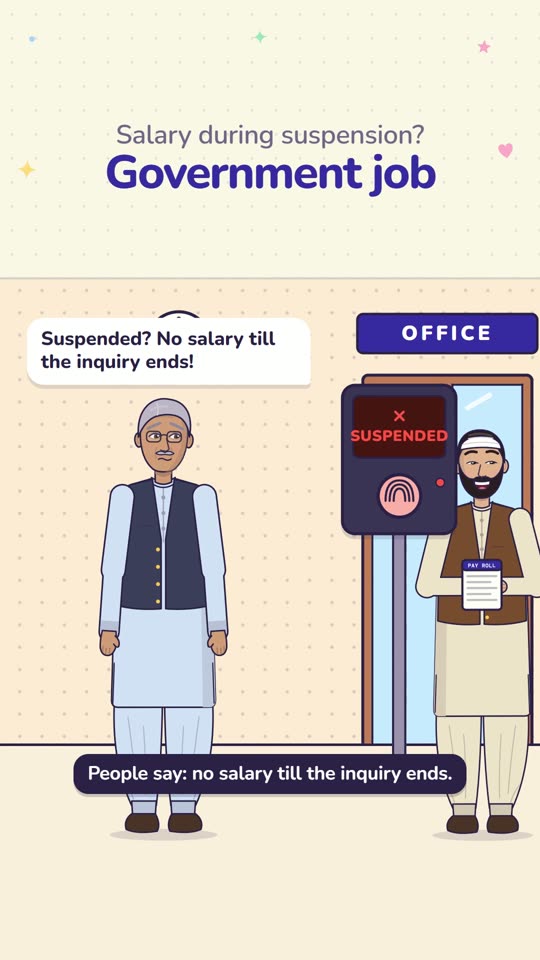
Next one: true or false? “Suspended? No salary till the inquiry ends.”
Sources
- Tahir Kazmi and another v. Inspector General of Police, Punjab, Lahore and others, PLD 2026 SC 145 (Supreme Court of Pakistan, 14 May 2025)
The doctrine of constructive continuity: a reinstated civil servant is deemed to have remained in service and gets back benefits, subject to any substituted penalty; deferred when reinstatement is only on a procedural ground. - Muhammad Sharif v. Inspector General of Police, Punjab, Lahore, 2021 SCMR 962 (Supreme Court of Pakistan, 28 April 2021)
Back benefits on reinstatement are the rule; part can be withheld only for gainful employment or the civil servant's own fault. Relied on in PLD 2026 SC 145, paras 11 and 13. - Civil Servants Act, 1973, Section 17 text checked in FAI Statute Search, 2 November 2026
- Constitution of the Islamic Republic of Pakistan, 1973, Article 10A text checked in FAI Statute Search, 2 November 2026
- Constitution of the Islamic Republic of Pakistan, 1973, Article 9 text checked in FAI Statute Search, 2 November 2026
Every quote and section above is traced to the full judgment or statute text by an automatic check that runs on every update.
What the reel says
Read the words of the reel
Fired from a government job, then taken back, and the office says the years out stay unpaid?
Naukri se nikala, phir bahal kiya: do you get pay for the years you were out?
Wrong. The law counts you as if you never left.
Faisalabad, 2011: a police head constable was compulsorily retired as a punishment. Years later the punishment was cut (two years of service forfeited) and he was taken back, but the Service Tribunal called the years out unpaid leave. On 14 May 2025 the Supreme Court said: once reinstated, he "was entitled to be treated as if he had never left service". Back pay is the rule, not a favour: pay, increments and pension rights, all from 29 April 2011 (2026 PLD 145). The court called it the doctrine of constructive continuity, set out for the first time.
But two things can cut it: a paid job elsewhere in those years, or a win only because the inquiry was faulty; then the money can wait for a fresh inquiry.
If you are taken back:
1. Keep both orders: the one that sent you home and the one that brought you back.
2. In your appeal, ask for back pay, increments and pension rights by name.
3. Get the years in between regularised in your service record, so your service stays unbroken.
Educational legal information, not legal advice. Every case turns on its own facts. Speak to a lawyer about your own case. Last checked: 2 November 2026. Review status: Pending advocate review. How we check.