Consumer rights · Sindh High Court
Old bank account money: who must prove it was paid?
The myth: “If the bank says you cashed your old deposit, you must prove you didn't.”Wrong: once the bank admits the deposit, the bank must prove it paid
The short answer
The bank, once it admits the deposit. An old record is no excuse.
A v. B (names withheld) · Sindh High Court · Constitutional Petition No. 5267 of 2024 · decided 27 March 2025
By the FAI Legal editorial desk · 10 November 2026 · 6 min read

If a bank admits that you deposited the money, it is the bank that has to prove it paid you back, not you who has to prove it did not. On 27 March 2025 the Sindh High Court held this for a man with a 1999 dollar deposit receipt and kept the Banking Mohtasib's order: the bank pays him US$ 10,374 with profit.
A bank can still win with real proof of payment. Here it said the record was too old, then showed a 1999 debit voucher, and the Court called its stance self-contradictory (paras 10 and 14).
Key points
- The burden is on the bank: "When disputed amount is admitted by the bank to have been deposited, the burden would be upon the bank to show that the said amount was subsequently withdrawn by respondent No.4." (para 11).
- No proof of payment, and the money is presumed still with the bank: "the presumption would run against the bank that the disputed amount remained in its possession and was never withdrawn." (para 11).
- "The record is too old" did not help: "The bank is regulated by the laws and regulations and hence is required to maintain the record of every transaction for future reference." (para 12).
- The bank said it had no records, yet relied on a debit voucher of 20 November 1999; the Court found its stance self-contradictory (paras 10 and 14).
- The Banking Mohtasib's order stands: the bank pays US$ 10,374 with profit (paras 5 and 14).
Old bank account money: the short answer
Your bank says you withdrew an old deposit long ago, and you cannot remember. Who has to prove it? The bank, once it admits the deposit was made. The Sindh High Court decided this on 27 March 2025: with no convincing proof that the money was paid out, the law presumes it is still with the bank.
People search this as claiming old bank account money, how to claim money from an old bank account and what happens to money in inactive bank accounts. How to complain to the Banking Mohtasib, step by step, is on our page failegal.site/media/bank-will-not-refund-go-to-the-banking-mohtasib.
1999 to 2019: a receipt, and a question
On 3 October 2019 a man wrote to his bank with a receipt for a dollar term deposit worth US$ 10,374 as on 25 May 1999. He asked the bank to check it, because he could not remember whether he had cashed it or not (para 2). He still had the cheque book of his old dollar account (para 3).
The bank answered that the deposit was rolled over on 16 November 1999 and cashed on 20 November 1999 at his request, against bearer bonds. It also told the Banking Mohtasib that it was unable to retrieve any data, "being very old record", and that the funds had not gone to the State Bank as an unclaimed deposit (para 2).
The Mohtasib, the President, the High Court
He complained to the Banking Mohtasib Pakistan. The Mohtasib found that the bank "has not provided any proof regarding payment made to the Complainant.", could not show it had taken back the original receipt, and had committed gross maladministration; it directed the bank to pay or credit US$ 10,374 to his account with profit (para 5).
The bank's representation to the President was dismissed on 28 August 2024 (para 6). It then filed a petition in the Sindh High Court: the complaint came twenty years late, the burden was on him to prove he had not cashed the deposit, and banks need keep records for only 10 years (para 7).
We checked it in FAI Legal
The judgment is on FAI Legal's Judgment Search, marked as a citation from the court record, with every paragraph open in the judgment reader. The paragraphs quoted on this page are paras 2, 3, 5, 6, 7, 10, 11, 12 and 14. Sections 31 and 82D of the Banking Companies Ordinance, 1962 are on Statute Search.
You be the judge: him, or the bank?
The Court began with what was not in dispute: "The bank is not disputing deposit of disputed amount with it by respondent No.4." (para 10). The bank said it had no documents because the deal was from 1999, yet it relied on a debit voucher dated 20 November 1999: "The plea that the document of withdrawal are not available therefore is not founded on any solid undergird." (para 10).
Then the rule: "When disputed amount is admitted by the bank to have been deposited, the burden would be upon the bank to show that the said amount was subsequently withdrawn by respondent No.4." (para 11). The bank brought no convincing evidence beyond that voucher, and the Court held that "once the amount is admitted by the bank to have been deposited with it, the burden is upon the bank to show its withdrawal etc. and in this case the bank has miserably failed to discharge its burden and the stance taken in this regard is self-contradictory." (para 14). The petition was dismissed.
Why the burden is on the bank
The bank holds the records. "The bank is regulated by the laws and regulations and hence is required to maintain the record of every transaction for future reference." (para 12). Its claim that the record was disposed of after 10 years had nothing behind it: "The bank has placed no document/memos on record that after 10 years, the relevant record pertaining to TDR facility availed by respondent No.4 was destroyed or disposed of to support such plea." (para 12).
So without valid evidence of a withdrawal, "the presumption would run against the bank that the disputed amount remained in its possession and was never withdrawn." (para 11). A bank that brings convincing proof of payment can discharge that burden; this bank did not (paras 11 and 13).
Have an old receipt? What to do
Keep every receipt, deposit slip, cheque book and statement, however old. Write to your bank first with copies. If it does not answer within thirty days, or its answer does not satisfy you, you may complain to the Banking Mohtasib within a further thirty days; the complaint is made in writing on oath, with the full particulars of the transaction (section 82D(1) and (2) of the Banking Companies Ordinance, 1962). The Mohtasib may accept a late complaint if satisfied there were grounds for the delay.
If an account sees no transaction and no request for a statement for fifteen years (for a fixed deposit, counted from the day it matured), the bank must send the depositor three months' notice by registered post and, with no reply, pay the amount with any profit to the State Bank (section 31(1), as amended in 2024). The State Bank lists unclaimed amounts on its website, and the owner can claim through the bank (section 31(8) and (10)). Your case may be different: talk to a lawyer about your own papers.
Find rulings like this on FAI Legal
FAI Legal is a website: open failegal.site in your phone's browser, there is nothing to download. Ask your question in plain words, read sections 31 and 82D on Statute Search, and see this judgment in full on Judgment Search. Don't go by what you hear: read the judgment yourself.
The case at a glance
- Facts
- On 3 October 2019 the depositor asked the bank to check a dollar term deposit receipt worth US$ 10,374 as on 25 May 1999, as he could not remember whether he had cashed it; the bank said it was rolled over on 16 November 1999 and cashed on 20 November 1999 against bearer bonds (para 2). The Banking Mohtasib found no proof of payment and gross maladministration and directed the bank to pay US$ 10,374 with profit (para 5); the President dismissed the bank's representation on 28 August 2024 (para 6).
- The question
- Whether the depositor had to prove he had not withdrawn the deposit, or the bank had to prove it had paid it out, and whether the bank's 10-year record rule excused it (paras 7 and 14).
- What the Court held
- Once the bank admits the deposit, the burden is on the bank to show its withdrawal; with no valid evidence, the presumption runs against the bank that the amount remained with it; the bank's stance was self-contradictory; the concurrent findings of the Banking Mohtasib and the President were endorsed and the petition dismissed (paras 10, 11, 13 and 14).
- Why
- The bank did not dispute the deposit (para 10); its plea that no records survived was contradicted by its own 1999 debit voucher (para 10); a regulated bank must maintain the record of every transaction, and it placed no document showing the record was destroyed after 10 years (para 12); concurrent findings are not disturbed in constitutional jurisdiction unless shown to be illegal or perverse (para 14).
- Limits
- The ruling turns on the bank admitting the deposit and bringing no convincing evidence of payment; a bank with such evidence can discharge its burden (paras 11 and 13). It is a Sindh High Court ruling on the facts before it.
The law it relies on
Prior to making a complaint, the complainant shall request the concerned banking company to redress the complainant's grievances and if the banking company either fails to respond or makes a reply which is un-satisfactory to the complainant within a period of thirty days, the complainant may file a complaint at any time thereafter within a further period of thirty days.
The State Bank shall place on its website a list of the amounts received by it under sub-section (1) and not claimed by any person.
No transaction and no statement of account requested for fifteen years (for a fixed deposit, from the day the fixed period ended): the bank gives the depositor three months' notice by registered post and, with no reply, pays the amount with any profit to the State Bank; the person entitled can claim it from the State Bank through the bank (as amended by Act XXIX of 2024).
What this does not mean
- It does not mean the depositor always wins: a bank that brings convincing evidence of payment can discharge its burden. This bank had none beyond a voucher that contradicted its own story (paras 10, 11 and 13).
- It does not set a general rule on how long banks must keep records: the Court decided this case on its facts, where the bank showed no document that the record was destroyed (para 12).
- It is a Sindh High Court ruling on a petition against the Banking Mohtasib's and the President's orders; the Court would not disturb their concurrent findings unless shown to be illegal or perverse (para 14).
- The reel's tin box, the shelf and the daughter are a picture of the question; the judgment says he came to the bank with the receipt and still had his cheque book, not where he kept them.
Questions people ask
Who has to prove an old bank deposit was paid out?
The bank, once it admits the deposit. On 27 March 2025 the Sindh High Court held that when the bank admits the amount was deposited, the burden is upon the bank to show it was withdrawn (Constitutional Petition No. 5267 of 2024, paras 11 and 14).
Can a bank refuse because it keeps records for only 10 years?
Not without proof. In this case the Court said a bank is required to maintain the record of every transaction for future reference, and the bank placed no document showing the record was destroyed after 10 years (para 12).
How do I complain to the Banking Mohtasib about an old deposit?
Write to your bank first. If it does not answer within thirty days, or its answer does not satisfy you, you may complain to the Banking Mohtasib within a further thirty days, in writing on oath (section 82D of the Banking Companies Ordinance, 1962). The steps are on failegal.site/media/bank-will-not-refund-go-to-the-banking-mohtasib.
What happens to money in an inactive bank account in Pakistan?
After fifteen years with no transaction and no statement requested (for a fixed deposit, from the day it matured), the bank must send three months' notice by registered post and, with no reply, pay the amount to the State Bank. The State Bank lists unclaimed amounts on its website, and you claim through your bank (section 31, as amended in 2024).
Purane bank account ka paisa: bank kehta hai aap ne nikal liya. Saboot kaun de?
Bank. Agar bank maanta hai ke paisa jama hua tha, to saboot bank ko dena hai ke paisa wapas diya gaya (Sindh High Court, 27 March 2025).
Check yourself
True or false? “If the bank says you cashed your old deposit, you must prove you didn't.”
Wrong: once the bank admits the deposit, the bank must prove it paid. The bank, once it admits the deposit. An old record is no excuse.
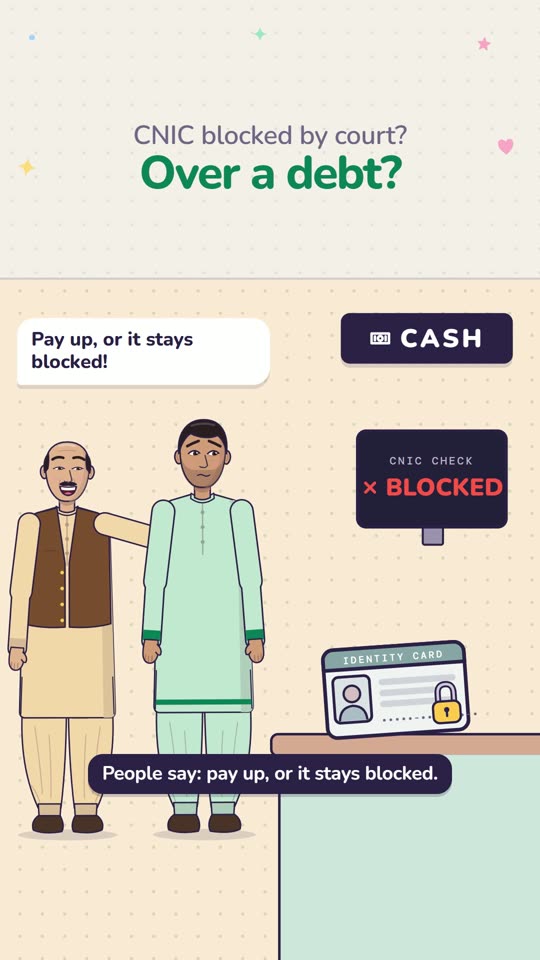
Next one: true or false? “A court can keep your CNIC blocked until you pay a debt.”
Sources
- A v. B (names withheld), Constitutional Petition No. 5267 of 2024 (Sindh High Court, 27 March 2025)
Once a bank admits a deposit, the burden is on the bank to show its withdrawal; with no valid evidence the presumption runs against the bank; the Banking Mohtasib's order to pay US$ 10,374 with profit stands. - Banking Companies Ordinance, 1962, Sections 31 and 82D text checked in FAI Statute Search, 10 November 2026
Every quote and section above is traced to the full judgment or statute text by an automatic check that runs on every update.
What the reel says
Read the words of the reel
Old bank account money: the bank says you were paid. Who must prove it?
A man brings his bank a 1999 receipt. A dollar fixed deposit, $10,374. Twenty years on, he can't remember if he ever cashed it. The bank says he did, in November 1999, and that it's far too late to check now, because it only keeps records for 10 years and there's nothing left to show him.
The Banking Mohtasib told the bank to pay him, with profit. The bank went to the President. Lost. So it took the fight to the Sindh High Court, arguing that the burden was on him.
Here's what the High Court said on 27 March 2025:
1. Once a bank admits you deposited the money, it's the bank that has to prove it paid you. Not you.
2. No proof? Then the money is presumed to still be with the bank.
3. This bank said it had no records, and then, in the same case, showed a 1999 voucher of its own, which the Court called self-contradictory. It lost. The Mohtasib's order stands.
4. To be fair, though: a bank with real proof of payment can win.
So keep every receipt, cheque book and statement you've got. And for your own case, talk to a lawyer.
Full story: failegal.site/media/old-bank-account-money-bank-must-prove-2025 Was the court right? Tell us in the comments, no names.
Educational legal information, not legal advice. Every case turns on its own facts. Speak to a lawyer about your own case. Last checked: 10 November 2026. Review status: Pending advocate review. How we check.