Property and inheritance · For citizens (tenants)
Landlord won’t take your rent? Don’t stop paying.
In short
Holding the money is how a default case starts. In Punjab you can deposit the rent through the Rent Tribunal (section 20). In Sindh you send a money order or deposit it with the Controller (section 10(3)). Keep every receipt.
By the FAI Legal editorial desk · 15 November 2026 · 12 slides · 2 min read
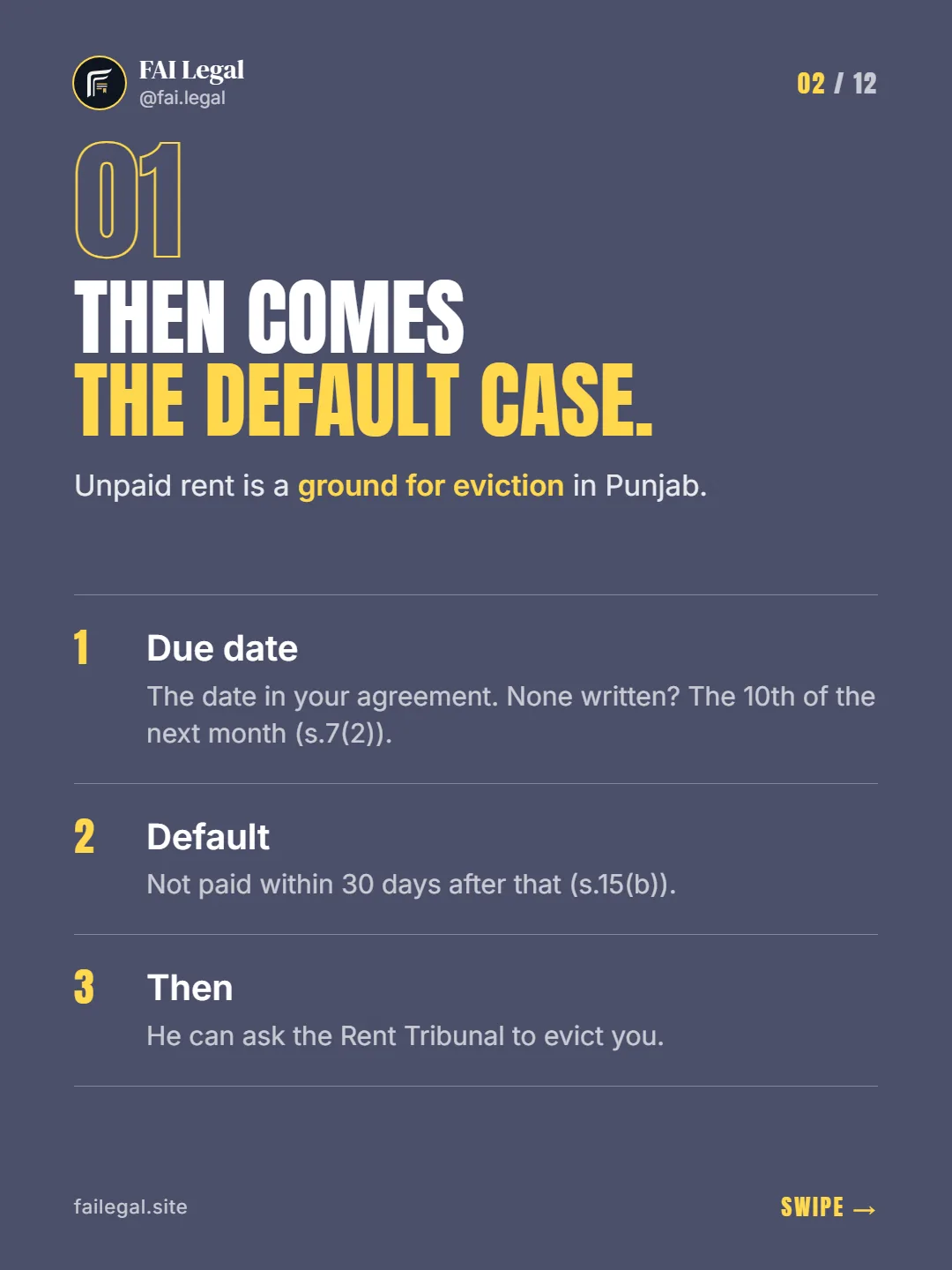



Then comes the default case.
Unpaid rent is a ground for eviction in Punjab.
- Due dateThe date in your agreement. None written? The 10th of the next month (s.7(2)).
- DefaultNot paid within 30 days after that (s.15(b)).
- ThenHe can ask the Rent Tribunal to evict you.
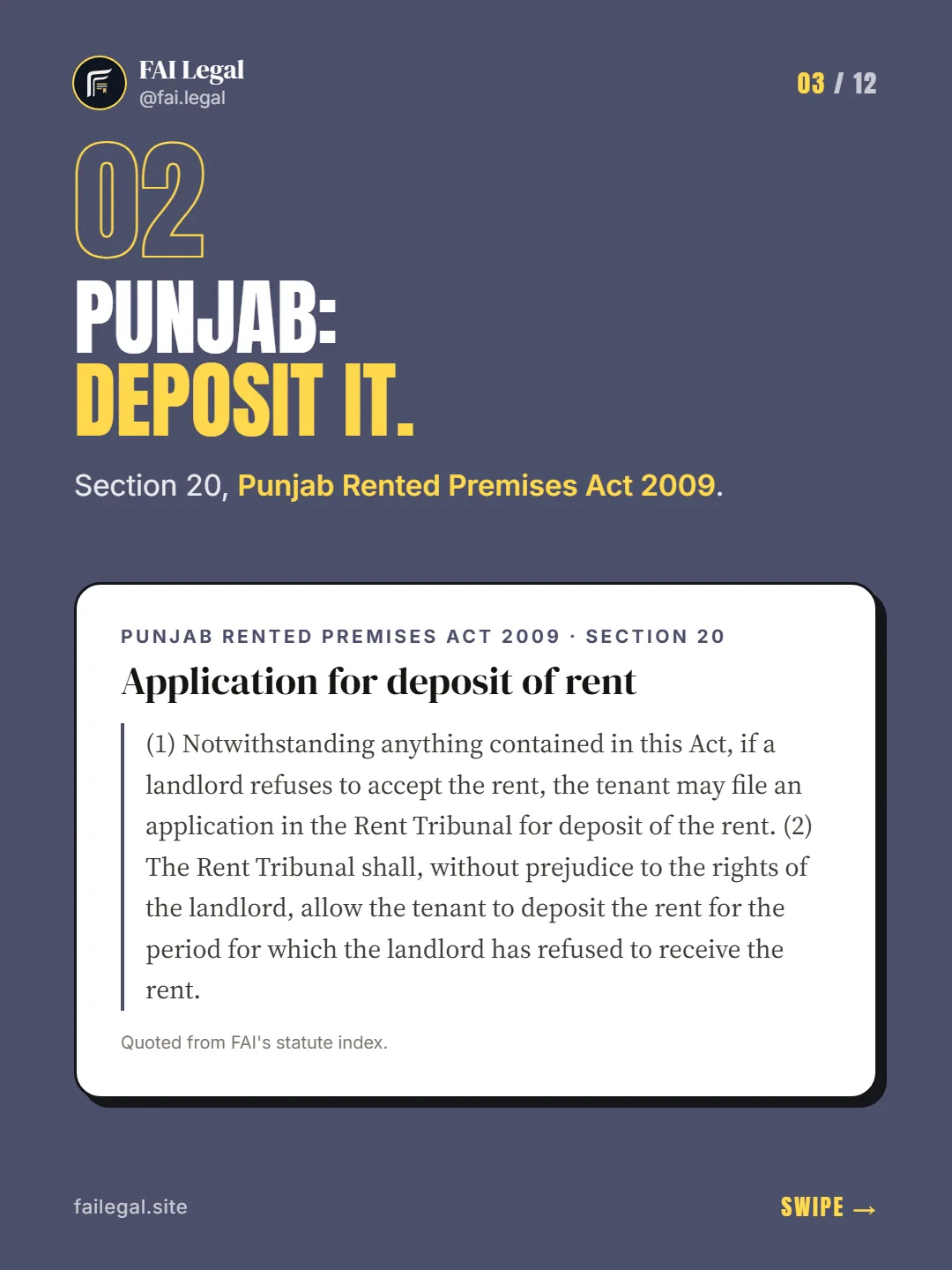
Punjab: deposit it.
Section 20, Punjab Rented Premises Act 2009.
“(1) Notwithstanding anything contained in this Act, if a landlord refuses to accept the rent, the tenant may file an application in the Rent Tribunal for deposit of the rent. (2) The Rent Tribunal shall, without prejudice to the rights of the landlord, allow the tenant to deposit the rent for the period for which the landlord has refused to receive the rent.”
Punjab Rented Premises Act 2009 · Section 20, Application for deposit of rent
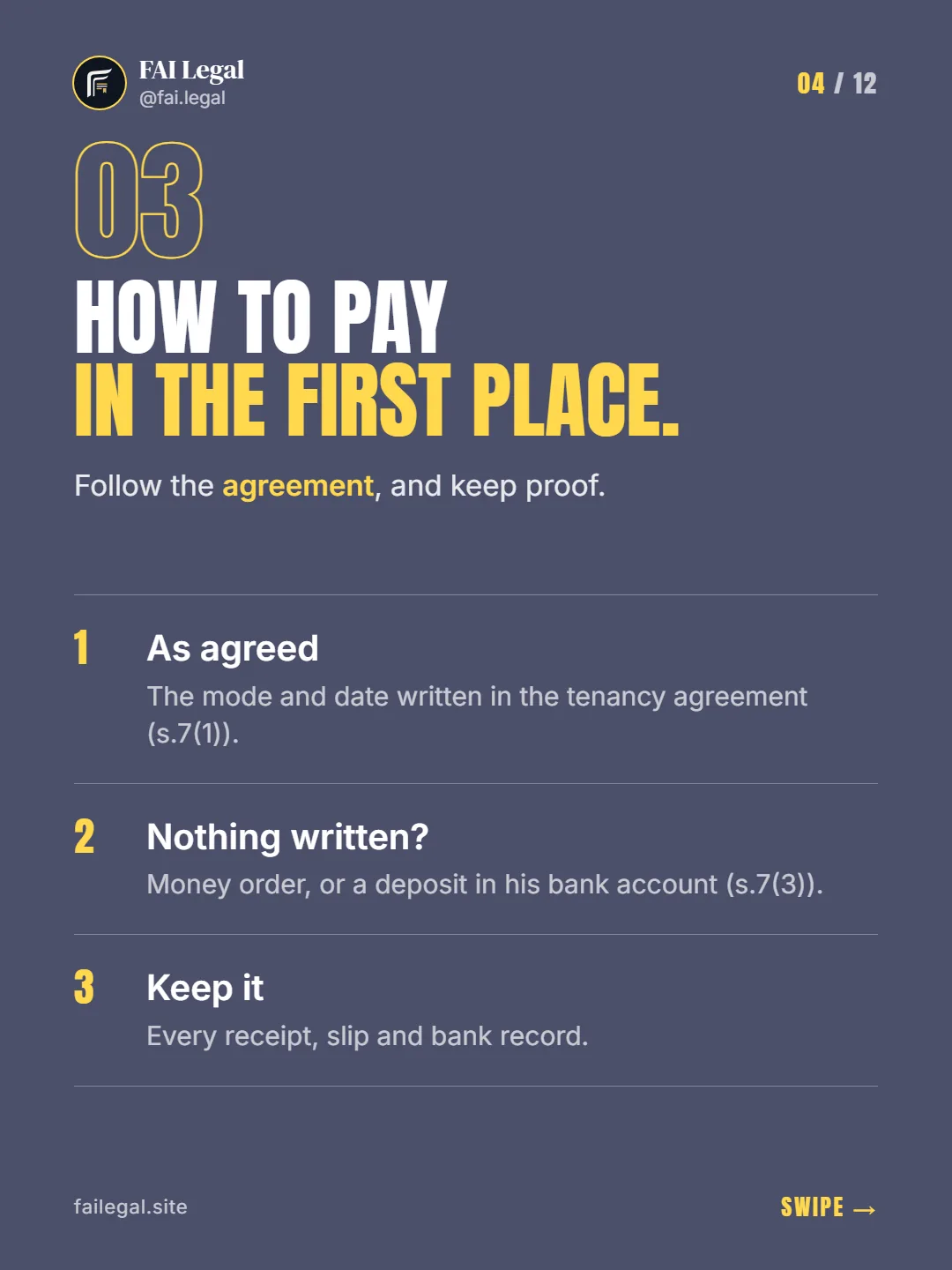
How to pay in the first place.
Follow the agreement, and keep proof.
- As agreedThe mode and date written in the tenancy agreement (s.7(1)).
- Nothing written?Money order, or a deposit in his bank account (s.7(3)).
- Keep itEvery receipt, slip and bank record.
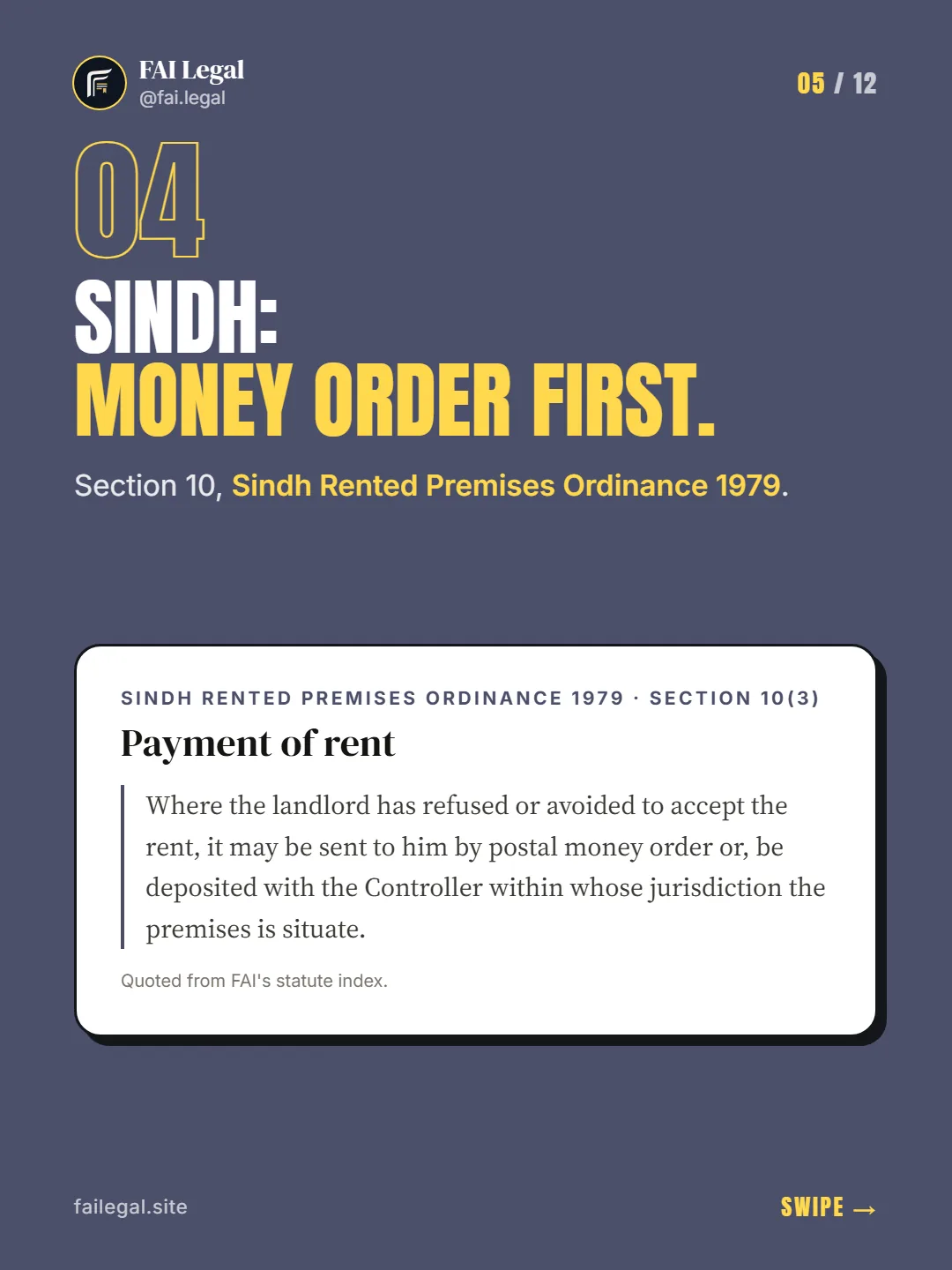
Sindh: money order first.
Section 10, Sindh Rented Premises Ordinance 1979.
“Where the landlord has refused or avoided to accept the rent, it may be sent to him by postal money order or, be deposited with the Controller within whose jurisdiction the premises is situate.”
Sindh Rented Premises Ordinance 1979 · Section 10(3), Payment of rent
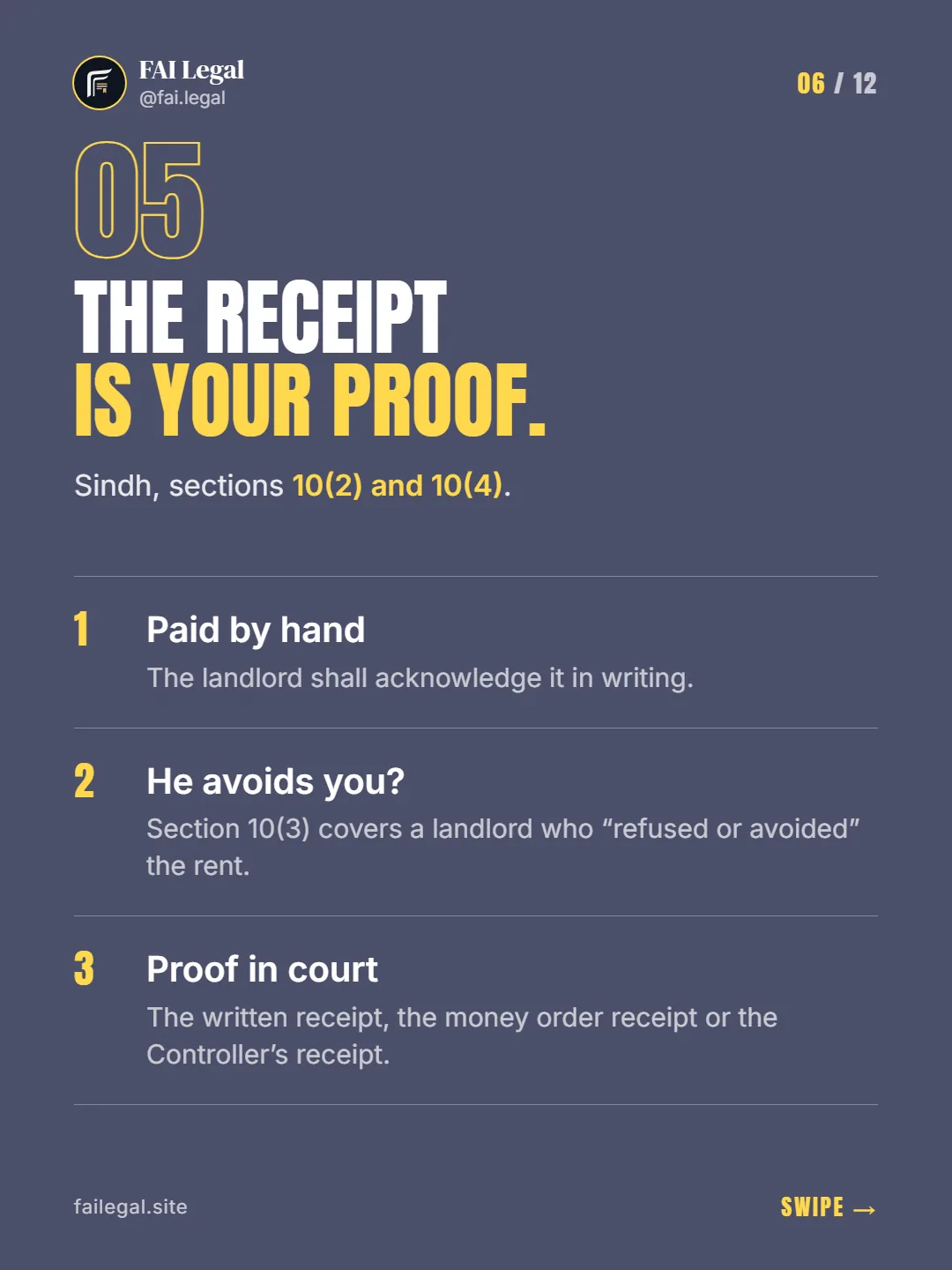
The receipt is your proof.
Sindh, sections 10(2) and 10(4).
- Paid by handThe landlord shall acknowledge it in writing.
- He avoids you?Section 10(3) covers a landlord who “refused or avoided” the rent.
- Proof in courtThe written receipt, the money order receipt or the Controller’s receipt.
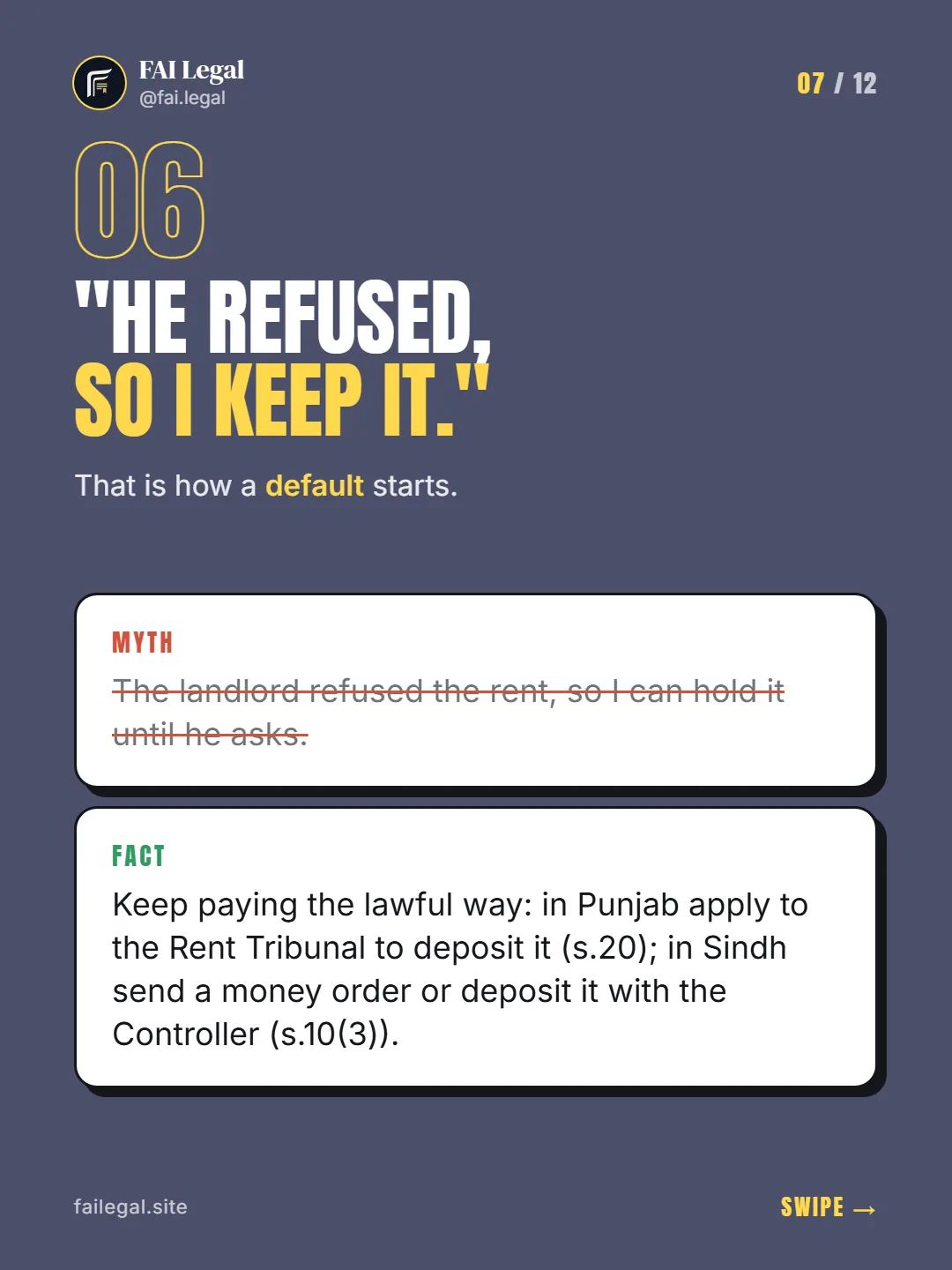
"He refused, so I keep it."
That is how a default starts.
- Myth: The landlord refused the rent, so I can hold it until he asks.
- Fact: Keep paying the lawful way: in Punjab apply to the Rent Tribunal to deposit it (s.20); in Sindh send a money order or deposit it with the Controller (s.10(3)).
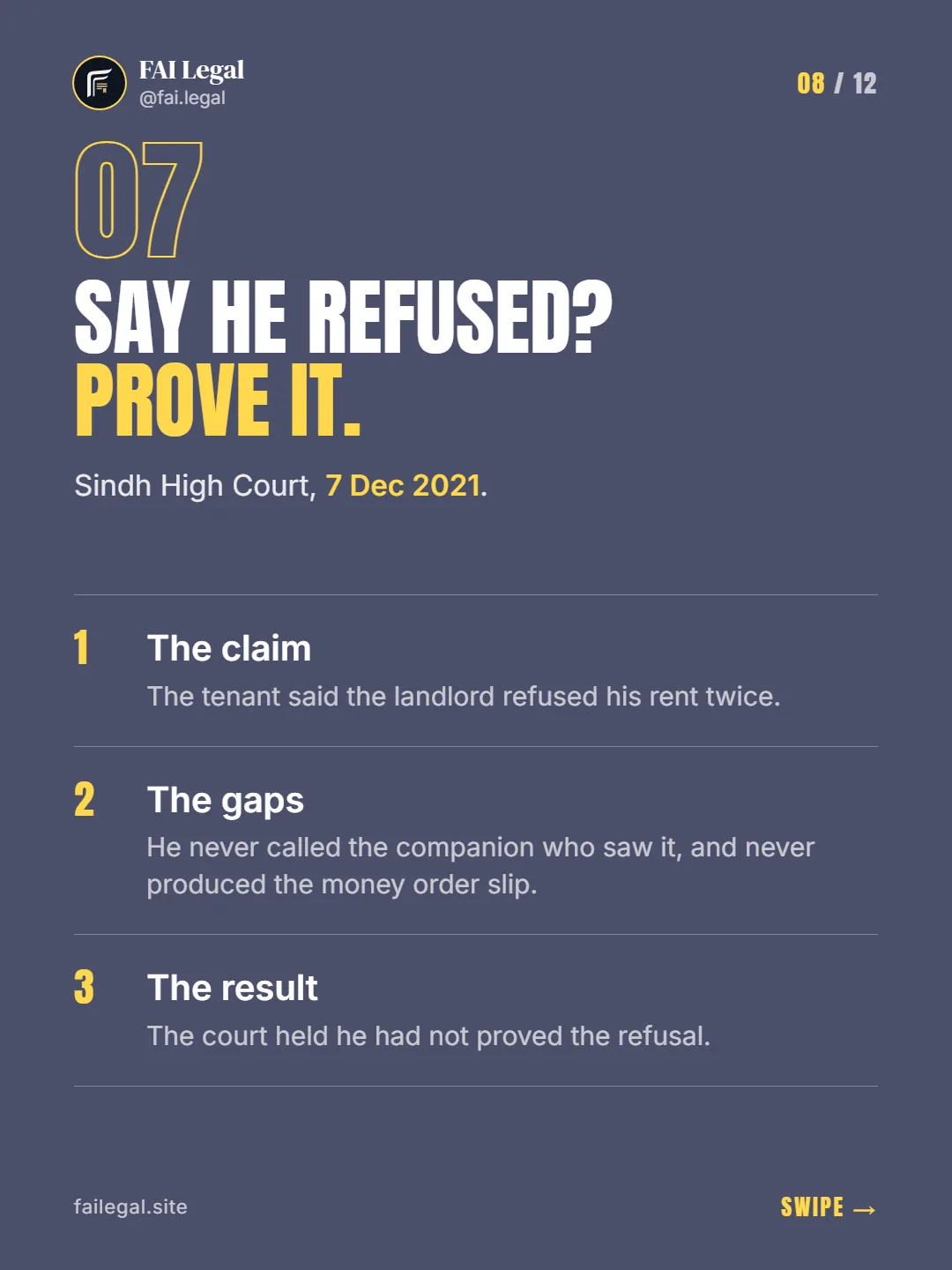
Say he refused? Prove it.
Sindh High Court, 7 Dec 2021.
- The claimThe tenant said the landlord refused his rent twice.
- The gapsHe never called the companion who saw it, and never produced the money order slip.
- The resultThe court held he had not proved the refusal.
House sold? Pay the new owner.
Punjab, section 30.
- The new ownerMust tell you in writing and register with the Rent Registrar.
- The RegistrarSends you a notice of the change.
- Your 30 daysPay the new owner within 30 days of when that notice should reach you, and you are not in default.
Quick quiz. What do you do?
Guess first, then swipe for the answer.
- A. Keep the money until he asks
- B. Apply to the Rent Tribunal to deposit it
- C. Give it to a neighbour to hold
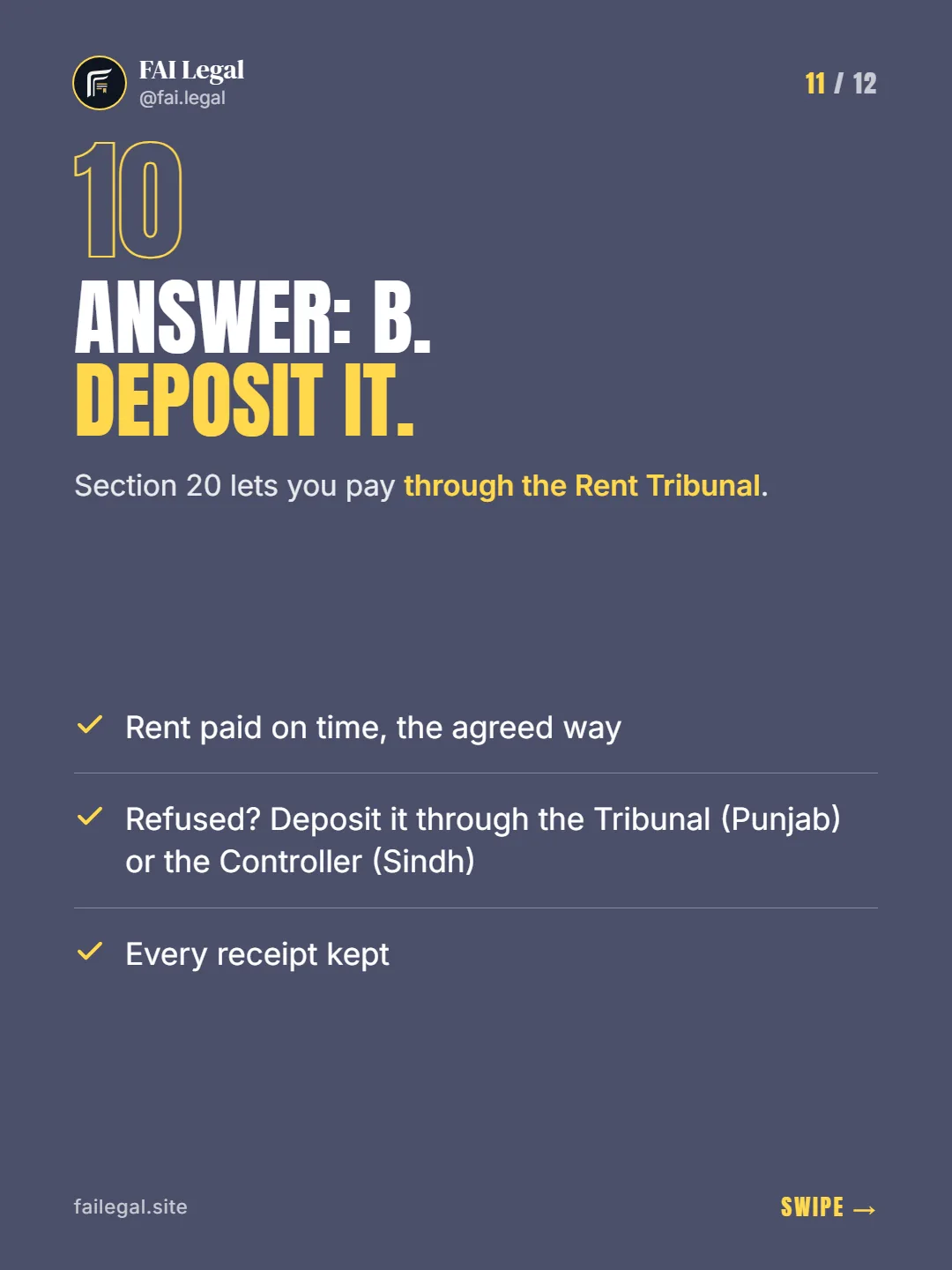
Answer: B. Deposit it.
Section 20 lets you pay through the Rent Tribunal.
- Rent paid on time, the agreed way
- Refused? Deposit it through the Tribunal (Punjab) or the Controller (Sindh)
- Every receipt kept
Sources
- Punjab Rented Premises Act 2009 · Section 20
Application for deposit of rent Punjab Code - Sindh Rented Premises Ordinance 1979 · Section 10(3)
Payment of rent
Educational legal information, not legal advice. Every case turns on its own facts. Speak to a qualified lawyer about your situation. Review status: Pending advocate review. How we check.