Criminal law · Lahore High Court
A false case by police: what happens to the officer?
The myth: “Nothing happens to the police after a false case.”Wrong: section 26 of the narcotics law punishes a search or arrest without reason, up to three years
The short answer
Up to three years under section 26 of the narcotics law, for a search without reasonable grounds or a vexatious and unnecessary arrest; but only where the record shows it, not after every acquittal.
The SI v. the accused and the State (names withheld) · Lahore High Court · Criminal Appeal No. 350 of 2004 · decided 1 June 2015 (heard)
By the FAI Legal editorial desk · 15 November 2026 · 5 min read

Something can happen to the officer. Section 26 of the Control of Narcotic Substances Act 1997 punishes an officer who searches without reasonable grounds of suspicion, or vexatiously and unnecessarily seizes property, detains, searches or arrests a person: up to three years and a fine of up to Rs 25,000.
But an acquittal alone is not enough. The Lahore High Court (Criminal Appeal No. 350 of 2004, heard on 1 June 2015) set aside a trial court's order for a case against the officer, because it had not been established on the record that the arrest was vexatious and unnecessary.
Key points
- Section 26: a search without reasonable grounds of suspicion, or a vexatious and unnecessary seizure, detention, search or arrest, up to three years and a fine of up to Rs 25,000.
- Not after every acquittal: the court must find on the record that the arrest itself was vexatious and unnecessary (Lahore High Court, paras 14 and 15).
- The offence is cognizable, so a case can be registered directly; the court need not follow sections 190, 195 or 476 of the Criminal Procedure Code (paras 12 and 13).
- The fair way (Peshawar High Court, 2024): a show-cause notice and a hearing, a separate case, investigation by another officer, then a trial.
- If a search had no reason, get that on the record at your trial; for your own case, speak to a lawyer.
A false charas case: what happens to the officer? The short answer
asdnvd asked on our charas reel: what about that policeman? The answer is in the narcotics law itself. Section 26 makes a search without reasonable grounds, or a vexatious and unnecessary arrest, an offence of its own. The courts use it carefully: only where the record shows the search or arrest had no reason, not after every acquittal.
What section 26 of the narcotics law says
Section 26 of the Control of Narcotic Substances Act 1997, in its own words: "Any person empowered under section 20 or section 21 who (a) without reasonable grounds of suspicion, enters or searches, or causes to be entered or searched, any building, place, premises or conveyance; (b) vexatiously and unnecessarily seizes the property of any person on the pretence of seizing or searching for any narcotic drug, psychotropic substance, controlled substance or any other article or document relating to any offence under this Act; and (c) vexatiously and unnecessarily detains, searches or arrests any person, shall be punished with imprisonment for a term which may extend to three years and shall also be liable to fine which may extend to twenty-five thousand rupees."
It covers the officers the Act empowers to search and arrest. "Vexatious" here means without reasonable or probable cause: harassing. "Unnecessary" means not required in the circumstances.
Not after every acquittal: the Lahore High Court
In a charas case from 2001, the trial court acquitted the accused in 2004 and told the police to register a case under section 26 against the sub-inspector who had made the arrest. In 2015 the Lahore High Court (Criminal Appeal No. 350 of 2004, heard on 1 June 2015) set that direction aside. It agreed that the offence is cognizable, so a case can be registered directly, and that the court need not follow sections 190, 195 or 476 of the Criminal Procedure Code. But the trial court had never found that the arrest itself was vexatious and unnecessary, and section 26 needs that.
The High Court's reason protects both sides: without that finding, every acquittal would be turned into a case against the officer who made the complaint, and officers would stop reporting real cases.
Where the record shows it: the Peshawar High Court's way
In 2024 the Peshawar High Court (Criminal Appeal No. 39-D of 2023, decided on 23 April 2024), ruling under Khyber Pakhtunkhwa's own 2019 narcotics Act (its section 32 is the same kind of rule), set aside an SHO's conviction passed on a show-cause notice alone. It explained the fair way: once the court tentatively forms the opinion that the offence is made out, "the course open to such Court would be to direct the appropriate police station to register a separate FIR against the authorized officer"; before that, "a show-cause notice should also be served on the authorized officer and he should be provided an opportunity of hearing before lodging criminal prosecution against him" (para 12).
Then "investigations are to be conducted by another authorized officer", and the Special Court tries the case (para 13). The good-faith protection the officer has "cannot be equated with immunity" (para 11), and a conviction "without any investigation and trial is not sustainable" (para 14).
What you can do after a false narcotics case
If a search truly had no reason, it has to be shown on the record of the trial: the trial court can then act under section 26. Because the offence is cognizable, a case can also be registered directly; if a police station refuses a cognizable case, the law has the Justice of Peace route, explained in our reel on complaints against a police officer: failegal.site/media/complaint-against-police-officer-fir-pakistan.
An acquittal on doubt, such as a broken chain of custody, is not by itself proof that the search had no reason. For your own case, speak to a lawyer.
Ask FAI Legal
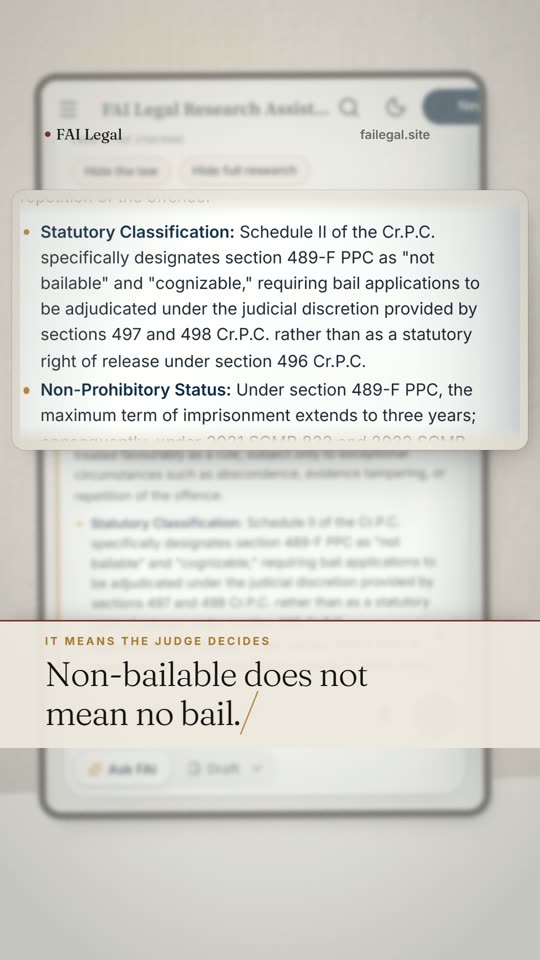
We read section 26 in FAI Legal's Statute Search and both rulings in full in its Judgment Search. FAI Legal is a website: open failegal.site in your phone's browser, ask in plain words, and read the judgments and the exact section.
The case at a glance
- Facts
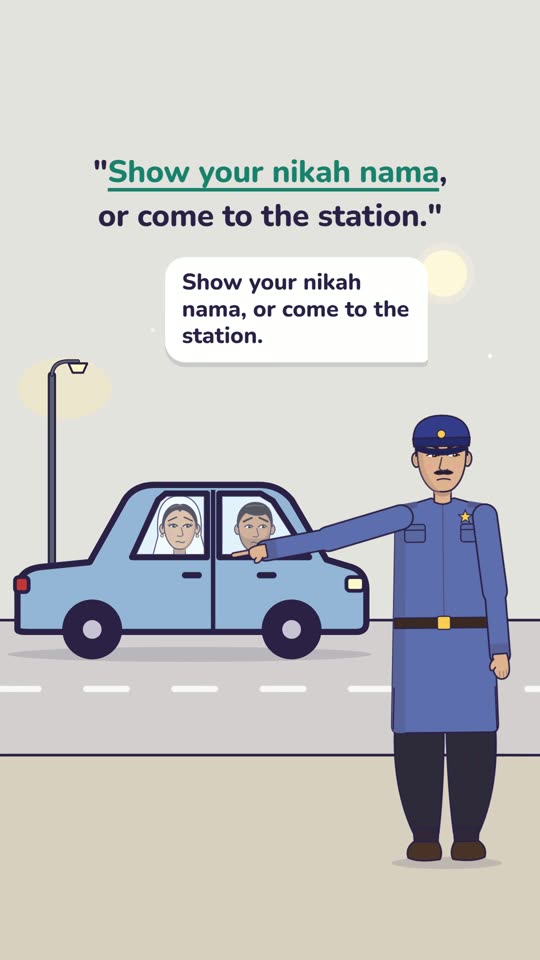
- Police say they found charas on you; the court acquits you; a friend says nothing ever happens to the police. A follower asked what happens to the officer. The reel's people are drawn; the two court cases are real and nobody in them is named.
- The question
- After a false or failed narcotics case, can the officer who made the search or arrest be prosecuted, and when?
- What the Court held
- Yes, under section 26 of the Control of Narcotic Substances Act 1997 (up to three years and a fine), but only where it is established on the record that the search or arrest was without reasonable grounds, vexatious and unnecessary; then a separate case after a notice and a hearing, investigated by another officer, and a trial.
- Why
- Section 26's own words; the Lahore High Court (heard 1 June 2015), paras 12 to 16; the Peshawar High Court (23 April 2024), paras 11 to 14.
- Limits
- An acquittal alone is not enough. The Peshawar ruling applies Khyber Pakhtunkhwa's own 2019 Act, section 32. Both are High Court rulings. Whether a particular search had reasonable grounds depends on its facts.
In the Court’s words
“FIR can be registered directly under the said Section without adopting any other mode”
Criminal Appeal No. 350 of 2004, para 12
“the Court is not obliged to adopt the procedure provided under sections 190, 195 or 476 of The Code of Criminal Procedure, 1898”
Criminal Appeal No. 350 of 2004, para 13
“it has to be established on the record that the accused was vexatiously and unnecessarily detained, searched or arrested in the offence”
Criminal Appeal No. 350 of 2004, para 14
“can only be invoked where it appears that the seizure and arrest is vexatious and unnecessary”
Criminal Appeal No. 350 of 2004, para 15
The law it relies on
Section 26 (as FAI's Statute Search shows it): "Any person empowered under section 20 or section 21 who (a) without reasonable grounds of suspicion, enters or searches, or causes to be entered or searched, any building, place, premises or conveyance; (b) vexatiously and unnecessarily seizes the property of any person on the pretence of seizing or searching for any narcotic drug, psychotropic substance, controlled substance or any other article or document relating to any offence under this Act; and (c) vexatiously and unnecessarily detains, searches or arrests any person, shall be punished with imprisonment for a term which may extend to three years and shall also be liable to fine which may extend to twenty-five thousand rupees."
What this does not mean
- It does not mean every acquittal leads to a case against the officer: the record must show the search or arrest was without reason.
- It does not mean an officer is convicted on a notice alone: there is a separate case, an investigation by another officer and a trial.
- It does not mean the good-faith protection is a shield for anything: it "cannot be equated with immunity" (Peshawar High Court, para 11).
- It does not settle any one case: whether a search had reasonable grounds depends on its own facts.
Questions people ask
What happens to a police officer who makes a false narcotics case?
Section 26 of the Control of Narcotic Substances Act 1997 punishes a search without reasonable grounds, or a vexatious and unnecessary arrest, with up to three years and a fine of up to Rs 25,000, where the record shows it.
Does every acquittal mean a case against the officer?
No. The Lahore High Court set aside such an order because it had not been established on the record that the arrest was vexatious and unnecessary.
Can an FIR be registered against the officer under section 26?
Yes. The Lahore High Court held the offence cognizable, so an FIR can be registered directly under section 26 (para 12).
What process does the court follow against the officer?
A show-cause notice and a hearing, then a separate FIR, an investigation by another officer and a trial (Peshawar High Court, 2024, paras 12 and 13).
What is the punishment under section 26 of the narcotics law?
Imprisonment of up to three years and a fine of up to Rs 25,000. Khyber Pakhtunkhwa's 2019 Act, section 32, sets a fine of fifty thousand to one lakh.
Check yourself
True or false? “Nothing happens to the police after a false case.”
Wrong: section 26 of the narcotics law punishes a search or arrest without reason, up to three years. Up to three years under section 26 of the narcotics law, for a search without reasonable grounds or a vexatious and unnecessary arrest; but only where the record shows it, not after every acquittal.
Next one: true or false? “Non-bailable means no bail.”
Sources
- The SI v. the accused and the State (names withheld), Criminal Appeal No. 350 of 2004 (Lahore High Court, 1 June 2015 (heard))
Section 26 is cognizable and an FIR can be registered directly, but it can only be invoked where the record shows the seizure and arrest were vexatious and unnecessary; the trial court's direction against the sub-inspector was set aside. - The SHO v. the State (names withheld), Criminal Appeal No. 39-D of 2023 (Peshawar High Court (D.I. Khan Bench), 23 April 2024)
Under Khyber Pakhtunkhwa's 2019 Act, s.32: the court forms a tentative opinion, gives a show-cause notice and a hearing, directs a separate FIR, another officer investigates and the Special Court tries it; a conviction without investigation and trial set aside. - Control of Narcotic Substances Act 1997, s.26 text checked in FAI Statute Search, 15 November 2026
Every quote and section above is traced to the full judgment or statute text by an automatic check that runs on every update.
What the reel says
Read the words of the reel
A false charas case: what happens to the officer?
You asked (@asdnvd): "What about that policeman?" The narcotics law (CNSA 1997):
1. Section 26: for a search without reasonable grounds of suspicion, or a vexatious and unnecessary seizure, detention or arrest, an officer faces up to three years and a fine of up to Rs 25,000.
2. But not after every acquittal. The Lahore High Court set aside a trial court's order for a case against the officer, because it was never established on the record that the arrest was vexatious and unnecessary (Criminal Appeal No. 350 of 2004, heard 1 June 2015).
3. Where the record shows it, the Peshawar High Court set out the way on 23 April 2024: a notice to the officer, a hearing, a separate case, another officer investigates, then a trial (that case was under Khyber Pakhtunkhwa's own 2019 narcotics law, section 32).
4. If a search truly had no reason, get it on the record of your trial. For your own case, speak to a lawyer.
Full story: failegal.site/media/false-case-by-police-pakistan-narcotics-section-26 Did you know the narcotics law itself punishes a search without reason? Reply yes or no.
Educational legal information, not legal advice. Every case turns on its own facts. Speak to a lawyer about your own case. Last checked: 15 November 2026. Review status: Pending advocate review. How we check.